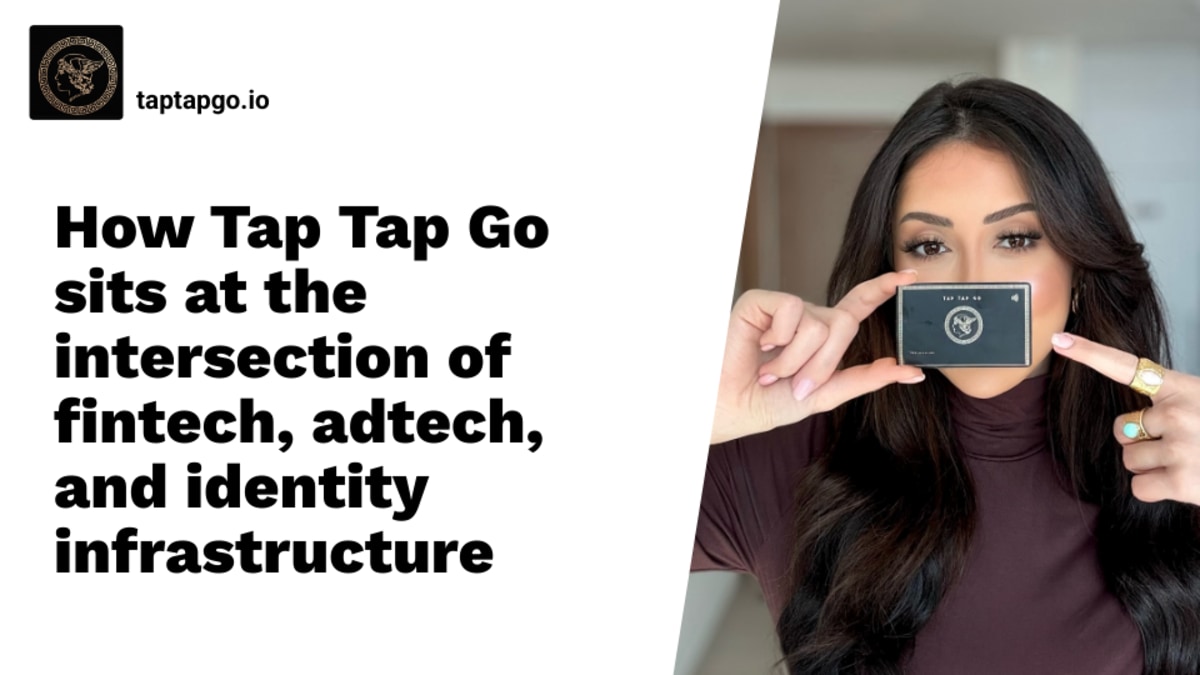

Why emerging markets will leapfrog business cards entirely, just like they leapfrogged landlines
Introduction
The most sophisticated professional network in Lagos does not have a drawer full of business cards — and that is not a gap. It is a structural advantage. While Western markets spent decades building, then dismantling, an entire infrastructure around printed contact exchange, the world's fastest-growing professional economies — across Africa, the Middle East, Southeast Asia, and Latin America — are entering the networking era without that legacy weight. Just as Sub-Saharan Africa bypassed copper-wire landlines entirely and leapt straight to mobile connectivity, a new generation of founders, executives, and entrepreneurs is skipping paper cards and moving directly to NFC-enabled digital profiles, AI-powered contact management, and tap-to-earn financial ecosystems. This is the leapfrog effect — and it does not just level the playing field. It quietly tilts it. The professionals who never built a dependency on outdated tools are now positioned to adopt the most powerful networking infrastructure in the world as their default starting point, not their reluctant upgrade.
The Leapfrog Playbook: From Landlines to Mobile, From Cards to NFC
Sub-Saharan Africa never waited for copper wires. In under a decade, the region vaulted from under 1% landline penetration to over 44% mobile penetration — not by upgrading old infrastructure, but by skipping it entirely. That is the leapfrog effect: when the absence of a legacy system becomes a structural advantage, enabling emerging markets to adopt superior technology as their baseline rather than their upgrade.
The same logic is now rewriting the rules of professional networking.
Paper business cards do not exist in isolation. They are the product of an entire ecosystem — commercial printers, card wallets, manual CRM entry, and the cultural habit of the follow-up email typed from a crumpled rectangle pulled from a jacket pocket. Western professionals spent decades building that ecosystem, and then became dependent on it. Many emerging-market professionals never did.
NFC — Near Field Communication, the same chip technology that powers contactless payments worldwide — eliminates every link in that chain. A single tap of a card or phone exchanges a complete digital profile instantly: contact details, social links, business credentials, and more. No printing. No scanning. No data entry.
Consider the contrast. A London-based executive has a drawer full of paper cards, a stack of forgotten follow-ups, and a CRM full of half-remembered names. A Lagos-based founder or a Riyadh-based entrepreneur entering professional life today has no such drawer — and no intention of building one. They start with digital-first tools because digital-first tools are simply what is available, practical, and aligned with how they already operate.
That is the structural advantage. NFC-enabled digital cards are not a disruption to the emerging-market professional's workflow. They are the workflow — adopted as a default, not retrofitted as an afterthought.
Why the Middle East and Africa Are the Sharpest Leading Indicators
Dubai is not an outlier — it is a preview. The UAE commands smartphone penetration above 90%, and its professional culture does not merely tolerate networking innovation; it actively rewards it. At events across Dubai's financial districts and accelerator hubs, the expectation is digital-first. Paper cards are not just inefficient here — they are increasingly out of place.
Africa tells an equally instructive story through its financial infrastructure. When M-Pesa launched in Kenya in 2007, it did not digitise an existing banking system — it replaced the need for one. Millions of Kenyans conducted peer-to-peer transactions entirely via mobile, leapfrogging the branch-and-cheque model that Western economies spent decades building. That same architectural logic — skip the legacy layer, adopt the superior alternative as the default — now applies directly to professional identity and networking infrastructure across the continent.
Southeast Asia adds a third data point. The dominance of super-apps like Grab and Gojek reveals a consistent emerging-market preference: professionals and consumers in high-growth regions gravitate toward consolidated platforms over fragmented, single-use tools. A standalone digital business card app holds limited appeal. A full-stack ecosystem combining NFC-enabled cards, AI-powered contact management, cross-border payments, and lifestyle rewards — all activated by a single tap — maps precisely onto how these markets already think about technology.
Then there is the diversity challenge that no paper card can solve. A Dubai-based founder in a room with attendees from Lagos, Jakarta, and São Paulo is navigating four distinct professional cultures simultaneously. Tap Tap Go's AI profile adaptation automatically adjusts the context, language emphasis, and industry framing of their digital profile in real-time — while AI matchmaking surfaces the highest-value introductions in the room before a single conversation begins. That is not an upgrade on the paper card. It is a different category of tool entirely.
The Financial Layer That Changes Everything
A paper business card is a dead end. It captures a name and a number, then sits in a pocket until it is discarded. It generates no financial activity, triggers no transaction, and produces no measurable return. Digital networking platforms eliminate that dead end entirely — integrating payments, contracts, and commerce directly into the moment of connection.
This is where Tap Tap Go's Go Cash fundamentally reframes what networking can be. Go Cash is a USDT-pegged stablecoin — a digital currency anchored to the US dollar, eliminating the volatility that makes traditional crypto impractical for everyday transactions. It enables zero-fee cross-border transfers, which carries particular weight for emerging-market professionals navigating some of the world's most expensive remittance corridors. Sending value between Lagos and London, or Nairobi and Dubai, no longer means surrendering a percentage to intermediary fees.
Then there is the earn-per-tap model. Every tap interaction on the platform generates $0.10 in Go Cash earnings — a figure that compounds to a projected $3,600 annually. For professionals in high-volume networking environments, this transforms their contact activity from a sunk cost into a revenue stream.
The contrast with the Western default is stark. A US executive might invest $500 annually in premium card printing — embossed stock, foil finishes, luxury cases — and walk away with zero quantifiable ROI. An emerging-market founder operating on a tap-to-earn model inverts that equation from day one.
The actionable strategy is straightforward: map your networking calendar against your tap potential. A single trade expo in Dubai, a startup accelerator demo day in Lagos, or a fintech summit in Singapore can yield hundreds of interactions per quarter. Calculate those interactions against Go Cash earning potential, and networking stops being an expense line — it becomes an asset.
Building a Digital Professional Identity That Crosses Borders
A paper card carries zero intelligence. It cannot update when you change roles, adapt when you enter a new market, or respond when a high-value contact revisits it six months later. A digital profile linked to an NFC card is a living document — one that evolves with your career, reflects your current positioning, and communicates your brand with precision every time it is accessed.
The follow-up problem disappears when AI handles it. Tap Tap Go's AI-generated meeting summaries attach automatically to each contact profile at the moment of connection — meaning a personalised follow-up that references specific conversation details is no longer a discipline you have to maintain manually. It is an automated output of the interaction itself.
At high-energy conferences — trade expos in Nairobi, accelerator demo days in Dubai, investor summits in Singapore — typing or scanning in the moment is impractical. Voice-first networking capabilities allow hands-free contact capture via voice command, so you never miss a connection because your hands were full or the room was loud.
Every tap also delivers your complete professional ecosystem. The integrated Media Hub connects LinkedIn, Instagram, personal websites, and all relevant channels into a single tap-activated profile — one interaction, full context, zero friction.
The practical framework is straightforward: treat your digital profile as your primary professional asset. Refresh it before every major event. Activate AI profile adaptation for the specific region you are attending. Then use AI contact prioritisation to identify your three highest-value new connections within 24 hours. In markets moving at the speed of emerging economies, that 24-hour window is where relationships convert into results.
The Future of Networking Is Being Built Where You Least Expect It
The professionals defining the next decade of global commerce are not waiting for permission. They are not upgrading from paper — they never started with it. They are building their professional identities natively on platforms that fuse digital presence, AI intelligence, and financial infrastructure into a single, tap-activated moment.
That is not a prediction. It is already underway in Dubai boardrooms, Lagos accelerators, and Jakarta trade expos — where every connection carries the potential to become a transaction, a collaboration, or a compounding relationship asset.
The leapfrog effect does not favour the early adopter. It favours the structurally unencumbered — the professional who builds on the right foundation from day one. Your network is not a contact list. It is net worth in motion.
Explore the full Tap Tap Go ecosystem at taptapgo.io and discover more insights on the future of professional networking at taptapgo.uk.