
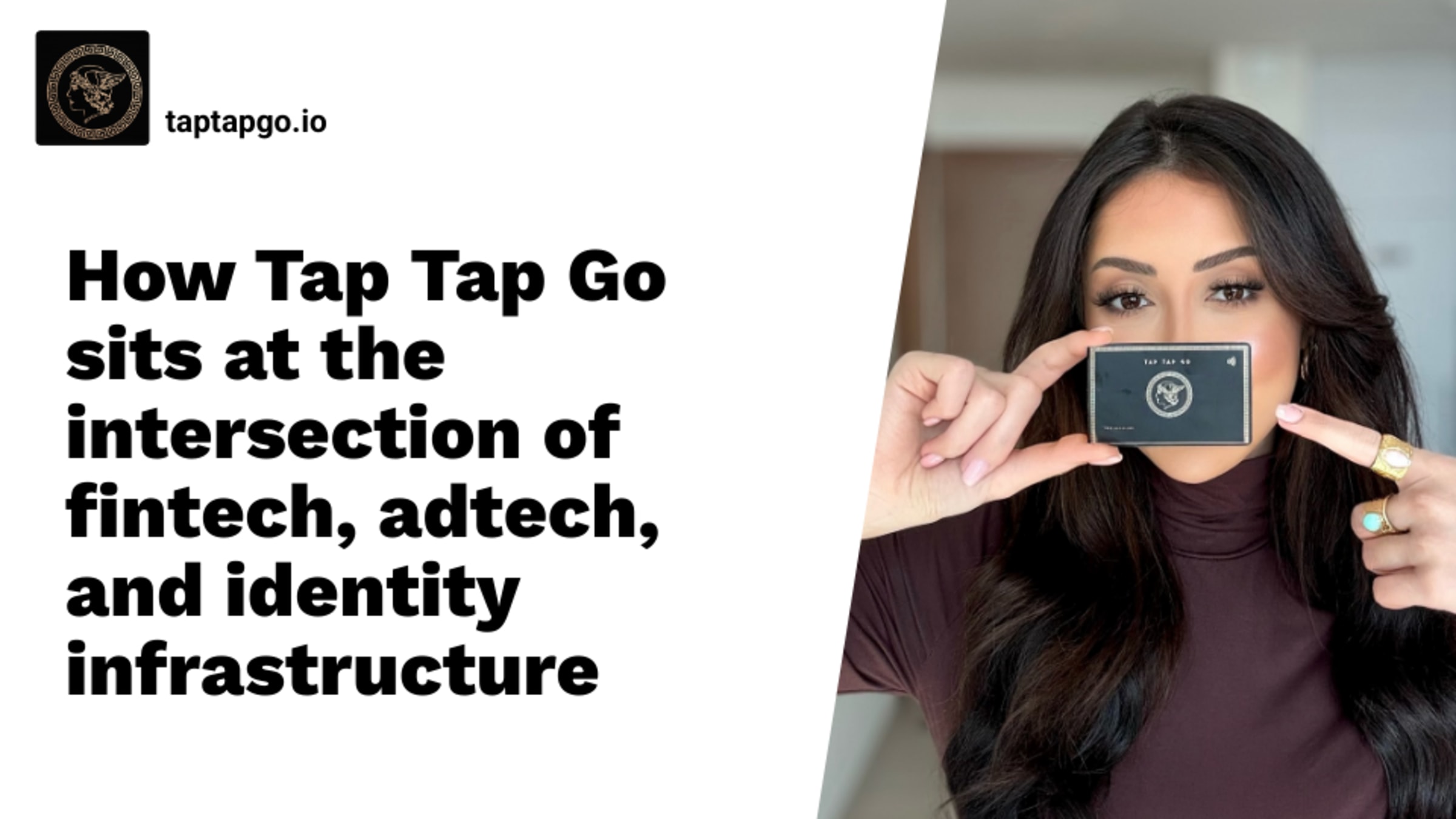
How Tap Tap Go sits at the intersection of fintech, adtech, and identity infrastructure
Introduction
Fintech, adtech, and identity infrastructure are not three industries — they are three fragments of a single broken workflow that ambitious professionals are forced to stitch together every day. The bank handles your money. The ad platform handles your audience. LinkedIn and a paper business card handle your identity. And somewhere between those three disconnected layers, real opportunities quietly disappear.
This fragmentation is not just an inconvenience — it is a structural cost. Every time a founder hands out a card, follows up via a separate email tool, and invoices through yet another platform, value leaks at every seam. The modern professional is not underserved by any one of these industries in isolation; they are underserved by the absence of a single layer that binds all three.
That convergence is no longer theoretical. It is happening now — and the platforms built to operate at that intersection are redefining what professional infrastructure looks like in the AI era. Tap Tap Go is one of very few built to occupy all three corners simultaneously.
Why Three Industries Are Collapsing Into One
Three distinct industries have quietly governed the professional world for decades. Fintech manages the movement of money — payments, transfers, and transactions. Adtech controls attention — how professionals build presence, reach audiences, and distribute content. Identity infrastructure provides verified professional context — the credentials, roles, and contact details that tell the world who you are. Historically, each operated in isolation, and that separation made sense.
Banks and payment processors built walls around financial infrastructure. Advertising platforms like Google and Meta owned the attention economy. LinkedIn, business cards, and corporate directories handled professional identity. Each industry developed its own rules, its own data, and its own gatekeepers. For a long time, professionals simply accepted the inconvenience of navigating all three.
That era is ending. The modern professional — especially one operating across borders and time zones — can no longer afford the friction of three disconnected tools. Every handoff between systems leaks value: time lost, context dropped, momentum broken. Separate platforms do not talk to each other, and the gaps between them cost real opportunities.
Consider a founder at a networking event in Dubai. They hand over a paper business card — an identity transaction that is static, forgettable, and impossible to track. Three days later, they send a follow-up email campaign through a separate marketing tool — an adtech move that reaches a cold inbox with no personalised context. When the conversation progresses, they issue an invoice through yet another platform — a fintech step entirely disconnected from how the relationship began. Three tools. Three logins. Three moments where value could have compounded but instead fragmented.
The professional who wins in this environment is not the one with the most tools — it is the one who operates within a single, integrated ecosystem where identity, attention, and money move together.
Identity Infrastructure: Your Professional Context Is Now a Data Layer
Identity infrastructure, in its modern form, is not a name and a job title. It is a dynamic, AI-adapted digital profile — one that shifts its framing based on who is reading it, where they are, and what industry they operate in. Static credentials are no longer enough. Context is the currency.
Tap Tap Go's NFC luxury cards — the Gold 24K Carat Crest, Platinum Prestige, and Obsidian Opulence — serve as physical anchors for this living digital identity. Unlike a paper card that freezes your professional story at the moment of print, each tap activates a profile that evolves alongside your career, your audience, and your geographic reach. The card is the key; the platform is the door.
The AI profile adaptation feature makes this tangible. When a Dubai-based investor taps your card, the platform surfaces the context most relevant to their world — investment thesis alignment, regional market presence, asset credentials. When a London tech executive makes the same tap, the framing recalibrates around product innovation, market traction, and technical depth. One professional. Multiple intelligent impressions. Zero manual effort.
Voice-first networking extends this intelligence further. Tap Tap Go's hands-free contact capture means that at a conference, your identity layer is building itself in real time — no fumbling for cards, no post-event data entry. Identity capture is becoming ambient. That is not a feature; it is a structural shift in how professional relationships begin.
The actionable takeaway is clear: audit your digital identity across every platform you occupy. Ask whether it adapts to the person reading it or simply lists what you have done. In a world where context determines credibility, a static profile is a missed opportunity at every tap.
Fintech Embedded Into the Networking Layer
Most professionals treat payments as an afterthought — something that happens after the connection is made, through a separate tool, on a separate platform. Tap Tap Go collapses that gap entirely by embedding a native financial layer directly into the networking moment.
At the centre of this is Go Cash, Tap Tap Go's integrated stablecoin — a digital currency pegged to the US dollar that eliminates the price volatility typically associated with crypto. Transactions settle in real value, instantly, with zero fees and zero gas costs. For international professionals navigating cross-border invoicing, remittance, or peer-to-peer transfers, this is a direct challenge to the SWIFT system and traditional remittance rails that routinely extract 3–7% per transaction.
Then there is the tap-to-earn model — and this is where the architecture becomes genuinely distinctive. Every NFC tap interaction generates $0.10 in earnings. Across active daily networking, that compounds to a projected $3,600 annual earning potential. Networking, for the first time, has a measurable financial return.
Consider a consultant working a Dubai conference and tapping 30 contacts in a single day. That is not just 30 connections logged — it is $3 earned, 30 financial relationship layers activated, and 30 warm audiences now reachable through Go Cash. The card does not just open a conversation; it opens a transaction channel.
What prevents this from feeling like a bolt-on feature is the intelligence underneath it. AI fraud detection monitors every financial flow in real time, while AI-powered payment and remittance suggestions adapt to the regulatory and currency context of each country. The fintech layer does not sit beside the networking layer — it is architected into it, functioning natively from the first tap.
Adtech Reimagined: From Passive Presence to Active Distribution
Traditional adtech was built to reach strangers — targeting cold audiences through programmatic spend, hoping the right person scrolled past the right ad at the right moment. Tap Tap Go inverts that model entirely. Its adtech layer does not chase unknown audiences; it deepens relationships with warm contacts who have already engaged with you, tapped your card, and entered your network.
The Media Hub sits at the centre of this. From a single hub, professionals generate AI-crafted content, link every social and professional channel into one personalised profile, and distribute across platforms simultaneously. Smart content recommendations adapt by industry and audience — a fintech founder in Dubai receives different prompts than a creative consultant in London. Your digital presence does not just exist; it performs.
The lifestyle and loyalty rewards ecosystem extends that presence between meetings. Partnerships with the Financial Times, WeWork, ClassPass, Deliveroo Plus, and MasterClass are not perks bolted onto a business card — they are a retention layer that keeps your network engaged and your brand top of mind long after the initial tap. Meaningful professional relationships require sustained touchpoints; the rewards ecosystem manufactures those naturally.
The most precise tool in this layer is AI-driven smart re-engagement. The platform reads activity signals across your contact base and identifies the optimal moment to reconnect with a specific lead — not a broadcast to thousands, but a targeted prompt to one high-value contact at exactly the right time.
LinkedIn ads and email blasts reach cold audiences with single-digit conversion rates. Tap Tap Go's adtech layer activates people who already chose to tap your card — an audience that is warmer, more receptive, and exponentially more valuable.
The Stack That Turns Connections Into Capital
The professionals who will define the next decade of business are not the ones with the most contacts — they are the ones who have collapsed the distance between identity, transaction, and presence into a single, intelligent system. Keeping those three layers separate is no longer a workflow preference; it is a competitive liability.
Every tap on a Tap Tap Go card activates all three simultaneously: a dynamic, AI-adapted identity is shared, a financial relationship is opened, and a distribution channel is engaged. That is the practical meaning of "Single Tap, Boundless Connection" — and it is how the platform turns a handshake into compounding professional value.
Your network has always had latent worth. The infrastructure to extract it simply did not exist — until now. "Transform Your Network Into Net Worth" is not a tagline; it is an operating principle for the modern professional.
Explore the full ecosystem at taptapgo.io, or read more expert insights at taptapgo.uk.