Why "contactless everything" isn't a pandemic trend — it's a permanent behavioral shift
Introduction
The pandemic didn't make us contactless — it simply made us honest about what we already preferred. For years, the friction of cash, paper cards, and branch visits wasn't something professionals accepted; it was something they endured, because no credible alternative had achieved critical mass. COVID-19 didn't create new behaviour — it collapsed the hesitation that was suppressing behaviour that was always more efficient, more elegant, and more aligned with how fast-moving professionals actually operate.
Here's what the narrative gets wrong: labelling contactless adoption as a fear response implies it will fade when the fear does. It hasn't. Mastercard reported that contactless transactions surpassed 50% of all in-person payments globally before 2023 — and they kept climbing. The same psychological logic applies to NFC-powered networking and stablecoin payments. Professionals who encountered frictionless alternatives didn't return to the old way. They couldn't justify it.
The professionals building structural advantages right now aren't waiting for the world to catch up. They've already recognised that contactless isn't a workaround — it's the standard.
The Data Doesn't Lie: Contactless Behaviour Outlasted the Crisis
By 2023, Mastercard reported that nearly 65% of all in-person transactions globally were contactless — a figure that not only held firm after pandemic restrictions lifted but continued to climb. Visa echoed the same trajectory, with contactless volumes across Europe growing year-on-year through 2022 and 2023, long after the hand sanitiser dispensers disappeared from doorways. If this were purely a fear response, the numbers would have retreated with the virus. They didn't.
The distinction that matters here is between fear-driven adoption and efficiency-driven retention. Fear drove people to tap their cards instead of entering PINs in 2020. Efficiency is why they never went back. Contactless transactions are faster, cleaner, and cognitively lighter — and once a behaviour delivers consistent convenience, the original motivation becomes irrelevant. The habit outlives the catalyst.
This pattern is not new. Email was widely dismissed as a crisis communication workaround during the shift away from fax — until it became the backbone of global business. Mobile banking was framed as a niche convenience for tech-savvy users — until branch visits became the exception, not the norm. In every case, the narrative was the same: temporary solution, permanent adoption. Contactless payments are simply the latest chapter in that story.
Here is the counterintuitive truth: the pandemic did not create the demand for contactless — it removed the friction blocking mass adoption. The preference for speed, hygiene, and seamlessness existed long before 2020. COVID-19 simply made the alternative — fumbling for cash, keying in PINs, handing over physical objects — feel unacceptably slow. Once consumers experienced the frictionless version, there was no credible argument for returning to the friction-laden one.
From Payments to People: How Contactless Redefined Professional Networking
Handing someone a paper business card at a conference in 2025 is the professional equivalent of writing a cheque — technically functional, but an immediate signal that your infrastructure hasn't kept pace with the world around you. The information is static, the format is fragile, and the moment it leaves your hand, you lose all control over the impression it makes.
NFC — Near Field Communication — changes that equation entirely. It is a short-range wireless protocol that transfers data with a single tap, requiring no app, no download, and no friction on the recipient's end. The technology is already embedded in every modern smartphone; what has shifted is how professionals are activating it as a primary networking tool.
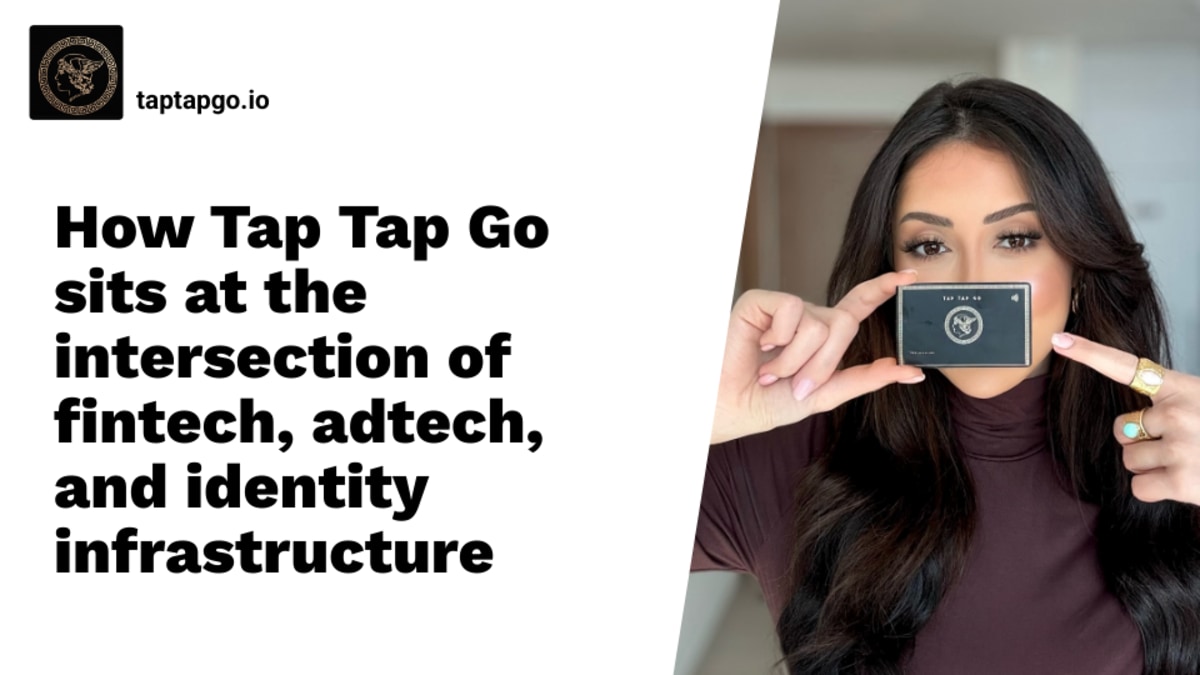
Consider the practical reality: a founder at a Dubai networking event taps their Tap Tap Go NFC card to a potential investor's phone. In that single gesture, the investor receives a complete digital profile — social links, a pitch deck, a calendar booking option, and curated business context. The entire first impression is architected before the conversation deepens.
That asymmetry matters more than most professionals realise. A paper card surrenders control the moment it changes hands — its content is fixed, its context is absent, and its fate is a desk drawer. An NFC-enabled profile keeps you present, dynamic, and actionable long after the conversation ends. You decide what the contact sees, clicks, and acts on.
This is the professional identity shift contactless networking demands: your digital presence is no longer supplementary to your introduction — it IS your introduction. What you transmit in that single tap defines your perceived value before you have said another word. In a world where first impressions form in seconds, the professionals who control that moment hold a decisive advantage.
The Financial Layer: Why Contactless Transactions Are Restructuring Cross-Border Commerce
The same friction that once plagued information exchange still dominates global finance — and professionals are running out of patience for it. Traditional cross-border payments take 2–5 business days to settle, carry fees of 3–7% per transaction, and move through a labyrinthine network of correspondent banks designed for a pre-digital era. For a London-based founder paying a Dubai contractor, or a freelance consultant invoicing an international client, that friction is not a minor inconvenience — it is a direct cost on every deal closed.
Stablecoins offer a structurally different model. Unlike volatile cryptocurrencies, stablecoins are digital currencies pegged to a stable asset — most commonly the US dollar — which means their value doesn't fluctuate between the moment you send and the moment the recipient receives. They combine the speed and borderlessness of digital assets with the predictability of fiat currency.
The practical difference is stark. A London-based consultant completing a project for a Dubai client no longer needs to wait four business days for a SWIFT transfer to clear, or absorb a 5% fee that silently erodes their margin. Through Go Cash — Tap Tap Go's USDT-pegged stablecoin — that same transaction settles in seconds, with zero fees and zero limits, regardless of geography.
The financial dimension of contactless networking extends further still. Every tap interaction on the Tap Tap Go platform generates $0.10 in earnings — a mechanic that projects to $3,600 annually for consistently active networkers. Networking, at this level, is not just relationship-building. It is a revenue channel.
The behavioural thesis holds here as cleanly as it does for payments and contact exchange: once professionals experience frictionless financial transactions, the tolerance for slow, expensive alternatives collapses entirely. Speed and zero-cost transfers are not premium features — they are rapidly becoming the baseline expectation.
The Actionable Framework: Building a Contactless-First Professional Identity
Knowing the shift is permanent is one thing. Positioning yourself ahead of it is another. Here is a practical three-part framework for professionals who intend to lead, not follow.
1. Upgrade your first-impression infrastructure.
A static paper card transmits a name and a number. An NFC-enabled dynamic profile transmits your brand — live social links, a portfolio, a booking link, a pitch deck, all updated in real time. The moment of introduction is too valuable to waste on outdated hardware. Replace it with a profile that works harder than you can in a handshake.
2. Integrate frictionless transaction capability.
If a new contact wants to pay you, commission you, or split an expense, friction at that moment costs you money and momentum. Ensure your financial infrastructure can receive and send cross-border payments instantly — zero fees, zero delays. The deal that has to wait four days for a SWIFT transfer is the deal most likely to go cold.
3. Let AI handle the follow-through.
The most underestimated variable in professional networking is timing. Tap Tap Go's AI doesn't send generic calendar reminders — it reads activity signals to identify the exact moment a contact is most receptive: a new funding announcement, a role change, a post signalling a challenge you can solve. Pair that with AI-generated meeting summaries attached to every contact profile, and nothing slips through.
For event-goers, voice-first contact capture removes the final point of friction — hands-free logging at the moment of introduction, no phone fumbling required.
The professionals who dominate the next decade won't simply be the most talented in the room. They'll be the ones whose tools compound their relationships automatically — while everyone else is still drafting follow-up emails.
The Tap Is Just the Beginning
Contactless behaviour was never about avoiding human contact — it was about elevating it. Every tap carries richer context, sharper intent, and more immediate opportunity than a paper card passed across a table or a follow-up email drafted three days later. The shift is permanent because the value is undeniable: faster first impressions, frictionless transactions, and AI-powered relationships that compound automatically while others are still chasing cold leads.
The professionals who will dominate the next decade are not simply the most talented in the room. They are the ones whose infrastructure turns every introduction into a lasting, monetisable connection.
That is the Tap Tap Go philosophy — transforming your network into net worth, one tap at a time.
If you are ready to build a contactless-first professional identity that works harder than you do, explore the full ecosystem at taptapgo.io or visit the blog at taptapgo.uk to go deeper on the strategies shaping the future of professional connection.