
The attention economy of networking: why a 3-second tap beats a 30-second pitch
You have rehearsed your elevator pitch until it lands perfectly — concise, compelling, and calibrated to the room. And yet, within 30 seconds of delivering it, the person standing in front of you has mentally drafted their own response, clocked the next person they want to speak to, and retained approximately none of your name. This is not a failure of delivery. It is a failure of medium.
Human attention is the scarcest professional currency in circulation, and the traditional networking pitch is one of its most inefficient spends. The professionals winning rooms today are not the ones with the sharpest monologue — they are the ones who have eliminated the friction of first contact entirely. They tap, transfer, and move on, letting their digital presence do what no 30-second verbal summary ever could: arrive complete, stay accessible, and compound over time.
The future of high-value networking is not about saying more. It is about transmitting more — instantly, effortlessly, and with zero cognitive load on the person you are trying to impress.
Your Pitch Is Fighting for Attention It Will Never Win
In 1971, economist Herbert Simon identified what would become the defining constraint of the modern professional world: as information multiplies, human attention becomes the scarcest resource of all. Fifty years later, that scarcity has reached critical levels — and nowhere is it felt more acutely than in a networking room.
At a conference in Dubai or London, every attendee is simultaneously processing noise, managing eye contact, scanning the room, and mentally rehearsing what they are about to say. Attention is not merely divided — it is already depleted before the first handshake. The environment is not neutral. It is hostile to memory formation.
The psychology is unambiguous: a first impression is formed within 7 seconds. By the 30-second mark — roughly the duration of a well-rehearsed elevator pitch — most listeners have mentally moved on, or are simply waiting for their turn to speak. The words being delivered are competing with ambient noise, social anxiety, and the cognitive overhead of a room full of strangers.
Consider the investment: hours crafting a pitch, refining delivery, memorising the arc. Then consider the return: research consistently shows that people forget up to 80% of what they hear within 24 hours. Names, companies, and value propositions dissolve before the event badge has been unpinned.
Here is the counterintuitive truth that high-performing networkers understand: the goal of a first interaction is not to be fully understood. It is to be remembered and followed up with. Those are entirely different outcomes — and they demand an entirely different mechanic. Compressing your introduction into something felt rather than heard is not a shortcut. It is a sharper strategy.
The Physics of First Contact: What NFC Actually Changes
NFC — Near Field Communication — is a short-range wireless protocol that transfers data between two devices the moment they make physical contact. That is the technical definition. The professional reality is something more significant: it is an attention-preserving mechanism that compresses the most friction-heavy moment in networking — exchanging information — from thirty seconds of verbal delivery to under three seconds of physical action.
Consider two executives at a conference in Dubai. One reaches into a jacket pocket, produces a slightly bent paper card, and reads out a website URL while the other person half-listens and half-scans the room. The second executive simply taps their card. Within three seconds, the recipient's phone displays a complete digital profile — social links, portfolio, contact details, a professional bio — all without downloading a single app.
That distinction is not trivial. The paper card interaction consumed attention. The NFC interaction preserved it, redirecting the conversation immediately back to substance.
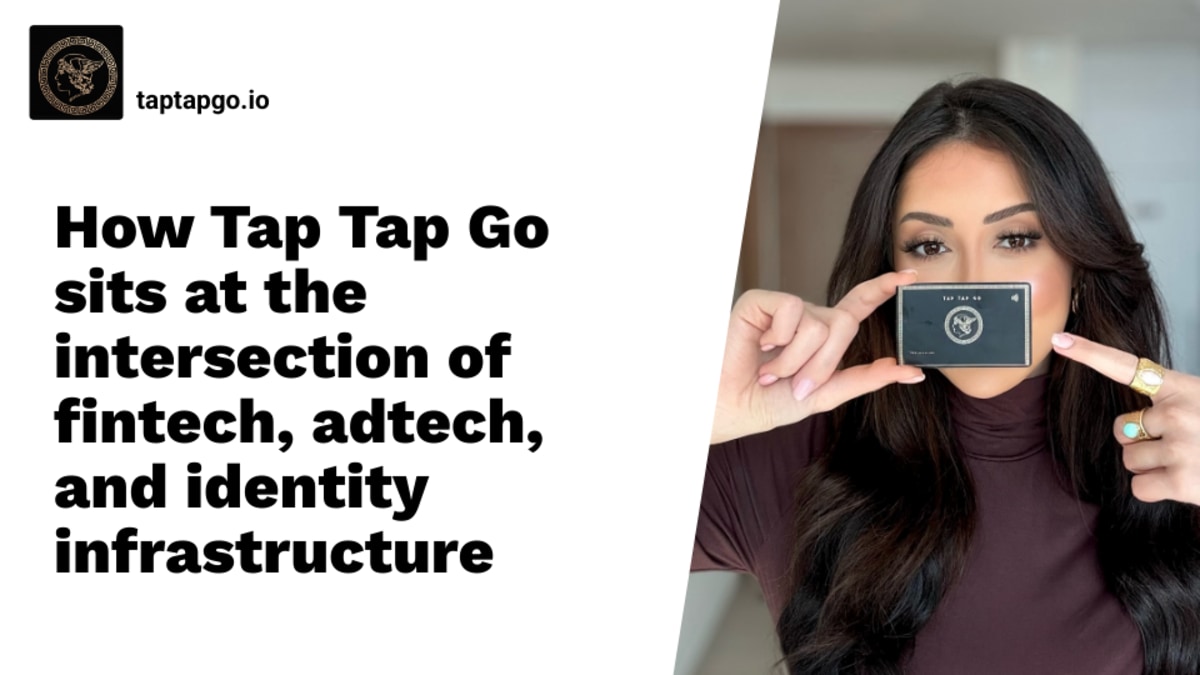
But the tap does more than transfer data — it communicates before the data even loads. The weight of a Tap Tap Go Obsidian Opulence or the mirror-finish of a Platinum Prestige card registers as a deliberate status signal. In a world where first impressions form within seven seconds, the tactile quality of that initial contact carries its own message: this is someone who operates with intention.
The zero-app requirement removes the last remaining friction point. There is no "do you have the app?" exchange, no QR code to scan and misfile, no manual contact entry. The recipient receives everything, immediately, on the device already in their hand — and the conversation moves forward, uninterrupted.
From Contact to Connection: Where AI Does the Heavy Lifting
The first meeting is rarely where professional relationships are lost. The bottleneck is what happens after — or more accurately, what doesn't. Research consistently shows that most new contacts decay within 48 to 72 hours of an initial meeting if no meaningful follow-up occurs. The card gets pocketed, the name gets forgotten, and the potential deal dissolves into the noise of the week.
This is where AI-powered contact management transforms a tap into a sustained relationship. Every connection made through Tap Tap Go's platform arrives pre-loaded with context: AI-generated meeting summaries auto-attached to contact profiles, relationship scoring that surfaces who matters most in your pipeline, and smart re-engagement triggers that monitor activity signals to identify the precise moment a reconnection will land.
At busy events — the kind where you're holding a drink in one hand and a conversation in another — Tap Tap Go's voice-first networking capability removes the friction entirely. Capture contacts hands-free, by voice, without breaking eye contact or reaching for your phone. Your network grows in real time, and the platform does the cataloguing.
The AI matchmaking layer goes further. Rather than leaving high-value introductions to chance encounters across a 200-person conference floor, the system analyses professional context, industry alignment, and stated goals to curate the introductions most likely to generate real outcomes. Serendipity, optimised.
The actionable reframe: abandon the manual 48-hour follow-up rule. Instead, set your AI to flag dormant contacts and auto-generate context-aware re-engagement prompts the moment conditions are right. Your network stops being a list you maintain and becomes an asset that compounds — quietly, intelligently, on your behalf.
Networking That Pays — Literally
Most professionals treat networking as an investment with no direct return — time spent, cards exchanged, relationships maybe cultivated. Tap Tap Go reframes the equation entirely. Every tap interaction generates $0.10 in earnings. At an active professional's pace, that compounds to a projected $300 per month and $3,600 per year — simply by doing what ambitious people already do: connecting.
This is not a gimmick. It is the logical extension of a philosophy that treats your network as net worth. When networking activity generates measurable financial output, it stops being a social obligation and becomes an asset class — one that appreciates with every event attended, every introduction made, every card tapped.
The financial layer runs deeper than earn-per-tap. Go Cash, Tap Tap Go's USDT-pegged stablecoin, powers frictionless cross-border transactions between the professionals who use the platform. For executives operating between London and Dubai, or founders transacting across emerging markets, Go Cash eliminates the familiar friction: zero fees, zero currency conversion losses, zero limits. A relationship built at a Canary Wharf breakfast can translate into a settled invoice in Dubai before the day ends.
Then there are the compounding lifestyle rewards. Premium partnerships with WeWork, the Financial Times, ClassPass, and MasterClass — among others — activate not through spend, but through engagement. The more you network, the more access you unlock.
At every layer — tap earnings, stablecoin transactions, lifestyle rewards — Tap Tap Go ensures that professional momentum translates into tangible value. Your network was always your greatest asset. Now it pays like one.
The Future of Networking Belongs to Those Who Remove Friction
The professionals winning in the attention economy are not the most eloquent in the room — they are the most efficient. They have stopped competing for seconds of fleeting attention and started engineering moments that convert: a single tap that delivers a complete professional identity, an AI that compounds every connection before it decays, a financial layer that makes cross-border collaboration as frictionless as a handshake.
Networking has always been the highest-ROI activity in professional life. The missing piece was a system built to honour that — one that works at the speed of human attention, not against it.
Single tap. Boundless connection. And when every interaction is designed to transform your network into net worth, the return on every room you walk into changes entirely.
The next conference, boardroom introduction, or chance encounter is an opportunity waiting to be activated. Explore the full Tap Tap Go ecosystem at taptapgo.io and discover how much your network is truly worth.