What the payments industry can learn from Tap Tap Go's identity-first approach
The payments industry has solved the wrong problem. Over the past decade, billions in R&D have been directed at making transactions faster, cheaper, and more frictionless — and by most technical measures, it has succeeded. Yet fraud is rising, cross-border trust remains fragile, and users abandon platforms the moment a competitor shaves off another basis point in fees. Speed and cost were never the core problem. The missing layer is identity.
Every major payment rail in existence today treats the person behind the transaction as secondary — an account number, a wallet address, a token to be verified and cleared. The relationship context, the professional credibility, the human intent behind the transfer: all of it is discarded. Tap Tap Go was built on a fundamentally different premise — that identity is not a compliance checkbox but the foundation of every meaningful financial interaction. What that shift reveals about the future of fintech should concern every payments platform still optimising for milliseconds.
The Payments Industry's Blind Spot: Speed Without Context
The payments industry has achieved something remarkable over the past decade: transactions that settle in seconds, cross-border transfers that cost fractions of what they once did, and infrastructure that operates invisibly at global scale. The rails are faster, leaner, and more sophisticated than ever. And yet, the industry has optimised itself into a fundamental blind spot — one that speed alone cannot fix.
Most payment platforms treat their users as anonymous endpoints. You are an account number. A wallet address. A card token. The platform knows what you spent, when you spent it, and where — but it has no meaningful understanding of who you are, what you do, or the professional relationships that give your transactions their context. Identity, in most fintech architectures, is a compliance checkbox — not a design principle.
The real-world consequences are tangible. Cross-border professionals, entrepreneurs operating between London and Dubai, freelancers invoicing clients across time zones — these users switch platforms constantly, and every time they do, they start from zero. No relationship history. No professional context. No persistent identity that travels with them. Trust dissolves at the point of transition because it was never structurally embedded in the first place.
Tap Tap Go is built on a fundamentally different premise. Every tap of an NFC-enabled luxury card, every Go Cash transaction, every AI-driven interaction is anchored to a rich, verified professional identity — one that persists, evolves, and compounds in value across every touchpoint. The platform does not separate who you are from what you transact.
The distinction matters more than the industry has yet acknowledged: payments without identity are infrastructure. Payments with identity become relationships. And relationships, unlike rails, generate loyalty, trust, and long-term financial value.
How Identity-First Architecture Changes the Transaction Model
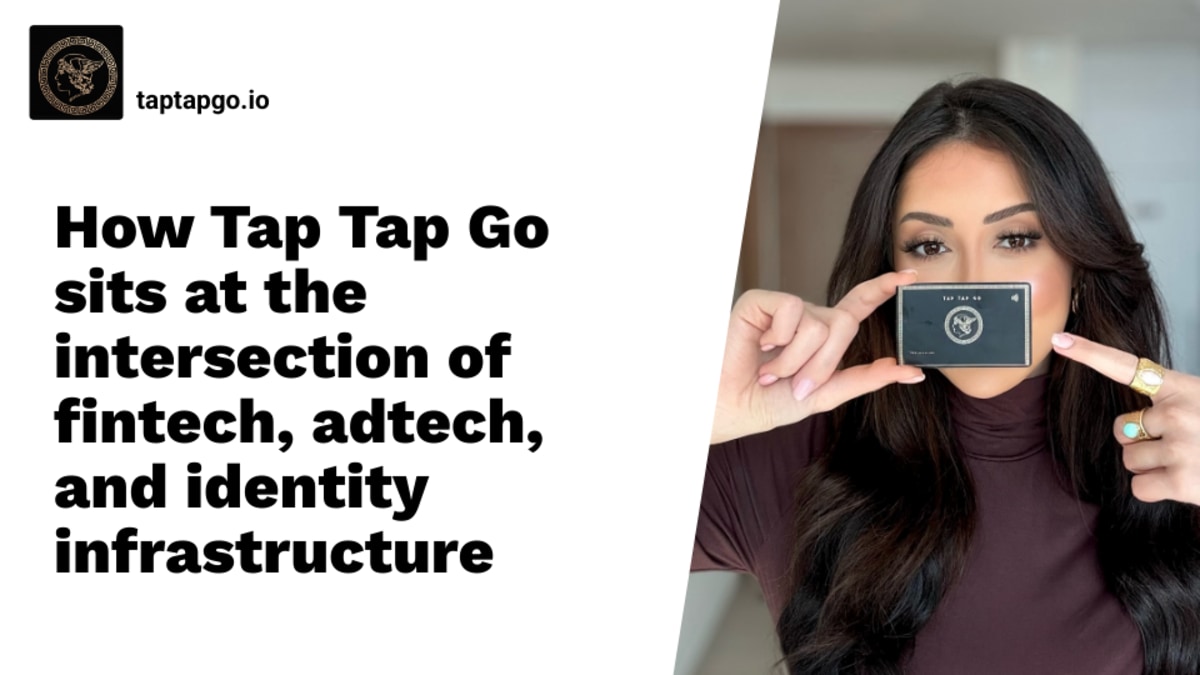
Tap Tap Go's architecture begins with a foundational premise: every financial interaction should be anchored to a verified, rich professional identity — not an anonymous string of characters. When a user taps their NFC-enabled luxury card — whether the Gold 24K Carat Crest, Platinum Prestige, or Obsidian Opulence — they are not simply exchanging contact details. They are activating a persistent identity layer that travels with every subsequent interaction on the platform.
This principle is most visible within Go Cash, Tap Tap Go's USDT-pegged stablecoin. When a user sends or receives funds, the transaction is not routed between two wallet addresses in a vacuum. It is tied to a professional profile — complete with verified credentials, relationship history, and networking context. That added layer of accountability transforms a routine transfer into a trust-anchored exchange. The distinction matters: accountability at the identity level deters bad actors before compliance tools ever need to engage.
Tap Tap Go's AI fraud detection reinforces this. Rather than flagging anomalies based on transaction data alone, it cross-references behavioural and relational identity signals — who the user regularly interacts with, how their professional network has evolved, and whether a transaction aligns with their established patterns. The result is a fraud model that is contextually intelligent, not merely reactive.
Identity-first architecture also generates direct financial returns. At $0.10 per tap interaction — with a projected earning potential of $3,600 annually — the platform proves that professional identity has quantifiable monetary value. Every connection made is a revenue event.
This same identity depth powers Tap Tap Go's AI-driven payment suggestions per country. Because the platform understands who the user is, where they operate, and which professional contexts they inhabit, it can surface smarter, region-specific remittance recommendations — turning identity into financial intelligence at every touchpoint.
What Fintech Platforms Get Wrong About Trust
The payments industry has built its trust model almost entirely on compliance. KYC checks, AML screening, two-factor authentication — these are the foundations of modern fintech security, and they are necessary. But they are not sufficient.
Compliance verifies that a user exists. It does not establish that they are worth trusting. There is a critical difference between knowing someone's identity on paper and understanding who they are in a professional context — their industry, their track record, the relationships they have already earned. Traditional fintech platforms make no attempt to bridge that gap. They authenticate a transaction; they do not contextualise a relationship.
Tap Tap Go's AI matchmaking and contact prioritisation tools build a relational trust layer that exists before any transaction takes place. When two professionals connect via NFC card, the platform captures relationship signals — shared industries, mutual contacts, engagement history — and uses those signals to inform both networking and financial interaction. By the time a payment changes hands, the platform already understands the professional relationship behind it.
Consider a freelance consultant attending a conference in Dubai. They tap their Obsidian Opulence card, share a rich digital profile, and establish professional credibility in a single interaction. When they later send an invoice through Go Cash, the payment is not arriving from an anonymous wallet address — it is coming from a verified professional identity the recipient has already engaged with. The identity precedes the transaction, and that sequence fundamentally changes the trust dynamic.
The industry implication is concrete: fintech platforms that embed relational context into their payment rails will generate stronger user loyalty and detect fraud more effectively than those operating on transactional data alone. Behavioural and relational signals are far harder to spoof than a wallet address. Trust built through identity is not just better ethics — it is better risk management.
A Framework for Identity-First Payments: Three Principles Any Platform Can Adopt
The shift toward identity-first payments does not require a complete architectural overhaul. It requires a deliberate reorientation around three principles — each of which Tap Tap Go has already operationalised.
Principle 1 — Persistent Identity. Every interaction a user takes — a tap, a payment, a profile update, a new connection — should feed a single, evolving professional identity that travels across contexts and borders. Identity should not reset each time a user switches platforms or enters a new market. It should compound, building a richer, more trusted profile with every action.
Principle 2 — Contextual Intelligence. Payments should be informed by who the user is, not merely what they are doing at any given moment. Tap Tap Go's AI adapts payment and remittance suggestions based on region, language, and professional sector — because a consultant operating between London and Dubai has fundamentally different transactional needs than a freelancer based in a single market. Intelligence without context is just automation. Context transforms it into precision.
Principle 3 — Value Attribution. Platforms must reward identity-driven engagement, not spending alone. Tap Tap Go's earn-per-tap mechanic — $0.10 per interaction, with a projected annual return of $3,600 — demonstrates that professional activity itself carries financial value. When combined with a premium lifestyle rewards ecosystem spanning partners like WeWork, the Financial Times, and ClassPass, the platform turns consistent engagement into measurable return.
Audit your current payment and networking tools now. Are they treating you as a persistent professional identity, or an anonymous endpoint? If the latter, you are leaving both relationship capital and financial efficiency on the table.
The next frontier of fintech is not faster rails or lower fees in isolation. It is the unification of identity, trust, and transaction into a single, seamless experience — and that convergence is already active, one tap at a time.
The Future of Payments Is Personal — And It Starts With Identity
The payments industry has mastered speed. What it has yet to master is meaning. A transaction without identity is just data in motion — it carries no trust, no context, no relationship. The professionals and platforms that recognise this shift earliest will not simply process payments more efficiently; they will build ecosystems where every financial interaction deepens a relationship and compounds in value over time.
That is precisely what Tap Tap Go is engineered to do. Every tap, every transfer, every AI-powered introduction anchors financial activity to a verified professional identity — transforming your network into measurable net worth, one interaction at a time.
The next frontier of fintech is not lower fees or faster rails in isolation. It is the convergence of identity, intelligence, and transaction into a single, seamless experience.
If you are ready to operate within that future, explore the full Tap Tap Go ecosystem at taptapgo.io or visit our blog at taptapgo.uk to go deeper.