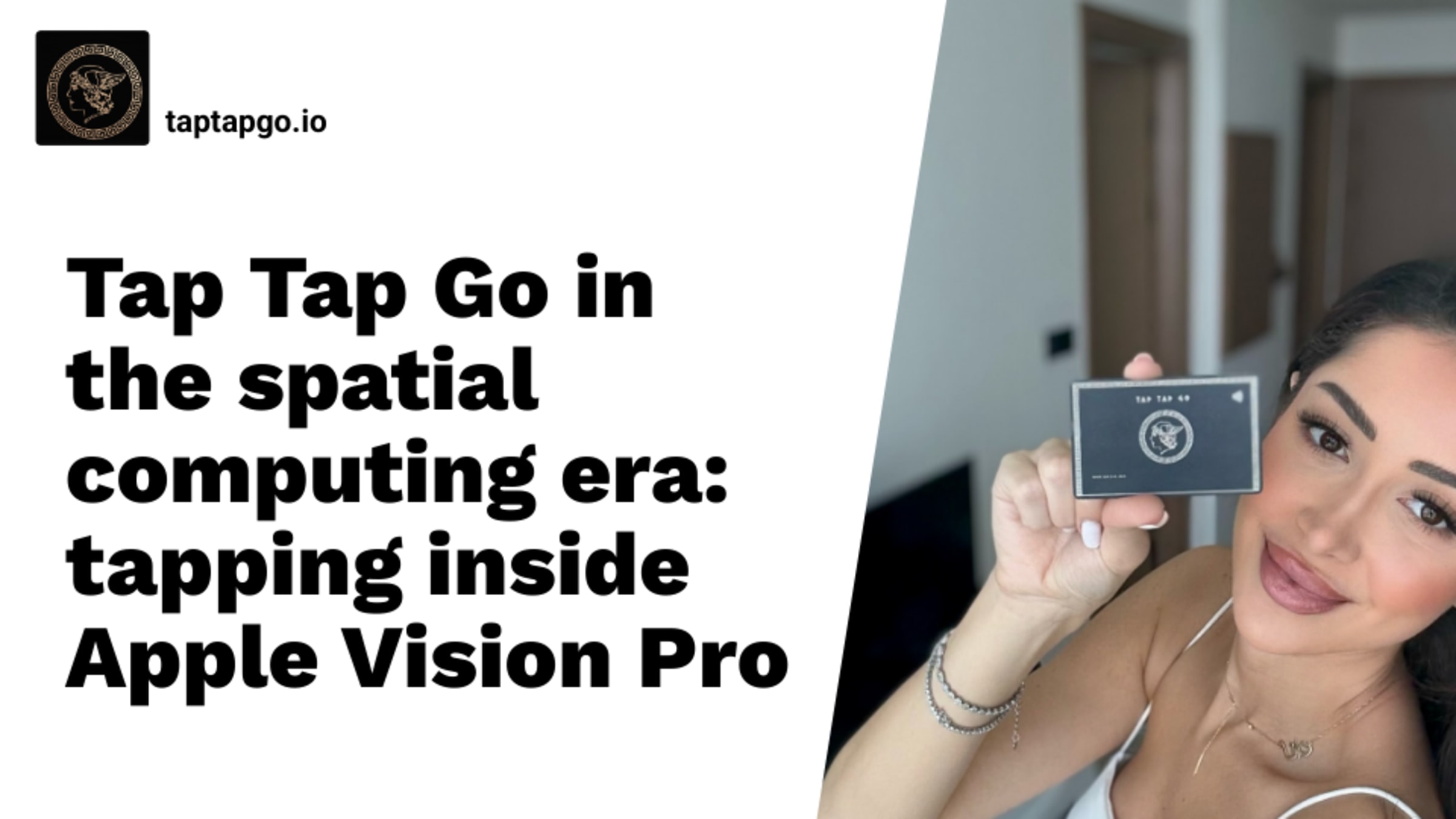
Tap Tap Go in the spatial computing era: tapping inside Apple Vision Pro
You handed a Vision Pro headset to a founder last quarter, watched them pinch-gesture toward your brand card — and the card collapsed. Flat. Lifeless. A JPEG floating in three-dimensional space like a Post-it note on the surface of the sun.
Tap Tap Go in the spatial computing era means your virtual card behaves as a native spatial object inside Apple Vision Pro — anchored, interactive, and visually intact — not a 2D asset awkwardly suspended in a 3D environment.
Most digital brand infrastructure was built for glass screens. That was fine in 2021. It is a liability now.
Vision Pro's early adopter base skews executive, investor, and premium buyer — the exact ICP that premium brands spend the most to acquire. When those users reach for your membership card, affiliate card, or loyalty card inside a spatial layer and it renders like a scanned receipt, the brand equity damage is immediate. It happens before they read a single word.
The gap is already visible. The question is whether your brand is on the right side of it.
Why Tapping Inside Apple Vision Pro Changes Everything About Digital Brand Identity
You designed your digital card for a thumb. Vision Pro doesn't have one.
Apple Vision Pro replaces tap-on-glass with eye tracking, pinch gestures, and spatial anchoring. That is not an incremental UI update — it is a different interaction contract entirely. A card built for a 2D screen loses visual hierarchy and brand fidelity the moment it gets rendered into a 3D spatial layer.
Brand equity in spatial environments is established in the first 3 seconds of a card interaction — before a user reads a single word.
The brands that invested in premium digital card infrastructure early are already running Vision Pro tests. We'll be honest: we underestimated how fast spatial interaction would expose the weaknesses in flat card design. We rebuilt accordingly.
What Tap Tap Go in the Spatial Computing Era Actually Looks Like in Practice
A TAPTAPGO virtual card rendered inside Vision Pro is not a flat image floating in space. It behaves as a spatial object — pinned to an environment, passed between users, and activated through native visionOS gestures like pinch and dwell. No tapping glass. No scrolling a wallet.
Membership cards, affiliate cards, and loyalty cards gain physical-like presence. Users don't hunt for them — they reach for them.
That shift in interaction mechanics changes funnel conversion. A spatial card interaction encodes deeper in memory than a 2D screen tap — the physical metaphor is doing real cognitive work.
Your omnichannel strategy needs spatial now. Vision Pro adoption is accelerating among the exact ICP premium brands are already spending to reach. TAPTAPGO's card architecture was built for surface portability from day one. Spatial is just the next surface — and it's already live.
The Brand Infrastructure Gap That Spatial Computing Just Made Visible
Most brands have a card problem they haven't named yet. Their digital identity lives in PDFs, wallet passes, and screenshots — assets built for a single surface and never designed to travel. Spatial computing didn't create this problem. It just made it impossible to ignore.
Your card infrastructure gap isn't technical. It's strategic.
Brands that treat digital card infrastructure as a marketing asset — not an IT deliverable — are the ones with spatial-ready identities. Early Vision Pro session data already shows dwell time and interaction depth metrics that flat screens never captured. Attribution modeling in spatial environments is still maturing, but the directional signal is clear: presence and visual integrity drive engagement in ways clicks never measured.
A poorly rendered brand card in a spatial environment doesn't just underperform. It signals the brand wasn't ready — and that's a brand equity problem, not a UX ticket.
How to Position Your Brand for the Spatial Tap Before Your Competitors Do
Start with an audit. Pull your existing digital card and render it outside its native context — a different screen size, a different OS, no supporting UI around it. If it loses hierarchy or looks generic, it will fail in spatial.
Build for gesture-native interaction now. Cards that depend on form fields or keyboard input are dead on arrival in Vision Pro. The interaction is a pinch, a glance, a reach — not a type.
Your digital card is a first-impression object in spatial computing. It floats in a user's field of vision before any other brand asset appears. That moment has no fallback.
TAPTAPGO is the direct answer. Premium virtual cards built for memberships, affiliates, and loyalty programs — with the visual integrity and surface portability to perform in spatial environments today, not eventually.
Start with one card built to the right standard. Everything else follows.
The Window Is Open. It Won't Stay That Way.
Spatial computing doesn't reset the brand competition — it accelerates it. The brands already testing virtual card interactions inside Vision Pro are not experimenting. They are establishing presence in a channel where first impressions are rendered in three dimensions and recovered almost never.
This is not a 2026 problem. Vision Pro's early adopter base is precisely the ICP premium brands have always fought hardest to reach — high-income, high-attention, high-expectation.
You do not get a second chance to float a card in front of that audience.
TAPTAPGO virtual cards are built for this moment — portable across surfaces, visually intact in spatial layers, and architected for the interaction models that spatial computing demands. Membership cards. Affiliate cards. Loyalty cards. All of them ready to perform where flat design fails.
Build your card now. Your competitors are not waiting for a better time — they are shipping while you are still deciding.
The brands that own spatial brand identity in 2025 will not give it back.