
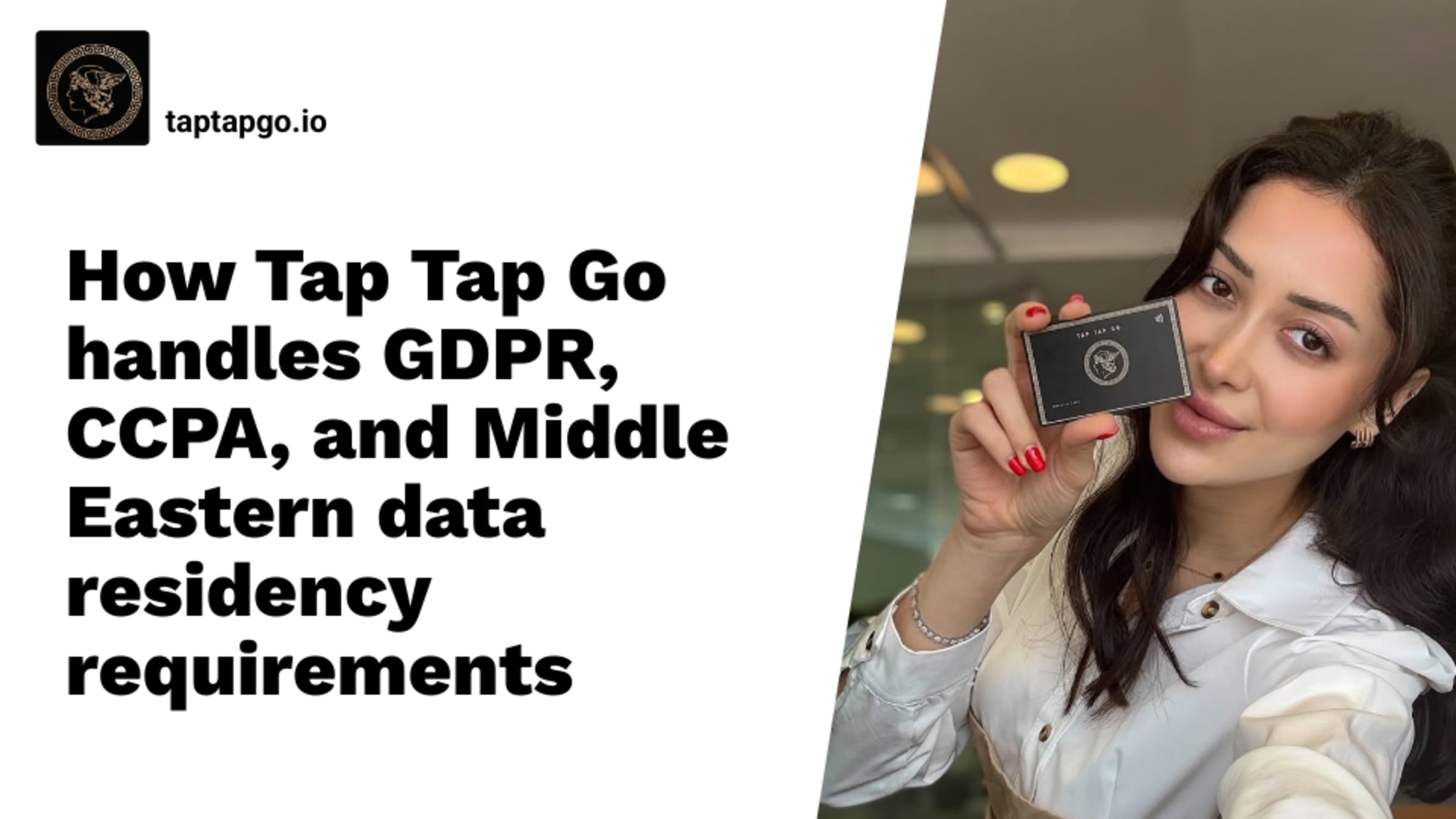
How Tap Tap Go handles GDPR, CCPA, and Middle Eastern data residency requirements
Data Without Borders: How Tap Tap Go Navigates GDPR, CCPA, and Middle Eastern Data Residency
The professionals least likely to read a privacy policy are often the ones exchanging data with the most people. At a single conference in Dubai or London, an ambitious networker might share contact details with dozens of individuals across five or six jurisdictions — triggering regulatory obligations they have never considered and cannot see.
That invisibility is the real risk. GDPR, CCPA, and the UAE's Federal Decree-Law No. 45 of 2021 on Personal Data Protection do not pause for a networking event. They apply the moment personal data crosses a border, enters an AI system, or gets stored on a server in the wrong region — and ignorance has never been a recognised legal defence.
Tap Tap Go was not patched for compliance after the fact. Its architecture — from NFC contact exchange to Go Cash transactions to AI-driven profile adaptation — was engineered with jurisdictional data governance as a foundational requirement, not an afterthought. That distinction matters more than most professionals realise, until it doesn't.
Why Data Compliance Is the Hidden Risk in Global Networking
Most professionals assign data compliance to legal teams or IT departments and move on. That assumption is expensive. The moment you exchange contact details at a Dubai networking event, tap an NFC card in a London boardroom, or sync an AI-generated meeting summary to your CRM, personal data crosses jurisdictions — instantly, silently, and with real legal consequences attached.
The frameworks governing those data flows are not uniform. GDPR, enforced across the EU and UK, grants individuals explicit rights to erasure, data portability, and consent-based processing. The California Consumer Privacy Act (CCPA) mandates opt-out rights whenever personal data is sold or shared commercially. Meanwhile, the UAE's Personal Data Protection Law (PDPL) and Saudi Arabia's Personal Data Protection Regulation (PDPD) impose strict data localisation requirements — meaning information collected on residents may be legally prohibited from leaving national borders.
These are not theoretical tensions. A London-based founder who stores contacts gathered at a Dubai conference inside a standard cloud CRM — hosted on US servers — may be simultaneously non-compliant with GDPR's adequacy requirements, UAE PDPL's residency rules, and CCPA's disclosure obligations. No malicious intent required. The infrastructure itself creates the exposure.
The strategic reframe, however, is this: compliance is not a constraint — it is a competitive signal. Professionals who architect privacy-first networks earn trust faster, close partnerships with less friction, and scale into new markets without regulatory drag. Understanding where data travels, who governs it, and how consent is captured is no longer a legal formality. It is a core competency for anyone operating across borders in 2025 and beyond.
GDPR and CCPA: Consent Architecture Built Into the Tap
Most data compliance failures happen because consent is retrofitted — added as a checkbox after the product is built. Tap Tap Go inverts that logic entirely. Every NFC contact exchange is an affirmative, bilateral interaction: the recipient chooses to tap, chooses to engage, and chooses what to share. There is no passive data harvest, no silent background collection — the tap itself is the consent mechanism.
Under GDPR, organisations processing personal data must establish a lawful basis — typically informed consent or demonstrable legitimate interest. Tap Tap Go's tap-to-connect model satisfies this by architecture, not legal workaround. When two professionals exchange profiles via NFC, the interaction is purposeful, initiated, and recorded as such — creating a defensible data trail from the first moment of contact.
CCPA compliance follows the same embedded logic. California-based users hold clear rights to access, delete, and opt out of data processing — and those rights are exercisable directly within Tap Tap Go's profile management settings. No legal request workflow. No 30-day waiting period. The controls are native to the platform.
This extends to AI-generated data as well. When Tap Tap Go's AI produces a meeting summary and attaches it to a contact's profile, that record falls under the same governance framework as any other stored data point. Users can delete, export, or anonymise any AI-stored interaction record at any time — a critical detail as regulators in both the EU and California sharpen their focus on automated data processing.
The practical upside for executives is significant. When a client in Frankfurt or Los Angeles requests data deletion, Tap Tap Go's architecture actions it in moments — protecting both legal standing and professional reputation without friction or escalation.
Middle Eastern Data Residency: Localisation as a First-Class Feature
The UAE's Personal Data Protection Law (PDPL), effective 2022, and Saudi Arabia's Personal Data Protection Regulation (PDPR) both impose strict conditions on cross-border data transfers — personal data relating to Gulf residents may only leave the jurisdiction under explicit consent or where equivalent protection guarantees are in place. For platforms operating casually across borders, this is a compliance minefield. For Tap Tap Go, it is a design principle.
Tap Tap Go's Dubai operational hub is not a symbolic address. It underpins the platform's capacity to offer data residency options aligned with Gulf Cooperation Council (GCC) regulatory expectations — ensuring that data generated by regional users is processed and stored within compliant infrastructure, not routed through distant servers as an afterthought.
Consider a practical example: an Abu Dhabi-based entrepreneur using Tap Tap Go's AI matchmaking at a GITEX-scale networking event generates contact data in real time. That data — names, professional details, interaction signals — is processed and stored in full compliance with UAE PDPL, automatically, without the user configuring a single privacy setting. The platform handles jurisdictional alignment invisibly and accurately.
This extends to financial data. Go Cash, Tap Tap Go's USDT-pegged stablecoin for cross-border payments, applies the same jurisdictional sensitivity to transaction metadata that the platform applies to contact data. Payment activity tied to UAE residents is governed accordingly — not pooled into a one-size-fits-all global data environment.
The strategic reality is straightforward: platforms with genuine Middle Eastern data infrastructure are rare. For any professional operating between London and Dubai — or expanding into Saudi Arabia, Qatar, or Bahrain — data residency compliance is no longer a procurement footnote. It is a trust differentiator, and increasingly, a non-negotiable one.
The Practical Framework: How Ambitious Professionals Can Audit Their Data Exposure Right Now
Most compliance failures are not the result of bad intentions — they are the result of no audit. Start correcting that today with four deliberate steps.
Step 1 — Map where your contact data lives. List every tool in your networking stack: your CRM, business card scanner, email platform, and any event networking app. For each one, identify the server region and the corresponding privacy framework. A US-hosted CRM storing London contacts falls under GDPR. A Dubai-based contact in a California SaaS tool triggers both DIFC considerations and CCPA exposure.
Step 2 — Review your consent trails. GDPR requires demonstrable, informed consent for every contact whose data you process. Not implied consent — documented consent. Most professionals, if honest, cannot produce that evidence for more than a fraction of their network. That gap is a liability.
Step 3 — Check your cross-border transfer mechanisms. Storing data on a UAE resident in a US-hosted platform without an adequacy decision, standard contractual clauses, or explicit consent is a breach waiting to surface. Identify every cross-jurisdictional data flow in your stack and confirm the legal basis for each transfer.
Step 4 — Consolidate onto a privacy-compliant ecosystem. Managing GDPR, CCPA, and Middle Eastern residency requirements across five separate tools creates five separate points of failure. A platform like Tap Tap Go — with regional data architecture, consent-first design, and cross-border compliance built into its infrastructure — eliminates that fragmentation at the source.
Your action step this week: block thirty minutes for a data residency audit. List every networking tool, its hosting region, and the privacy law governing the contacts stored within it. Most executives surface at least two compliance gaps within the first ten minutes.
Compliance Is the Competitive Edge You Haven't Activated Yet
The professionals winning in global markets are not simply those with the widest networks — they are the ones their contacts trust. GDPR consent architecture, CCPA opt-out mechanisms, and Middle Eastern data residency requirements are not legal boxes to tick; they are the foundation upon which every meaningful professional relationship is built.
Tap Tap Go treats every tap as a compliant, protected, and purposeful exchange — not just a transfer of contact details, but a signal that your network operates with integrity. When your digital identity crosses borders from London to Dubai to Los Angeles, it does so with encryption, localisation, and consent built in by design, not bolted on as an afterthought.
In a world where data exposure is a silent liability, privacy-first networking is the clearest statement of professional intent you can make.
Explore how Tap Tap Go is redefining privacy-first global networking at taptapgo.io, and visit taptapgo.uk for further insights on the future of intelligent, compliant connection.