
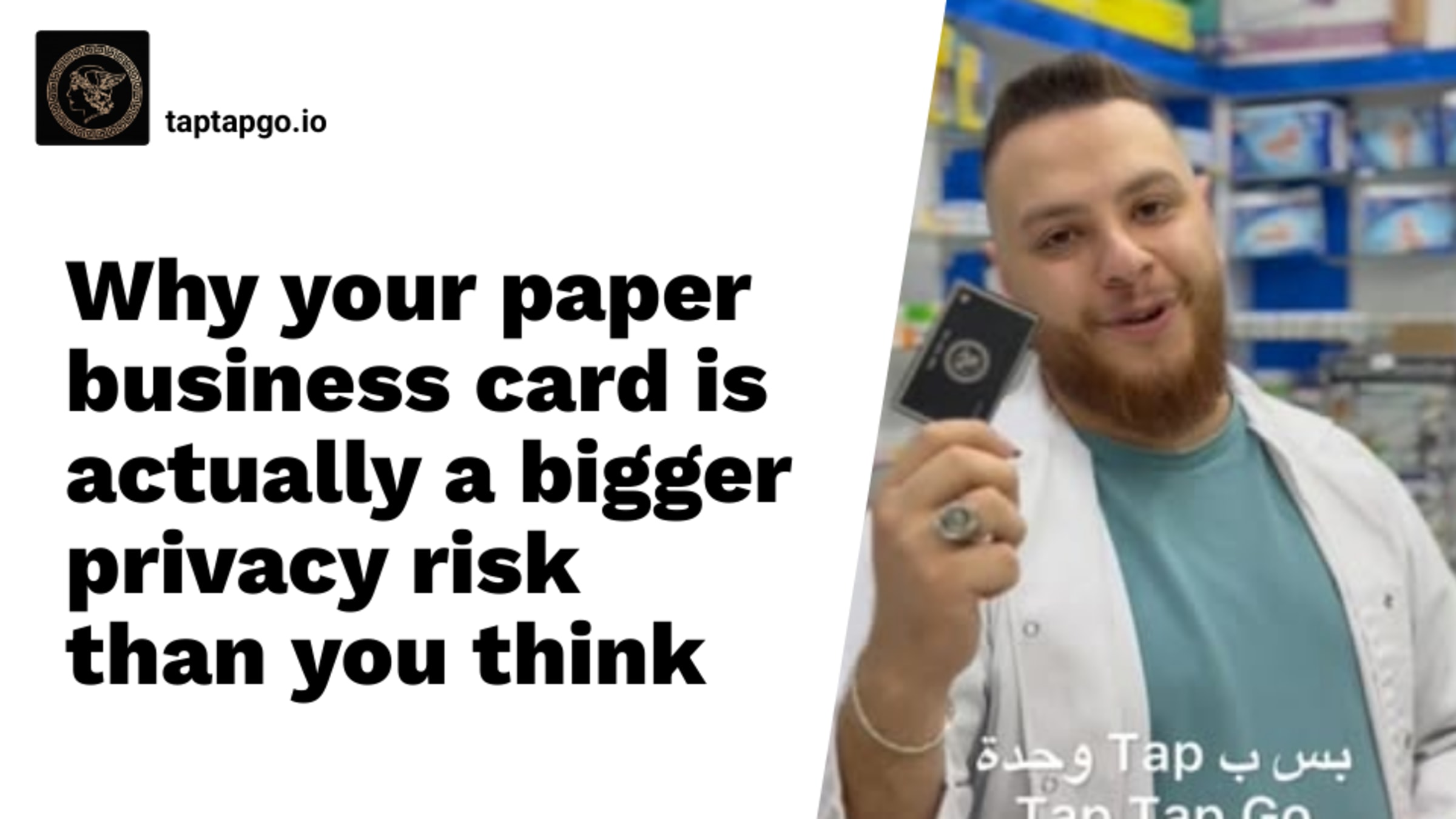
Why your paper business card is actually a bigger privacy risk than you think
Introduction
The most unprotected piece of personal data in your wallet is not your loyalty card or gym membership — it is the one you hand to strangers with a smile. Your paper business card carries your name, direct line, email, company, title, and often your home city, printed in full and surrendered without a contract, a consent form, or a second thought. Once it leaves your hand, you have no idea where it goes.
That card could be entered into a CRM you have never heard of, photographed by a data scraping app, sold to a lead generation broker, or simply left on a hotel table for anyone to pick up. There is no deletion request you can make. No opt-out you can invoke. The ritual of the card exchange — one of professional life's most trusted gestures — has quietly become one of its greatest privacy blind spots. In a world where data is currency, handing out paper cards is the equivalent of leaving cash on the street.
The Data You Hand Over Without a Second Thought
Every paper business card you distribute contains the core components of your professional identity — full name, direct phone number, work email, job title, and company affiliation. That is, in a single physical object, everything a bad actor needs to construct a convincing phishing email, spoof a caller ID, or launch a targeted cold outreach campaign impersonating your brand. You hand it over with a handshake and never think about it again.
That is precisely the problem.
Once a card leaves your hand, you lose all control over it. It can be photographed at a table, scanned in a hotel lobby, or uploaded to a third-party CRM before you have even made it back to your seat. There is no audit trail, no consent mechanism, and no way to revoke access. The card owner holds your data now — and they are under no obligation to tell you what they do with it.
Business card scanning apps accelerate the exposure. Platforms like CamCard and Covve ingest the data from scanned cards and store it on servers that may sit entirely outside your legal jurisdiction. Under GDPR, the recipient of your card technically becomes a data controller the moment they store your personal information — yet most professionals who scan and sync cards into these apps have no compliant data processing basis for doing so.
The risk compounds at scale. A card left at a tradeshow booth can be scanned by multiple attendees, uploaded to competing CRM systems, and redistributed across sales teams within hours — all without a single notification to you. Your details do not stay in one place. They travel, silently, through networks you never agreed to enter.
The Physical Card Is a Permanent, Unrevokable Data Leak
A paper business card is a fixed document. Once it leaves your hand, you have zero control over where it travels, who reads it, or how long it survives. There is no recall mechanism, no deactivation switch, no way to update what is already in circulation.
This creates a compounding risk over time. When professionals change roles, rebrand, or switch companies, outdated cards do not disappear — they linger in desk drawers, contact books, and event bags for months or years. That creates two distinct problems: identity confusion, where contacts reach out through stale channels, and impersonation risk, where bad actors exploit the gap between who you were and who you are now.
The exposure scales dramatically at events. A stolen wallet or an unattended box of cards at a conference is a bulk data event — potentially hundreds of contacts compromised in a single moment. Unlike a data breach on a digital platform, there is no breach notification protocol, no way to warn the people whose details were also on those cards, and no audit trail.
Consider a founder who distributed 200 cards at a Series A funding event, only to pivot their business model or part ways with a co-founder six months later. Every one of those cards still carries the old narrative — the wrong title, the wrong company positioning, the wrong contact point — with no mechanism to retract or correct it.
NFC-enabled digital cards, which use Near Field Communication technology to share profiles via a single tap, eliminate this vulnerability entirely. The profile lives on a server the owner controls. Change a number, update a role, or restrict specific details — the update propagates instantly across every contact who has ever tapped the card. The data stays current because the owner stays in command.
How the Networking Industry Became a Data Black Market
Badge scanners at conference exhibition stands harvest your contact details the moment a sales rep swipes your lanyard — often without a clear opt-in disclosure. That data rarely stays with the exhibiting company. Industry research consistently shows that event leads are routinely packaged and sold to third-party marketing agencies, data brokers, and lead generation platforms, with delegates remaining entirely unaware.
The business card scanning industry compounds the problem. Valued at several hundred million dollars globally, platforms built around digitising physical cards frequently monetise aggregated contact data rather than deriving revenue solely from software subscriptions. When you hand a card to a booth representative at a trade event in Dubai or a tech conference in London, that card may be bulk-entered into a CRM, exported to an email list, and deployed in outreach campaigns that directly violate GDPR and CAN-SPAM regulations.
Professional networking platforms with inadequate encryption or lax access controls create an additional attack surface. A harvester does not need to steal data from a single professional — they need access to one poorly secured platform holding thousands of contact profiles to extract high-value intelligence at scale. The personal email, direct mobile number, and company affiliation you printed on your card could end up inside a competitor's prospecting database before your flight home.
The professional risk extends beyond unsolicited email. Competitor intelligence gathering — mapping your client relationships, event attendance patterns, and industry affiliations — is a documented practice in high-stakes sectors like finance, legal, and technology. Every card you distribute is a breadcrumb. In the wrong hands, a handful of them builds a detailed picture of exactly who you know, where you move, and who moves in your circle.
The Smarter Standard: Privacy-by-Design Networking
Privacy-by-design is not a feature — it is a philosophy. In professional networking, it means you control precisely what you share, with whom, and for how long. The default is protection, not exposure.
NFC-enabled cards from Tap Tap Go operationalise this principle in practice. Rather than broadcasting a fixed set of details to every person you meet, you decide which fields surface per contact or context — sharing your direct line with a serious prospect while showing only a LinkedIn profile and email to a casual acquaintance. One tap, fully calibrated.
The AI layer adds intelligence without sacrificing discretion. Meeting summaries attach directly to contact profiles, relationship scoring surfaces your highest-priority connections, and smart re-engagement prompts tell you the optimal moment to follow up — all processed within the platform, never exposed to unknown third-party aggregators.
Start with an audit. Pull up the last business card round you printed — 18 months ago, perhaps more. Every person holding that card still has your personal mobile number, your direct email, and potentially your office address. Ask yourself honestly: do you still want all of them to? A digital profile can be updated, restricted, or deactivated. A printed card cannot.
Financial interactions demand the same discipline. Sharing bank details on a card — or in a follow-up email after an event — creates unnecessary vulnerability at every point of transfer. Go Cash replaces that exposure entirely: USDT-pegged stablecoin transactions settle cross-border with zero fees, zero limits, and AI fraud detection monitoring every flow in real time. Your banking details stay invisible.
The professionals who will own the next decade of networking are not those who share the most — they are those who share with precision, protected by infrastructure built to keep them in control.
Your Network Should Build Your Future, Not Expose It
The paper business card was never designed with your privacy in mind — it was designed for a world that had no better option. That world no longer exists.
Every card you hand over without control is a data point you can never retrieve — your phone number circulating in a broker database, your email harvested into a cold outreach list, your identity reduced to a scanned JPEG in someone else's CRM. That is not networking. That is data liability dressed as professionalism.
The modern professional standard is intentional, revocable, and built to compound. Every connection you make should be an asset — one that earns, evolves, and remains entirely yours to command.
Tap Tap Go was built for exactly this moment. One tap shares precisely what you choose, backed by AI that turns introductions into ongoing relationships and a financial ecosystem that turns your network into measurable net worth.
Your next connection should be your most powerful one. Explore the platform at taptapgo.io — Single Tap, Boundless Connection.