
The case for verified identity in a world of deepfakes and AI-generated personas
In 2024, a finance worker at a multinational firm in Hong Kong transferred $25 million to fraudsters after attending a video call with what appeared to be his CFO and several colleagues — every face on that call was AI-generated. This was not a phishing link or a poorly worded email. It was a boardroom. It was a familiar face. And it worked.
Identity fraud is no longer a consumer problem absorbed by banks and insurance claims teams. It has moved upstream — into executive communications, investor relations, and high-value deal flows — precisely because professionals carry the highest-trust, highest-stakes interactions, and historically the weakest personal verification infrastructure.
Here is the uncomfortable truth: in an era where a convincing professional persona can be fabricated in minutes, anonymity is not neutrality — it is vulnerability. Verified digital identity is no longer a compliance checkbox. It is the strategic asset that separates professionals who command trust from those who are perpetually having to prove they have earned it.
The Deepfake Economy Is Already Inside the Boardroom
In early 2024, a Hong Kong-based finance worker transferred $25 million to fraudsters after attending a video call with what appeared to be his company's CFO and several colleagues. Every face on that call was AI-generated. The incident was not a phishing email or a crude scam — it was a sophisticated, real-time deepfake operation executed at boardroom level.
This is no longer the edge of the threat landscape. It is the centre.
AI-generated LinkedIn profiles now pass automated verification checks with ease. Fake executive personas are being deployed in B2B procurement fraud, fabricated investor outreach, and credential spoofing at high-value networking events. The tools required to build a convincing professional identity from scratch — a polished headshot, a curated employment history, a network of synthetic connections — cost less than a business lunch and take under an hour to assemble.
The professional networking context makes this especially dangerous. When you exchange details with someone at a conference or accept a connection request on a professional platform, there is no native mechanism to confirm they are who they claim to be. Trust is assumed by default, and assumption is exactly what bad actors exploit.
The asymmetry is stark. It takes seconds to fabricate a credible digital persona. It can take months — and significant reputational capital — to unwind the damage of a fraudulent connection that led to a compromised deal, a leaked pitch deck, or a drained account.
This dynamic creates what can be called identity debt: the accumulated vulnerability that accumulates when a professional has no verified, consistent, and authenticated digital footprint. Without one, you are not just invisible — you are impersonatable. And in the age of deepfakes, anonymity is not humility. It is a liability.
Why Traditional Verification Methods Are Failing Professionals
Email signatures, LinkedIn profiles, and paper business cards share a fundamental flaw: anyone can copy them. There is no cryptographic handshake behind a Gmail signature, no hardware binding a LinkedIn URL to a living person. A motivated bad actor can clone your professional identity in under twenty minutes using publicly available information.
Platform-based verification compounds the problem rather than solving it. LinkedIn's blue checkmark confirms that an account exists — it does not confirm who controls it, whether their credentials are real, or what their intentions are. Email domain matching tells you a message came from a server, not from the person you believe you are dealing with. These systems authenticate accounts, not identities.
NFC-enabled hardware changes the equation entirely. Near Field Communication works through short-range radio frequency, meaning a card must be physically present — within centimetres — to transmit data. That physical constraint is a security feature. Unlike a QR code that can be screenshotted and redistributed, or a LinkedIn URL that can be forwarded to anyone, an NFC card is a tamper-resistant credential that ties a verified digital profile to a specific physical object.
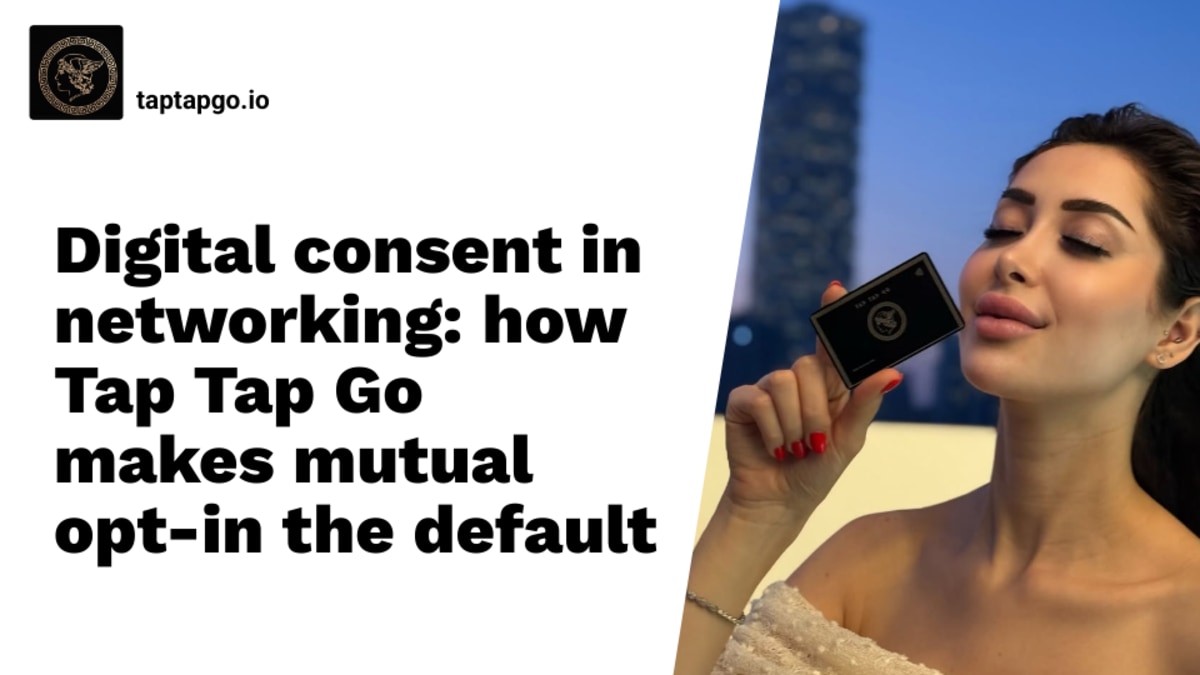
When someone taps a Tap Tap Go Obsidian Opulence or Platinum Prestige card, that interaction carries an implicit two-factor signal: physical presence plus authenticated digital profile. A fabricated AI persona — no matter how sophisticated — cannot replicate a hardware-backed NFC exchange. It cannot physically tap a card across a conference table.
This is the trust gap that traditional verification leaves open, and it is precisely where a premium, NFC-anchored identity layer becomes a professional necessity rather than a luxury differentiator.
The Framework: Building a Verified Professional Identity Stack
Verified professional identity is no longer a single document or a LinkedIn profile — it is a layered architecture. Think of it as a three-tier stack: a Hardware Layer, a Digital Layer, and a Financial Layer. Each reinforces the others, and together they create an identity signal that is exceptionally difficult to counterfeit.
The Hardware Layer is your physical credential in digital form. An NFC-enabled card — such as Tap Tap Go's Obsidian Opulence or Gold 24K Carat Crest — acts as a tamper-resistant, tap-activated token that links directly to your verified profile. A fraudster can clone a name; they cannot replicate a physically issued, profile-bound NFC credential in someone's hand.
The Digital Layer is your unified, AI-curated presence. Start with an audit: Google your name, search your professional handles, and identify what surfaces when a contact taps your card for the first time. Gaps — an outdated LinkedIn, a dormant domain, an unlinked portfolio — are the ambiguities that impostors exploit. Tap Tap Go's AI closes those gaps by adapting your profile context for region, language, and industry, ensuring your identity reads consistently whether you are closing a deal in London or networking in Dubai.
The Financial Layer transforms transactions into identity proof. Go Cash, Tap Tap Go's USDT-pegged stablecoin wallet, applies AI fraud detection to every financial interaction — meaning each payment, transfer, or remittance is traceable to a verified participant. Financial identity is no longer separate from professional identity; every zero-fee cross-border transfer you execute carries your verified signature.
Consistency across all three layers is the modern equivalent of a notarised credential — one that operates in real time, at global scale, activated by a single tap.
Trust as a Competitive Advantage: How Verified Professionals Win
In a market flooded with AI-generated personas and synthetic content, radical transparency has flipped from defensive posture to offensive differentiator. The professionals who win high-value relationships are not simply those with the best pitch — they are the ones whose identity is instantly, irrefutably provable.
Consider two founders approaching an investor at a London networking event. The first shares a LinkedIn URL and waits. The second taps a Tap Tap Go Obsidian Opulence NFC card — instantly surfacing a verified profile, a curated media hub, and a confirmed Go Cash payment identity. One earns a follow-up meeting. The other earns a saved contact that never gets opened.
This is where AI matchmaking compounds the advantage. Tap Tap Go's AI matchmaking engine scores relationships and drives high-value introductions based on profile depth and consistency — the richer and more verified the profile, the more precisely the algorithm positions you in front of the right rooms. Garbage-in, garbage-out applies to relationship graphs just as it does to any model.
The earn-per-tap model reinforces why verification is non-negotiable at the infrastructure level. Every $0.10 earned per tap interaction — accumulating toward $3,600 annually — flows through an ecosystem where AI fraud detection actively identifies and excludes illegitimate interactions. Verified identity is not a courtesy; it is the condition of participation.
And unlike a deepfake, a verified professional identity compounds. Every authentic interaction, AI-summarised meeting note, and smart re-engagement signal adds another layer to a relationship graph that no synthetic persona can replicate. Verification, sustained over time, becomes the most valuable asset in your network.
Your Identity Is Your Infrastructure
Verification is not a defensive measure you adopt when threats arise — it is the foundation on which every meaningful professional relationship is built. In a landscape where AI-generated personas can replicate your voice, mimic your likeness, and infiltrate your network before you've shaken a single hand, anonymity is not neutrality. It is vulnerability.
The promise of "Single Tap, Boundless Connection" only holds when that tap carries weight — when the identity behind it is authenticated, trusted, and impossible to fake. Professionals who invest in verified digital identity today are not just protecting themselves. They are compounding their professional leverage with every interaction, turning trust into a tangible, measurable asset.
That is the infrastructure Tap Tap Go is building: a platform where your identity, your network, and your financial interactions all operate from a foundation of verified credibility. Explore it at taptapgo.io, or visit the blog at taptapgo.uk for more insights on the future of intelligent, trusted professional networking.