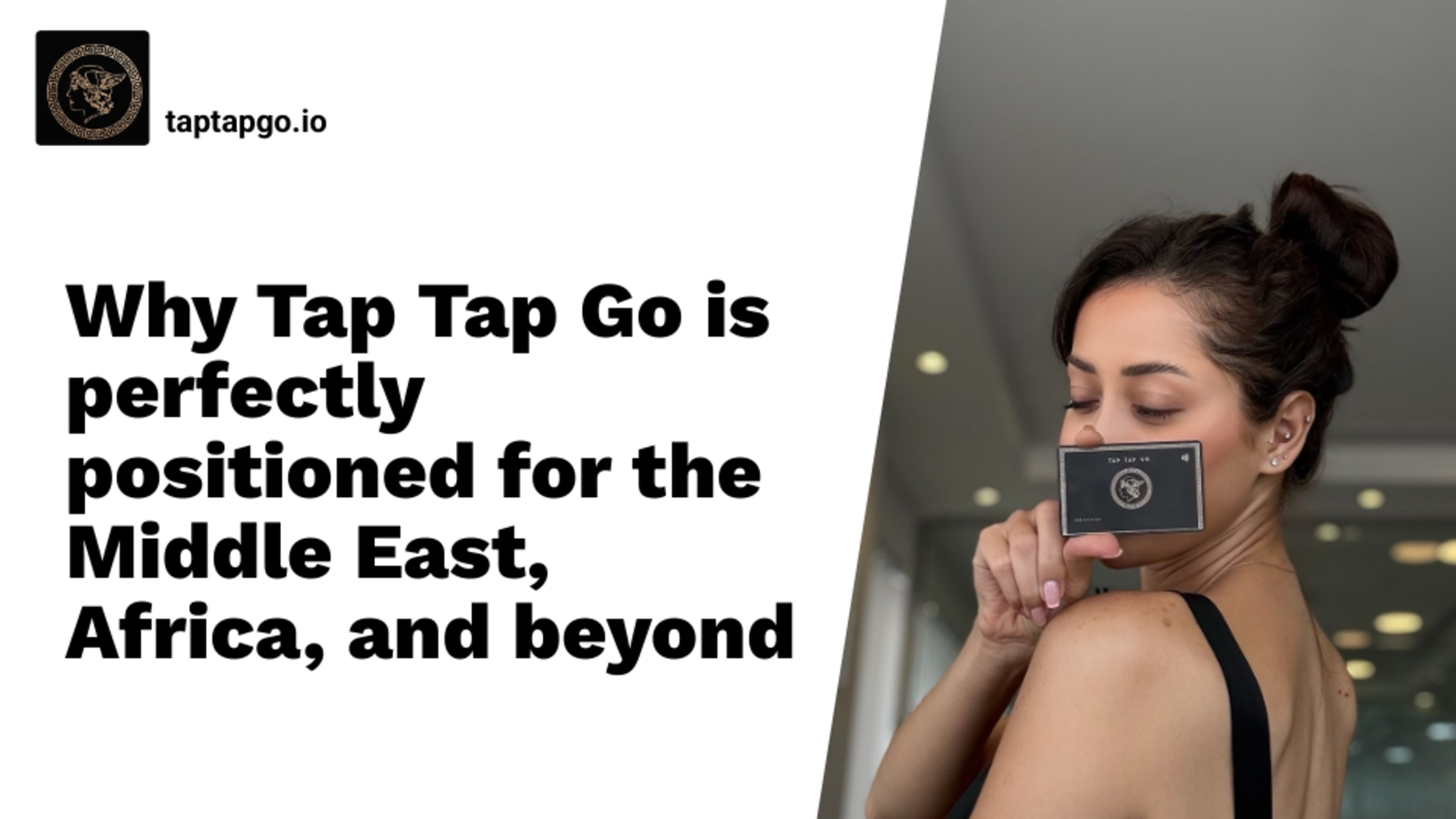
Why Tap Tap Go is perfectly positioned for the Middle East, Africa, and beyond
The next decade of global wealth creation will not be written in Silicon Valley — it will be signed, sealed, and tapped across Dubai, Nairobi, Lagos, Riyadh, and Cairo. The Middle East and Africa collectively represent one of the fastest-expanding arenas for entrepreneurship, foreign direct investment, and digital financial adoption on the planet, with Africa's fintech sector alone projected to exceed $65 billion by 2030. Yet most Western platforms are still retrofitting their products to fit a market they fundamentally misread — treating MEA as an afterthought rather than an origin point.
Tap Tap Go was not adapted for this moment. It was built for it. Its NFC-enabled luxury cards speak directly to a business culture where trust is forged face-to-face and first impressions carry serious commercial weight. Its Go Cash stablecoin eliminates the cross-border payment friction that has long made regional commerce unnecessarily expensive. And its AI networking intelligence adapts to the room — and the region — in real time. This is not market fit by coincidence. It is architecture by design.
The MEA Opportunity That Most Platforms Are Too Slow to See
Dubai alone hosts over 40,000 active businesses and draws a relentless flow of founders, investors, and executives from every corner of the globe. Across Africa, more than 600 million people access the internet primarily through mobile devices — a population that has leapfrogged legacy banking infrastructure entirely and is building its financial future on digital-first rails. These are not emerging markets. They are accelerating ones.
Yet cross-border payment friction remains the single biggest commercial blocker across the MEA region. Sending money between Lagos and Nairobi, or Riyadh and Accra, still involves punishing fees, unpredictable exchange rates, and correspondent banking delays that cost businesses time and margin they cannot afford to lose. Most global fintech platforms were engineered for Western banking infrastructure — IBAN-centric, dollar-denominated, and largely indifferent to local currency volatility or language adaptability.
The same blind spot applies to professional networking. In the Middle East and across much of Africa, business culture is relationship-first. Trust is established face-to-face before any digital exchange takes place — which is precisely why a physical, tap-to-connect mechanism is not just a convenience in these markets; it is culturally resonant in a way that a QR code or a cold LinkedIn request will never be.
Tap Tap Go's dual headquarters in London and Dubai is a structural advantage, not a branding flourish. It positions the platform inside the regulatory frameworks and professional networks of both hemispheres simultaneously — giving it the market credibility that purely Western or purely Gulf-based competitors cannot replicate. The MEA opportunity is vast, fast-moving, and underserved. Tap Tap Go is already operating at its centre.
NFC Networking in a Relationship-First Business Culture
Across the GCC and sub-Saharan Africa, exchanging a business card is not a formality — it is a signal. The weight of the card, the quality of the finish, the deliberateness of the gesture: all of it communicates status, respect, and seriousness of intent before a single word of business is spoken. In markets where relationships precede transactions, the card you present is the first negotiation.
Tap Tap Go's three card tiers — Gold 24K Carat Crest, Platinum Prestige, and Obsidian Opulence — are engineered precisely for this cultural register. These are not repurposed plastic cards with a QR code. They are crafted status artefacts that command attention in boardrooms from Riyadh to Lagos, communicating excellence before the conversation begins.
The platform's no-app-required mechanic removes the single greatest friction point in digital card adoption across these markets. A prospect simply taps and receives your full profile — no download, no account creation, no barrier. In regions where smartphone penetration is high but app fatigue is real, this distinction is decisive.
Consider the scenario: an executive at a Dubai investment summit taps their Obsidian Opulence card to a sovereign wealth fund contact. Tap Tap Go's profile adaptation engine instantly surfaces the most relevant credentials — adjusted for regional context, language, and industry expectations. The introduction is seamless; the impression is immediate.
At high-density events like GITEX Technology Week or the Africa Tech Summit, Tap Tap Go's voice-first networking capability takes this further. Executives capture contacts hands-free — the AI logs, tags, and generates interaction summaries without breaking the flow of conversation. In relationship-first cultures where presence and attentiveness are everything, that matters enormously.
Go Cash: Solving Cross-Border Payment Friction at the Source
Moving money across MEA corridors remains one of the most expensive financial actions a professional can take. The World Bank estimates that sending money across African payment corridors costs an average of 8% per transaction — with settlement delays stretching three to five business days. For a region defined by entrepreneurial velocity, that friction is not a minor inconvenience; it is a structural brake on growth.
Go Cash is Tap Tap Go's USDT-pegged stablecoin — a digital currency anchored to the US dollar to eliminate volatility — enabling zero-fee, gas-free, near-instant cross-border transfers. This is not a workaround. It is a direct architectural solution to a problem that traditional banking has failed to resolve for decades.
The practical implications are immediate. A freelancer in Nairobi invoicing a client in Dubai no longer absorbs currency conversion losses and intermediary bank charges. A founder in Lagos receiving seed capital from a London investor closes the round in minutes, not days. Go Cash removes every layer of unnecessary cost between two professionals transacting across borders.
The platform goes further with AI-powered payment routing — recommending the most efficient transfer pathway based on the recipient's geography and local regulatory environment. Rather than navigating complex international banking rules independently, Go Cash users receive intelligent, context-aware guidance at the point of transaction.
Then there is the earn-per-tap model. Every NFC interaction generates $0.10 for the card holder — projecting $300 per month, or $3,600 annually, at consistent networking volume. In MEA markets, where a single conference floor can yield dozens of meaningful tap exchanges in a single afternoon, this mechanic transforms everyday professional activity into a measurable income stream. Networking, quite literally, pays.
AI That Understands the Room — and the Region
Most networking platforms treat AI as a search function with a better interface. Tap Tap Go's AI operates at a fundamentally different level — adapting, anticipating, and briefing users in real time, based on the cultural and commercial context of every connection they make.
The platform's profile adaptation engine automatically adjusts how a user's digital profile reads depending on the region, language, and industry of the person receiving it. A UK-based founder connecting with a Dubai-based investor sees a different profile presentation than the Berlin startup partner who tapped the same card the previous week. In a region spanning Arabic, Swahili, French, and Hausa business dialects, this is not a convenience feature — it is a commercial necessity that Western-first platforms have consistently failed to build.
At live events, Tap Tap Go's AI matchmaking engine moves beyond keyword proximity to relationship scoring — surfacing high-value introduction opportunities based on who you should know, not just who happens to be nearby. For event organisers across Nairobi, Lagos, Riyadh, and Dubai, this transforms every conference from a passive gathering into a structured deal-flow environment.
Smart re-engagement adds another layer of precision. The AI monitors activity signals across a user's contact network and alerts them at the optimal moment to reconnect — for example, notifying a user when a prospect from a Nairobi summit just announced a Series A round. That is a warm outreach window that manual follow-up systems would almost certainly miss.
Every contact profile also carries AI-generated meeting summaries — giving executives an instant briefing before any follow-up call. When a professional is managing 50 event conversations across three cities, that cognitive clarity is not a luxury. It is the difference between a closed deal and a forgotten contact.
A Lifestyle Rewards Ecosystem Built for Global Ambition
The MEA professional — whether a Gulf-based executive or a Lagos entrepreneur scaling into new markets — does not separate professional tools from personal ambition. Access, exclusivity, and curated experiences are not perks; they are signals of standing and instruments of growth. Tap Tap Go's lifestyle partner ecosystem is architected around exactly this mindset.
Members unlock premium partnerships with the Financial Times, WeWork, ClassPass, Deliveroo Plus, MasterClass, NordVPN, and Headspace — a curated stack of professional development, wellness, and productivity tools built for a globally mobile life. These are not discount codes. They are access-first benefits aligned with how high-performing professionals in Riyadh, Dubai, and Nairobi actually operate.
WeWork access carries particular weight across the region. Dubai and pan-African entrepreneurs who move between cities no longer need to negotiate separate co-working memberships in each market. A single tap unlocks premium workspace in London, Dubai, or Nairobi — continuity without friction, credibility without compromise.
For businesses on the platform, Tap Tap Go's AI-driven loyalty tools go further still. A Riyadh-based wealth manager can design a bespoke loyalty tier for their top 20 clients, triggered through NFC tap interactions — delivering personalised perks at the moment of connection rather than weeks after a meeting closes.
Actionable tactic: MEA-based professionals should immediately audit their current stack of networking tools, payment methods, and loyalty programmes. If three or more separate platforms are handling what Tap Tap Go consolidates into one tap-activated ecosystem, the consolidation ROI is not theoretical — it is immediate, measurable, and compounding with every interaction.
The Future of Professional Networking Has a MEA Postcode
The Middle East and Africa are not waiting for the world to catch up — they are setting the tempo. From Dubai's deal-making corridors to Lagos' fintech frontier, the professionals shaping this region operate at a pace and scale that demand tools built for them, not tools translated from markets that have never had to solve cross-border stablecoin payments, multilingual AI profiling, or relationship-first networking at this level of ambition.
Tap Tap Go is not a Western platform retrofitted for MEA. It is a global ecosystem architected from the ground up for exactly this reality — where a single tap can open a boardroom conversation in Riyadh, settle a transaction in Nairobi, and earn you rewards in London, all before the follow-up email is even drafted.
"Single Tap, Boundless Connection" and "Transform Your Network Into Net Worth" are not taglines here. They are operational truths for a region that has always known the value of a trusted connection.
Explore the full platform at taptapgo.io or visit the blog at taptapgo.uk to go deeper.