
Why “who you are” will matter more than “what password you remember” by 2030
You have already forgotten a password today. Statistically, you forget an average of four each month — and yet the global economy still runs on this fragile, frictionless fiction that a string of characters confirms who you are. It does not. It never did. A password has always been a proxy for identity, a crude workaround built for a world that had no better way to verify a human being at scale.
That world no longer exists.
By 2030, biometric authentication, cryptographic identity, and AI-driven behavioural verification will render the password as antiquated as a fax number on a business card. The internet's identity layer is being re-architected — not around what you remember, but around who you demonstrably are: your presence, your verified credentials, your professional network, your financial behaviour. For high-performing professionals, this is not a security update. It is a structural shift in how trust is established, how deals are made, and how value flows between people. The professionals who move first will not just be safer — they will be ahead.
The Password Was Never Really About You
A password does not verify who you are. It verifies what you know — and that distinction is the foundation of a billion-dollar security crisis. Steal the knowledge, and you become the person. It is identity by proxy, and it has never been more exposed.
Verizon's Data Breach Investigations Report consistently finds that 81% of data breaches involve compromised credentials. The most widely deployed security layer in the world is also the most reliably exploited. That is not a coincidence — it is a structural flaw.
The problem compounds through credential stuffing. When a password is stolen from one platform, automated tools test it across dozens more within hours. A single breach at a retail site becomes unauthorised access to email, banking, and cloud storage. The chain reaction is engineered, efficient, and largely invisible until it is too late.
Passwords were invented in 1961 by MIT's Fernando Corbató for a time-sharing computer system shared between a handful of researchers. They were never architected for a world of 400-plus digital accounts per person, cross-border financial transactions, or AI-powered phishing campaigns. The tool outlived its design by about fifty years.
Security built on memory is fragile by nature — memory fades, gets stolen, and can be guessed. Security built on biology, behavioural patterns, or cryptographically verified identity operates on a fundamentally different level. The shift from "what you know" to "who you are" is not an upgrade. It is a reckoning.
The Three Pillars of Post-Password Identity
Three forces are converging to make the password obsolete — and each one moves identity closer to something intrinsic rather than memorised.
Biometrics at scale. Face ID, fingerprint authentication, and behavioural biometrics — typing cadence, gait recognition, mouse movement patterns — are already authenticating billions of daily interactions. Apple, Google, and the FIDO2 standard have normalised the idea that your body is your credential. Behavioural biometrics go further: they don't just verify who you are at login, they monitor how you operate continuously, flagging anomalies in real time.
Cryptographic identity via passkeys. FIDO2 and WebAuthn protocols replace the shared-secret model entirely. Instead of transmitting a password to a server, your device holds a cryptographic private key that never leaves it. Google, Apple, and Microsoft have already rolled out passkey support across their account ecosystems — no server-side password database, nothing to breach, nothing to phish.
Decentralised identity (DID). Blockchain-anchored self-sovereign identity lets individuals own verified credentials — employment history, qualifications, financial standing — and present them selectively without relying on a central authority. The W3C has formalised the DID specification, and the EU's eIDAS 2.0 framework is building national digital identity infrastructure around these principles, signalling government-level commitment to the model.
Contextual AI as the connective layer. Sitting above all three is AI-driven continuous authentication — systems that triangulate device context, network signals, location patterns, and behavioural data to maintain a live confidence score on every session. Identity becomes a dynamic, always-on verification layer rather than a single moment of entry.
By 2030, these pillars converge into one reality: your identity is not a string you remember — it is a real-time, multi-signal verified profile that travels with you everywhere, invisibly and instantly.
What This Means for How You Network and Do Business
Professional identity is rapidly becoming a verified, portable asset. Your credentials, transaction history, and professional reputation will no longer be self-reported claims — they will be cryptographically verifiable, carried with you across every platform, border, and boardroom you enter.
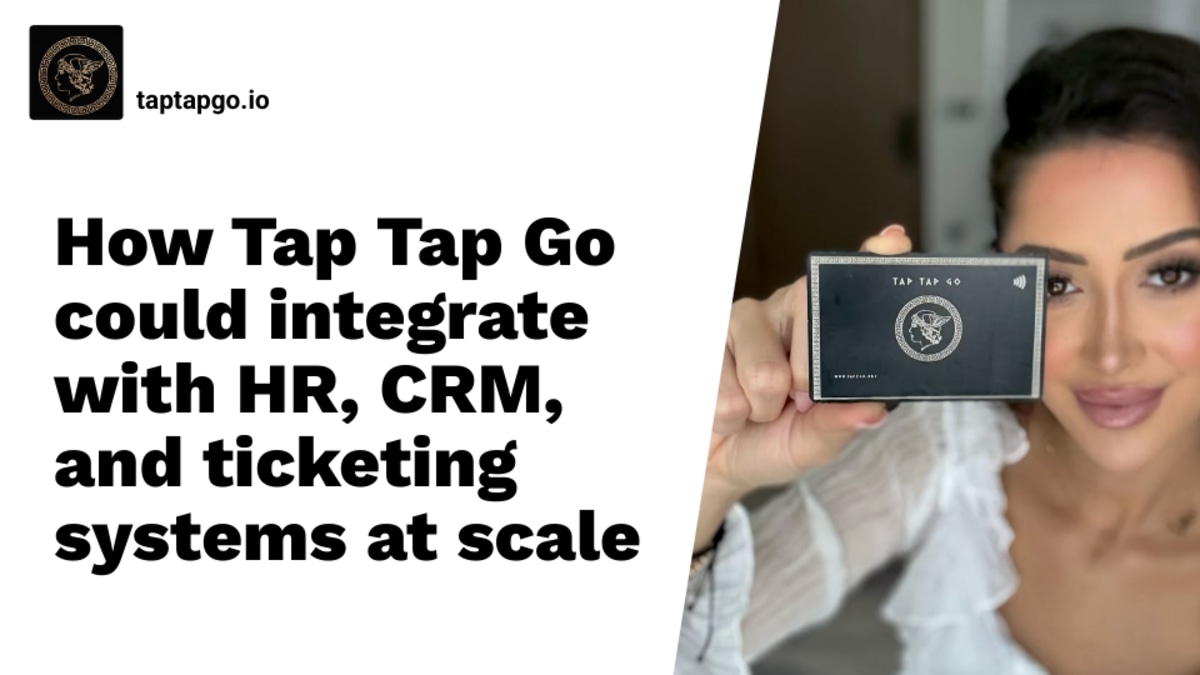
NFC-enabled networking already operates on this logic. When a Tap Tap Go member taps their Obsidian Opulence card at a Dubai investment summit, the recipient doesn't receive a static phone number — they receive a verified digital profile with AI-generated context adapted for the regional audience, the industry, and the moment. The card and profile together constitute a trusted identity signal. That is categorically different from handing over a paper card and hoping someone Googles you later.
The financial layer follows the same principle. Smart contracts and stablecoin transactions require trusted identity at their foundation. Tap Tap Go's Go Cash — a USDT-pegged digital currency — enables zero-fee cross-border payments precisely because identity is verified and every transaction is protected by AI fraud detection. The friction of international transfers doesn't disappear by accident; it disappears because identity has already been established.
In event networking, the stakes are equally direct. Tap Tap Go's AI matchmaking draws on verified professional profiles to make high-value introductions — meaning the completeness and credibility of your identity data determines the calibre of the people you meet. Vague profiles return vague introductions. Verified, rich professional identities unlock the room you actually want to be in.
By 2030, your verified identity will be the credential that opens doors — and the strength of that identity will determine which doors open first.
Your Professional Identity as a Financial Instrument
Identity and finance are converging faster than most professionals realise. Traditional credit scoring — built on borrowing history and repayment behaviour — is already being supplemented by on-chain activity, verified credentials, and reputation signals. Lenders and fintech platforms are beginning to evaluate who you demonstrably are, not just what debt you have serviced.
This shift makes your verified identity a revenue-generating asset in its own right. Tap Tap Go's earn-per-tap model — $0.10 per interaction, projecting $3,600 annually — is an early, concrete expression of this principle: your verified presence and professional engagement carry measurable economic value. Every tap is a transaction between identities, and that transaction now pays.
Digital asset wallets tied to verified identity extend this logic further. A wallet holding crypto or NFTs, anchored to a confirmed professional identity, becomes portable, borderless, and structurally resistant to fraud. It travels with you across markets and jurisdictions — not as a separate financial account, but as a financial layer built into who you are.
Reputation portability will amplify this advantage significantly. Verified professionals will carry their reviews, credentials, and transaction history across platforms, giving high-performers structural leverage in negotiations, partnerships, and client acquisition that generic profiles simply cannot match.
This is the practical meaning behind the philosophy of transforming your network into net worth. When your identity is verified, portable, and financially linked, your reputation is no longer soft currency — it is the instrument itself.
The Action Framework: Audit, Verify, Activate
Step 1 — Audit your footprint. Google yourself. Then look at what your LinkedIn, professional profiles, and scattered digital presence actually communicate to an algorithm scanning you in seconds. Most professionals are unsettled by what they find — outdated bios, inconsistent credentials, fragmented signals that fail to tell a coherent professional story.
Step 2 — Verify and consolidate. Migrate toward passkeys on every major account — Google, Apple, and Microsoft all support them today. Enable biometric authentication wherever available. Then consolidate your professional identity into a single verified hub rather than leaving it dispersed across platforms that never speak to each other.
Step 3 — Activate your identity as an asset. Use NFC-enabled tools like Tap Tap Go to deploy a tap-activated identity profile that shares verified, curated professional context — your achievements, industry positioning, and digital presence — not just a phone number on a paper card. One tap. Complete picture.
Step 4 — Build AI-readable professional context. Your profile should contain structured, specific information: industry, measurable achievements, stated goals, and relevant affiliations. AI matchmaking systems interpret what they can parse — vague profiles return vague introductions, and vague introductions return no real opportunities.
The compounding advantage is real. Professionals who invest in identity infrastructure now — verified profiles, NFC networking, AI-readable context, stablecoin wallets like Go Cash — will operate with significantly less friction and significantly more leverage by 2030. The window to build that advantage early is open. The question is whether you step through it.
Your Identity Is the Infrastructure — Build It Now
By 2030, the professionals who thrive will not be those who remembered the right credentials — they will be those who built a verified, portable, AI-readable identity that works for them across every room they enter, every border they cross, and every transaction they initiate. Identity is no longer just authentication. It is your professional equity.
The shift is already underway. Biometrics are replacing passwords. AI is reading context before you speak. Financial instruments are being linked to who you are, not what you carry. The window to own this transition — rather than react to it — is open now, not in 2030.
Tap Tap Go is built for exactly this moment: a platform where your verified digital identity powers your networking, activates your earnings through Go Cash, and connects you to a global ecosystem of high-value relationships — with a single tap.
Transforming your network into net worth starts with owning who you are. Explore the platform at taptapgo.io or visit the blog at taptapgo.uk.