
Why NFC is more secure than QR codes for sharing sensitive business information
QR codes did not become ubiquitous because they were the most secure option — they became ubiquitous because they were the cheapest to deploy. Scan-to-connect feels frictionless, modern, even sophisticated. But for professionals sharing board-level contact details, investor decks, and financial credentials, that frictionlessness conceals a serious flaw: a QR code has no memory, no authentication layer, and no way to verify who — or what — is on the other side of that scan.
The threat is not hypothetical. QR code phishing, or "quishing," surged by over 50% in 2023 according to cybersecurity researchers at Hoxhunt, with attackers replacing legitimate codes in high-traffic professional environments. Any printed QR code can be duplicated, redirected, or overlaid in seconds — no technical expertise required.
NFC operates on an entirely different architectural principle. It demands physical proximity, supports encrypted data exchange, and leaves a verifiable digital trail. For the modern professional, the distinction is not just technical — it is consequential.
The Hidden Vulnerability in Your QR Code
QR codes are, at their core, static image files — unencrypted, unverified, and completely open. Anyone who photographs or screenshots one can redirect it to an entirely different URL without the original creator ever knowing. There is no authentication layer, no identity verification, and no mechanism to confirm that the destination you intended is the destination your contact reaches.
This is not a theoretical edge case. In January 2022, the FBI issued a formal public warning about fraudulent QR codes being used to steal credentials and financial data — a cyberattack vector now documented under the term "quishing" (QR phishing). Attackers generate convincing lookalike codes that route unsuspecting users to malicious sites designed to harvest login details, intercept payment flows, or install malware.
The physical world carries an equally serious risk. Bad actors have been documented placing counterfeit QR stickers directly over legitimate ones at parking meters, restaurant tables, and conference booths — seamlessly redirecting foot traffic to fraudulent pages. At a professional event, a tampered code on a sponsor stand or networking table could compromise every executive who scans it.
The standard QR code has no way to verify who created it or who is scanning it. That absence of mutual authentication makes it structurally unsuited for sharing anything of consequence — investor decks, payment links, private contact data, or proprietary business profiles.
For entrepreneurs and executives, the risk calculus is stark. Every QR code you place in a pitch deck, display at a conference, or print on a branded asset is a static, unguarded door. The professional world has accepted this vulnerability largely out of habit — but habit is not the same as security.
How NFC Works — and Why the Architecture Is Fundamentally Safer
Near Field Communication transmits data via short-range radio frequency that only activates within 4 centimetres of contact. That physical constraint is not a limitation — it is the security feature. Remote interception becomes physically impossible; an attacker would need to be close enough to be seen.
Where QR codes exist as printable images anyone can replicate, NFC chips are hardware-embedded components. Attempting to alter or clone the chip destroys its functionality entirely. This tamper-evident architecture makes the physical replacement attacks that plague QR codes practically unworkable at scale.
The security advantage deepens at the data layer. NFC supports encrypted transmission and device-level authentication, meaning both ends of the exchange are verified before a single byte moves. There is no passive scanning, no silent harvesting — the handshake is mutual, deliberate, and cryptographically secured.
Active NFC platforms like Tap Tap Go extend this further by linking each tap to a live, updatable digital profile rather than a static file or encoded URL. The professional controls what is shared, updates it in real time, and can revoke or modify information instantly — without issuing a new card. The data the recipient receives is always current, always owner-authorised.
Every tap also generates an interaction record. Tap Tap Go logs each exchange, giving professionals precise visibility into who accessed their profile, on what device, and when. That audit trail transforms passive contact-sharing into an active intelligence layer — one that static QR codes, with no native logging capability, cannot replicate.
The architecture of NFC was not designed with convenience in mind first. It was designed with proximity, authentication, and control at its core — and those principles map directly onto what sensitive professional data exchange demands.
Real-World Stakes: What Professionals Are Actually Sharing
At an investor summit or M&A conference, a single business card exchange can carry far more than contact details. Professionals routinely share links to live pitch decks, private data rooms, and portfolio valuations — assets that, in the wrong hands, carry six- or seven-figure consequences. The medium used to share that link is not a trivial choice.
The exposure compounds for cross-border professionals. Those transacting via digital wallets or stablecoin payment links — such as Go Cash, Tap Tap Go's USDT-pegged financial layer — are effectively sharing financial access points every time they exchange credentials. A compromised payment link does not just create friction; it creates liability.
Freelancers and consultants face a quieter but equally real risk. Sharing invoice links or client portal URLs via QR code at a networking event or in a proposal document places an active payment flow into an uncontrolled channel. QR-based phishing attacks targeting invoice URLs have been documented by cybersecurity firms including Checkpoint Research, and the financial and reputational cost of a single interception can far outweigh months of earned revenue.
The practical strategy is clear: use NFC for primary data exchange wherever sensitive credentials are involved, and reserve QR codes strictly for low-sensitivity, public-facing content — social media follows, event check-ins, marketing landing pages.
Tap Tap Go's NFC cards are built precisely for this distinction. Each card shares only what the cardholder has configured, with profiles that are permission-controlled at the source. Sensitive links — payment credentials, private portfolios, gated client portals — are accessible only through an authenticated tap interaction, not an open scan. The cardholder commands what is shared, with whom, and under what conditions.
The Status Signal You Are Sending (and Why It Matters)
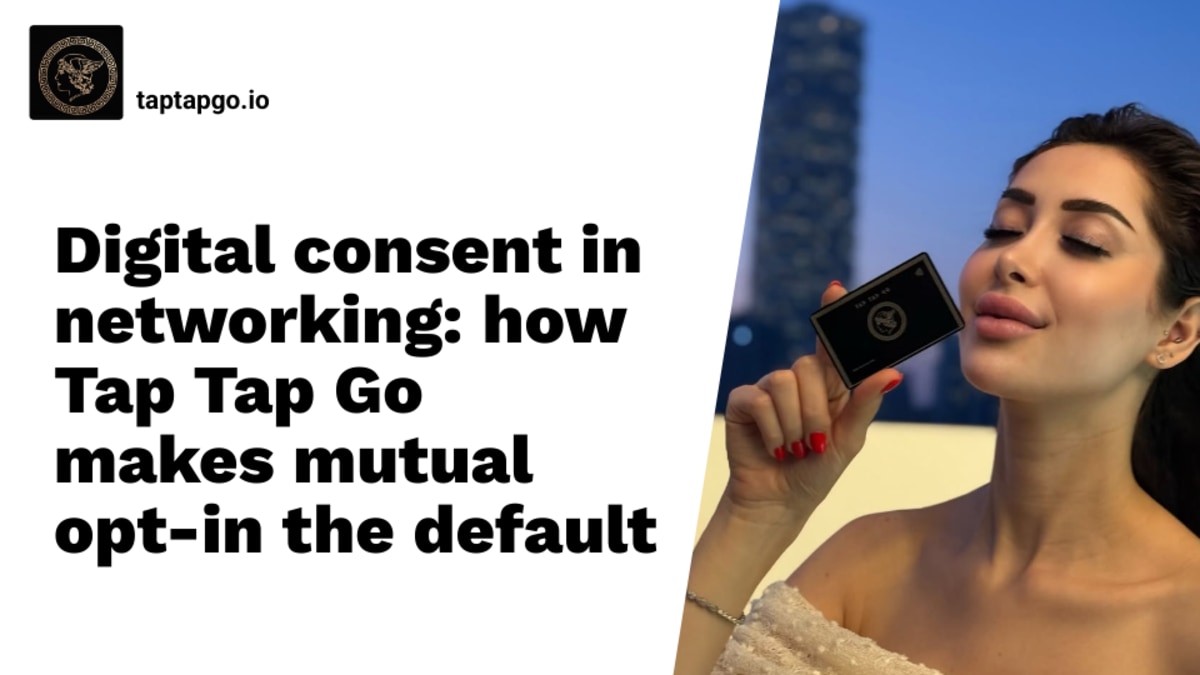
In elite professional circles, how you share information carries as much weight as what you share. Retrieving a 24K gold-finish NFC card communicates precision, intentionality, and a command of the tools serious professionals use — before a single word is exchanged.
QR codes have drifted firmly into mass-market territory. Restaurant menus, promotional discounts, event check-ins — these are the associations a QR code brings to a boardroom conversation. That context does not belong in a high-value introduction, and sophisticated professionals register it immediately.
NFC-based exchange is inherently one-to-one. You tap, a single recipient receives — there is no open code floating in the air for anyone to photograph. That deliberate, present, mutual quality mirrors the nature of premium networking itself, where the interaction matters as much as the outcome.
Executives and investors make subconscious trust assessments within the first moments of meeting someone. A premium NFC card paired with a polished, AI-curated Tap Tap Go profile — linking your verified credentials, social presence, and business details in a single tap — elevates that first impression from memorable to authoritative.
Tap Tap Go's three card tiers — Gold 24K Carat Crest, Platinum Prestige, and Obsidian Opulence — are engineered to function simultaneously as security infrastructure and personal brand statements. They are not accessories. They are the physical expression of a professional who understands that in high-stakes networks, every detail of how you show up either builds trust or quietly erodes it.
Your Network Deserves the Same Protection as Your Data
Security and status are not parallel concerns — they are the same concern. The tool you use to share your name, your role, and your financial details tells the room exactly how seriously you take your own professional identity. A QR code hands that judgment to chance. NFC removes the ambiguity entirely.
Encrypted, proximity-dependent, and immune to the passive interception that makes QR codes a persistent liability, NFC is not simply the more secure choice — it is the more intelligent one. And in a world where a single compromised introduction can cost a client, a deal, or a reputation, intelligent choices compound.
This is precisely the philosophy behind Tap Tap Go: that every tap should build something — trust, connection, net worth. One secure interaction at a time.
If you are ready to network with the precision and confidence your ambitions demand, explore the full ecosystem at taptapgo.io or visit our blog at taptapgo.uk.