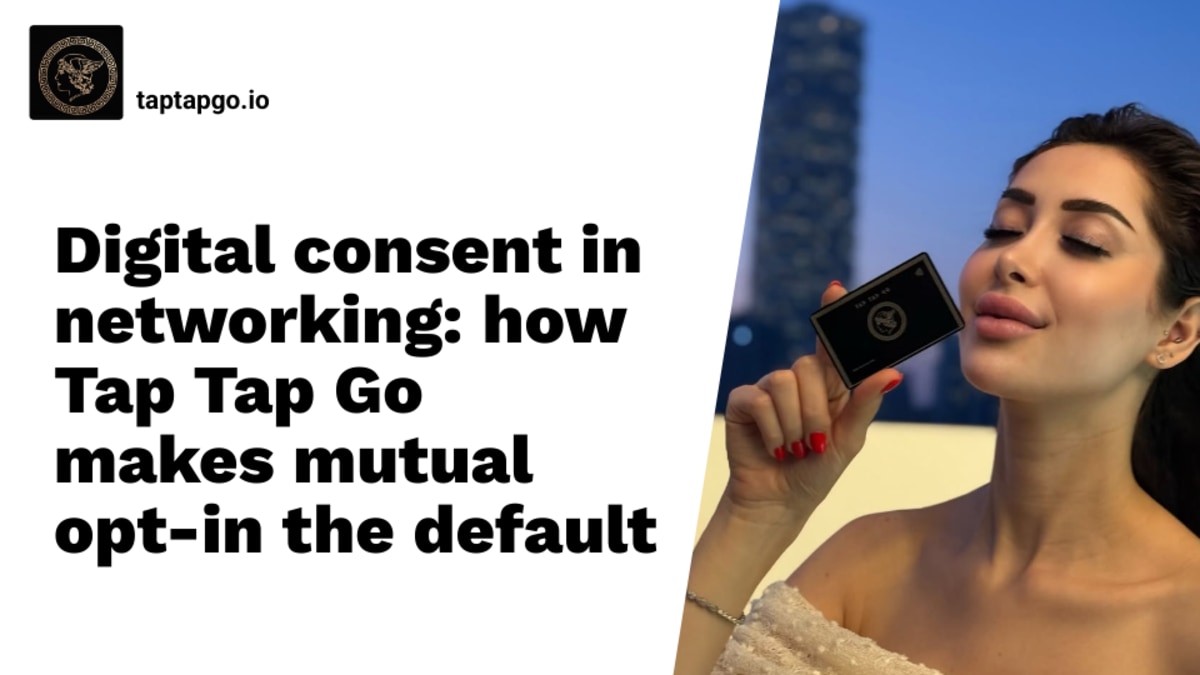

Understanding Tap Tap Go's encryption: what happens between the tap and the screen
Speed and security are not a trade-off — that is a myth built by platforms that never had the architecture to deliver both. The professionals who hesitate before tapping an NFC card at a high-stakes event, wondering whether convenience is costing them control, are asking exactly the right question. They simply have not yet seen what happens in the fraction of a second after contact is made.
What unfolds between the physical tap of a Tap Tap Go card and the moment a profile or payment surfaces on screen is not simplicity — it is a layered security sequence that most dedicated banking applications have not matched. Encrypted data channels, AI-driven anomaly detection, and identity-verification protocols activate simultaneously, invisibly, and instantly. The elegance of the experience is precisely what makes the depth of protection so easy to underestimate.
This is what it actually looks like inside the tap.
The NFC Handshake: What Happens in the First 50 Milliseconds
Near Field Communication operates on a 13.56 MHz radio frequency that activates only within approximately 4 centimetres of a compatible device. That physical constraint is the first line of defence — at that range, passive interception requires an attacker to be close enough to be visible, making ambient eavesdropping effectively implausible in any real-world professional setting.
When you tap your Tap Tap Go card, the exchange that follows is not a transfer of your contact details. The card broadcasts an encrypted session token — a short-lived, cryptographically signed identifier — to the recipient's device. Your name, number, email, and linked profiles never travel in plaintext across that radio channel. The token acts as a secure key, not the data itself.
Compare that to a QR code. A QR code is a static image encoding raw, readable data with no encryption layer between it and whoever scans it. Screenshot it, forward it, or photograph it from across a room — the data is fully exposed. Manual card exchanges carry the same vulnerability: a physical card left on a table is a permanent, unprotected record of your identity.
Tap Tap Go removes that exposure entirely. Because no app is required on the recipient's side, the security architecture lives within Tap Tap Go's infrastructure — not on a third-party device you cannot control. The recipient's phone simply reads the token and triggers a secure server-side resolution.
Critically, every tap generates a unique session token tied to that specific interaction. There are no reusable static identifiers that can be harvested, replayed, or spoofed. Each connection is cryptographically distinct — making your 50-millisecond handshake one of the most secure contact exchanges available to professionals today.
Encryption in Motion: How Your Profile and Financial Data Travel Safely
Once the NFC handshake completes, your data doesn't simply travel — it moves under escort. Every transmission between your Tap Tap Go card, the platform's servers, and the recipient's screen is protected by end-to-end encryption using industry-standard protocols, ensuring that what leaves your card arrives exactly as intended — and nowhere else.
The same security architecture governs Go Cash, Tap Tap Go's USDT-pegged stablecoin. Every financial transaction is monitored in real time by an AI fraud detection engine that analyses transaction patterns, flags anomalies, and intervenes before suspicious activity completes. This isn't passive protection — it's an active, intelligent layer that works continuously in the background.
Access to both your profile data and your integrated wallet is gated by two-factor authentication, meaning that even if credentials were ever compromised, an additional verification layer stands between an attacker and your identity or assets. Security here is structural, not cosmetic.
Consider the scenario: an executive at a Dubai investment summit taps their Obsidian Opulence card to share their profile with a prospective partner, while simultaneously initiating a Go Cash transfer to close a cross-border arrangement. Both actions — the profile exchange and the financial transaction — are processed through the same layered security stack, simultaneously, without friction. There is no trade-off between speed and protection.
This directly addresses a persistent misconception in digital finance: that zero-fee, gas-free cross-border transfers must sacrifice security for speed. Tap Tap Go's architecture proves otherwise — frictionless and fortified are not opposites. When the infrastructure is built correctly from the ground up, every tap can be both instant and ironclad.
AI as a Security Layer: Fraud Detection, Anomaly Signals, and Smart Alerts
Most people associate AI with content creation. Inside Tap Tap Go, it operates as a continuous security intelligence — scanning transaction flows, monitoring behavioural patterns, and neutralising threats before they surface as breaches.
The fraud detection engine begins by building a behavioural baseline unique to each user. It learns your typical tap locations, transaction volumes, and device fingerprints. When a payment originates from an unfamiliar geography, a transaction exceeds your established range, or a new device attempts authentication, the system triggers a smart alert — not after the fact, but in real time.
Go Cash's AI-powered payment and remittance suggestions take this further. By analysing country-specific regulatory environments and risk profiles, the engine recommends optimal payment routes per region. This is not just a UX convenience — it is active compliance and risk management, reducing exposure to high-risk corridors before a transaction is even initiated.
Legacy banking systems rely on static rule sets — rigid thresholds that fraudsters learn to work around within weeks. Tap Tap Go's model is adaptive. It ingests new threat signals continuously, recalibrating baselines as user behaviour and global risk landscapes evolve. The result is a detection layer that becomes sharper with every interaction rather than obsolete.
What makes this architecture genuinely distinctive is its unity. The same intelligence engine that flags an anomalous cross-border transaction also summarises your post-event meetings, adapts your profile for a Dubai audience versus a London boardroom, and scores your contact relationships. There is no patchwork of disconnected tools — just one unified AI layer working across every dimension of the platform, protecting your identity and your capital with equal precision.
What This Means for Professionals Who Network at Scale
Security is not a background feature — it is a reputation asset. When a data breach occurs in a networking context, the damage is not limited to leaked files; it is a collapse of professional trust, one that can unravel relationships, derail deals, and permanently alter how clients and partners perceive you. For high-volume networkers, that risk compounds with every new connection made.
Before committing to any networking platform, audit it against three non-negotiable criteria: encryption standard, data residency policy, and breach notification protocol. Most legacy tools — paper cards digitised through third-party apps, generic QR solutions, or outdated CRM integrations — will fail at least one. Knowing where your data lives and how quickly you would be informed of a compromise is not paranoia; it is due diligence.
The stakes are amplified further on Tap Tap Go because every interaction carries financial weight. At $0.10 per tap, with an annual earning potential of $3,600, each NFC exchange is simultaneously a data event and a revenue event. The security architecture protecting your profile is therefore financially material — not cosmetic.
For corporate teams, this security envelope extends beyond the individual. Business expense management, VIP client perks, and commercial relationship tools all operate within the same protected ecosystem, meaning the integrity of your professional infrastructure scales consistently from the first tap to the final transaction.
As NFC technology becomes standard across event venues, boardrooms, and global conferences, the platform you build on today becomes tomorrow's professional foundation. The security standard you accept now is the infrastructure you will operate on at scale — choose accordingly.
Security Is Not the Opposite of Speed — It Is the Foundation of It
The professionals who move fastest are the ones who trust their infrastructure completely. Every NFC tap, every Go Cash transfer, every AI-driven introduction on Tap Tap Go is engineered so that security operates invisibly — not as a barrier, but as the architecture beneath every seamless interaction.
That is what "Single Tap, Boundless Connection" truly means. Boundless, because the encryption, fraud detection, and identity protection are already in place before your card ever leaves your pocket.
And when your network is this secure, it becomes something more than a contact list — it becomes capital. Relationships deepen, transactions flow, and every interaction compounds into measurable professional and financial value. That is how Tap Tap Go turns your network into net worth.
Explore the full platform at taptapgo.io and discover how elite professionals are tapping into a smarter, safer, and more rewarding way to connect. For more insights on the future of networking and digital finance, visit the blog at taptapgo.uk.