
The science of being unforgettable: Psychology meets tech
We have all been there. You attend a conference, shake hands with a dozen people, and collect a small stack of paper business cards. A week later, you find that stack in a drawer. You look at the names, but the faces are a blur. You cannot remember who they were, what they did, or why you wanted to follow up.
The reality is that human memory is fallible. We are biologically wired to filter out the noise and retain only what is novel, emotional, or immediately useful.
Networking is not just about meeting people; it is about remaining in their minds long after the conversation ends. This is where the intersection of psychology and technology becomes fascinating. New tools, specifically Near Field Communication (NFC) cards, are not just replacing paper; they are leveraging psychological principles to make interactions stick.
The psychology of memorable networking
To understand why traditional networking often fails, we have to look at how the brain processes information. We are constantly bombarded with stimuli, so our brains act as strict gatekeepers.
The Von Restorff Effect
Also known as the 'isolation effect', this psychological principle states that when multiple similar objects are present, the one that differs from the rest is most likely to be remembered. If ten people hand over a white rectangle of cardstock, and one person taps a metal card against a phone to transfer data instantly, the brain isolates that unique event. The deviation from the norm creates a stronger memory trace.
The path of least resistance
Human behaviour is heavily influenced by friction. In user experience (UX) design and psychology, 'friction' is anything that prevents a user from accomplishing a goal. A paper business card is high-friction. To contact you, the recipient must take the card, type your number into their phone, and save it.
Every step in that process is an opportunity for them to give up. By removing the friction, you increase the conversion rate from 'meeting' to 'connection'.
Emotional arousal and novelty
Dopamine plays a significant role in memory formation. Novel experiences—like seeing a new piece of technology work seamlessly—trigger a small release of dopamine. This chemical response tells the brain, "This is interesting; pay attention." This creates a stronger neural pathway associated with that specific interaction.
NFC cards and enhanced recall
NFC technology is the practical application of these psychological concepts. By digitising the exchange of information, you are not just being efficient; you are hacking the memory bank.
When you use a smart card, you are utilizing multisensory engagement. A paper card is visual and tactile, but static. An NFC interaction involves movement (the tap), haptic feedback (the phone vibration), and immediate visual confirmation on the screen. Engaging multiple senses simultaneously increases the likelihood of recall.
Furthermore, digital profiles allow for visual storytelling. The brain processes images 60,000 times faster than text. When a profile loads instantly with a photo, a portfolio, or a video, you are providing visual anchors that help the new contact associate your face with your value proposition immediately.
Tap Tap Go as an amplifier
While many digital cards exist, few capitalise on these psychological triggers as effectively as Tap Tap Go. It positions itself not merely as an app or a card, but as a "global access infrastructure".
Tap Tap Go moves beyond simple contact sharing. It creates a unified layer of identity. When you tap the card, you are not just sharing a phone number; you are opening a door to your professional ecosystem.
The psychology of prestige
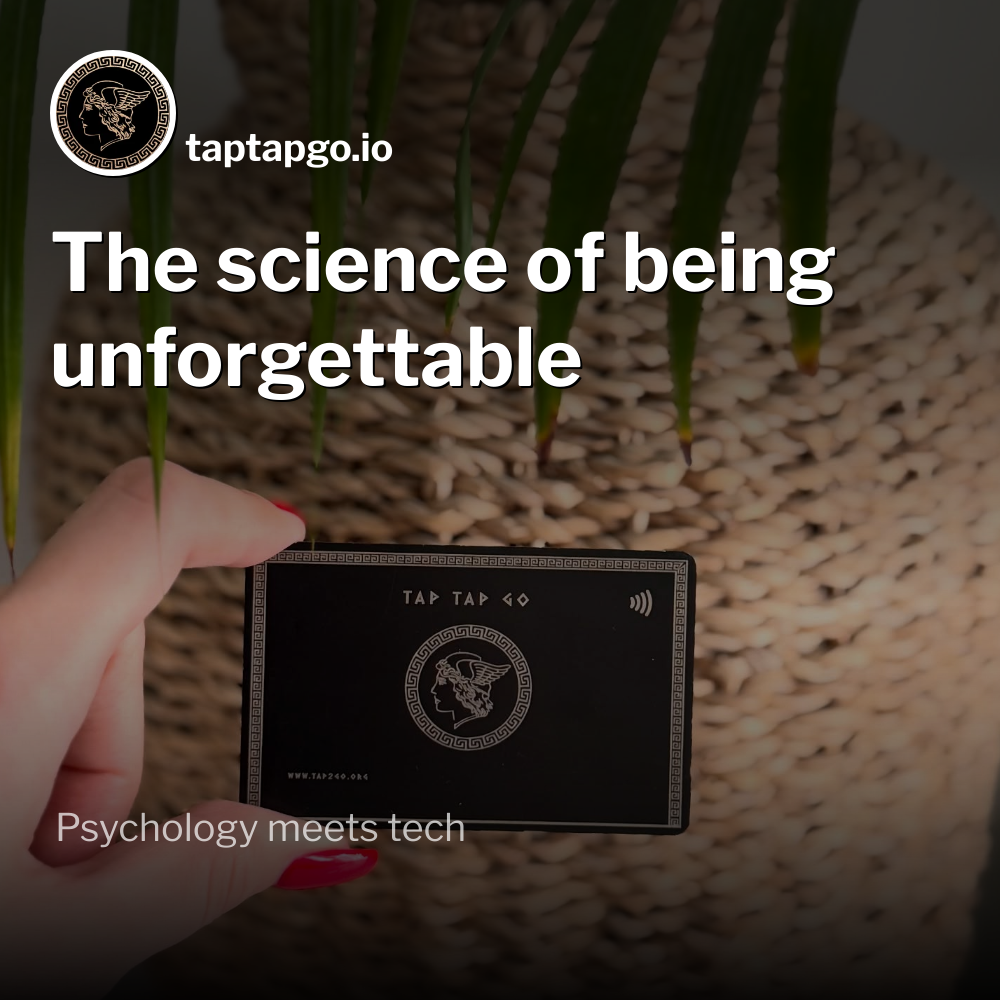
Tap Tap Go leverages the psychology of aesthetics and status through its physical design. The cards are available in 24K Gold, Platinum Prestige, and Obsidian Opulence finishes.
This connects to the 'halo effect', a cognitive bias where our overall impression of a person influences how we feel and think about their character. Presenting a heavy, mirror-polished metal card signals excellence and craftsmanship. It subconsciously primes the recipient to view your services or professional capability as high-quality before you have even pitched them.
Transforming connections into an ecosystem
For a connection to be valuable, it must lead to access. Tap Tap Go creates an "all-in-one" solution that keeps the user engaged long after the initial meeting.
1. Frictionless follow-through
With features like the 'Add to Contact' button, the friction of saving details is eliminated. However, the platform goes further with Quick Access Icons. Whether it is a direct payment link, a WhatsApp message, or a portfolio view, the recipient can take action immediately while the interaction is fresh.
2. Verified credibility
Psychologically, we look for social proof to establish trust. Tap Tap Go integrates Google Reviews directly into the profile. By showcasing glowing testimonials instantly, you bypass the skepticism phase of a new relationship.
3. Gamification and loyalty
The roadmap for Tap Tap Go includes a sophisticated loyalty programme and an 'Events Engine'. This taps into the psychological drive for reward. Users can earn points (and even revenue) through card taps, profile views, and referrals. By gamifying the networking process—literally earning while you connect—users are motivated to be more active and engaged.
4. A borderless financial layer
Perhaps the most distinct feature is the integration of Go Cash, a gas-free stablecoin. This turns the card from a passive piece of plastic into an active financial tool. Whether it is managing digital assets, sending cross-border remittances, or accepting payments for services via the integrated storefront, the card becomes central to the user's economic life.
The future of connection
The days of the Rolodex are over. In a digital-first world, carrying a stack of paper is not just outdated; it is psychologically ineffective.
Technology works best when it removes barriers between people. By understanding the psychology of memory—the need for novelty, the aversion to friction, and the reliance on visual cues—we can network smarter.
Tap Tap Go represents the next evolution of this logic. It is not just about making a connection; it is about granting access. It transforms a handshake into a lasting digital footprint, ensuring that when you walk away, your identity, credibility, and value remain firmly established.
In the end, the goal is not to collect more contacts. It is to build a network that actually works.