The psychology of the tap: why physical NFC gestures create stronger first impressions than links
Introduction
Sending a link takes two seconds. It is also almost entirely forgettable. Despite every advantage of frictionless digital sharing — instant delivery, zero material cost, infinite scalability — the research tells a different story: people form stronger, more durable impressions of professionals who engage them physically than those who slide into their notifications.
The networking world has accepted a quiet myth: that convenience and effectiveness travel together. They do not. In stripping away the physical moment of exchange, the industry accidentally removed the psychological architecture that makes first impressions stick — the deliberate gesture, the sensory cue, the brief, loaded pause of handing something over.
This is not nostalgia for paper. It is neuroscience. The field of embodied cognition — which examines how physical experience shapes thought, memory, and judgement — offers a precise explanation for why a tap lands differently than a link. Understanding that distinction does not just change how you hand over your contact details. It changes how you are remembered, trusted, and valued.
Why the Brain Treats Physical Gestures Differently
The human brain does not process all interactions equally. Embodied cognition — the theory that physical actions shape thought, memory, and meaning — tells us that the body is not a passive vehicle for the mind. When you engage in a deliberate physical gesture, you activate deeper neural encoding. The result: that moment, and the person attached to it, sticks.
This is the science behind the handshake. Research published in the Journal of Cognitive Neuroscience confirms that touch triggers oxytocin release, the neurochemical responsible for trust, bonding, and reciprocity. A handshake does not merely signal goodwill — it neurologically primes both parties for cooperation. Deliberate physical gestures carry social weight that no amount of digital convenience can replicate by default.
Tactile interactions also outperform passive digital ones in memory recall. A study by Maestro and colleagues found that physical objects and gestures are encoded more vividly and retrieved more reliably than information encountered through screens alone. When the body participates, the brain pays attention.
The NFC tap replicates this intentionality. Holding your card to another person's device is a conscious, directed act — it mirrors the deliberate reach of a handshake. Both parties are present, leaning in, completing a gesture together. That shared moment creates a psychological anchor that connects your identity to the experience of the interaction itself.
A shared link offers none of this. Dropping a URL into a chat or sending a LinkedIn request demands almost nothing — and the brain responds accordingly. Low-effort inputs get routed into the mental equivalent of a filing cabinet: acknowledged, stored, and rarely revisited. Passive digital exchanges feel transactional because, neurologically, they are. The tap is an event. The link is an errand.
The Friction Paradox: How Removing Effort Reduces Impact
Here is the counterintuitive truth: eliminating all friction from an interaction does not make it more valuable — it makes it forgettable. Behavioural economists call this the effort heuristic. We instinctively assign greater worth to things that demand deliberate, intentional action. A gesture that requires nothing registers as nothing.
The NFC tap is precisely calibrated friction. It asks for one conscious, physical act — a moment of agency — and that micro-investment is enough to anchor the exchange in memory. The effort is minimal, but its psychological signature is disproportionately large.
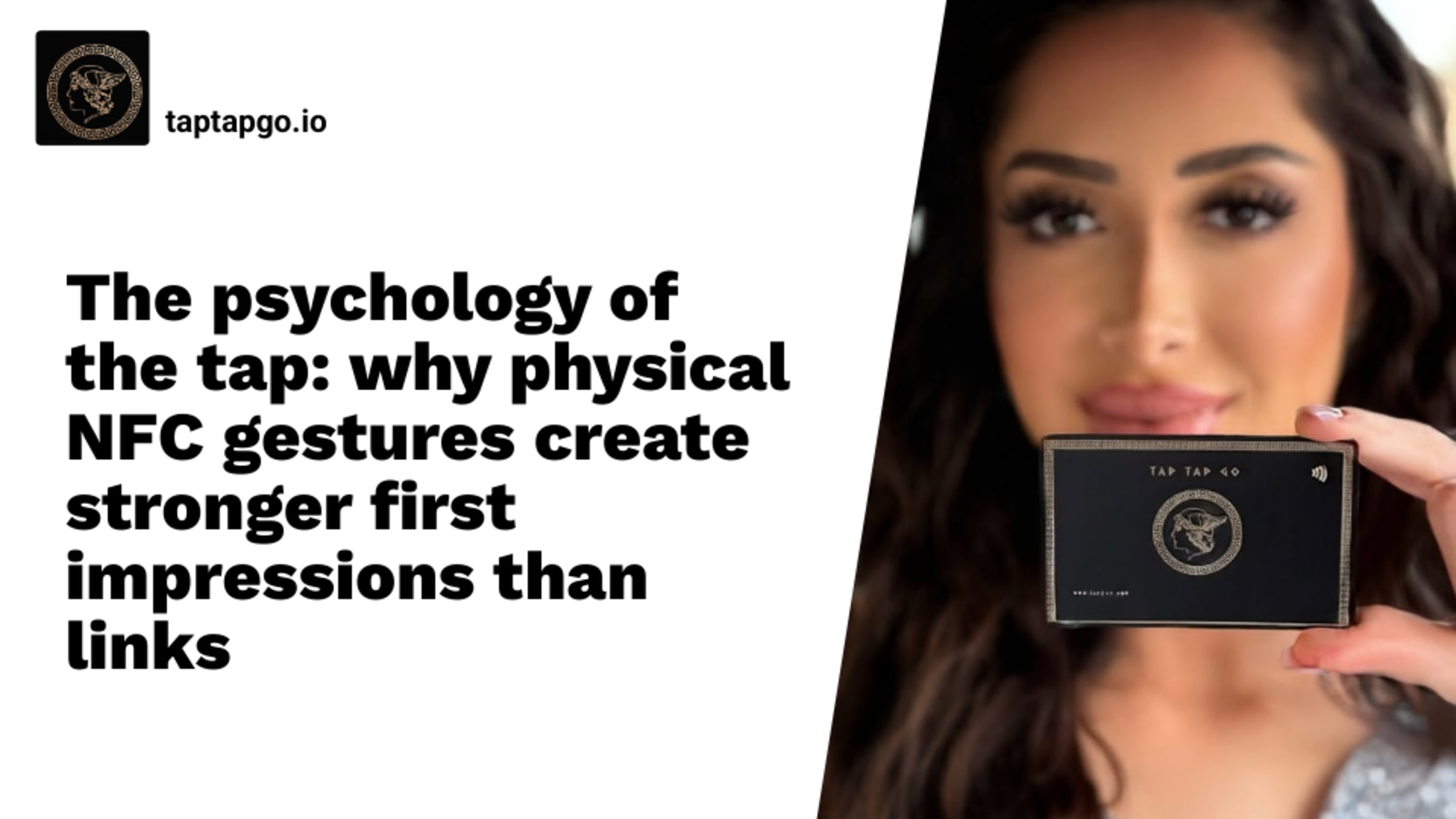
Consider a real scenario: you attend a conference and one contact fires a LinkedIn URL into a group chat, while another holds out a Tap Tap Go Obsidian card and asks you to tap. The next morning, you remember the tap. The URL has already dissolved into the noise of twelve other tabs you meant to open.
This is the link graveyard problem. Research consistently shows that the overwhelming majority of shared URLs go unopened within 24 hours — buried beneath notifications, inbox clutter, and competing priorities. A link asks the recipient to do all the work, later, alone. The NFC tap asks for nothing more than presence — and that is its power.
The tap also creates a bilateral moment that a shared link structurally cannot. Both parties are physically present, mutually aware, and simultaneously invested in the exchange. There is no asymmetry — no one sender and one passive receiver. That shared presence elevates the interaction from a data transfer to a social contract, and the brain encodes social contracts with far greater fidelity than it encodes notifications.
Deliberate connection, it turns out, is the feature — not the friction.
Status Signalling and the Material Dimension of Trust
Before you speak a word in a boardroom, the objects you carry have already spoken for you. Psychologists call this material signalling — the unconscious process by which physical artefacts communicate competence, investment, and social standing. A tailored suit, a precision timepiece, a weighted card placed deliberately on the table: each registers as a proxy for capability. The brain draws inferences about the person from the quality of what they present.
Tap Tap Go's card tiers are engineered around exactly this psychological principle. The Gold 24K Carat Crest, the mirror-finish Platinum Prestige, and the Obsidian Opulence are not aesthetic choices — they are non-verbal credibility statements. Each tier signals a different register of professional identity, communicating intentionality and precision before the NFC tap even occurs.
Consider the contrast: an executive enters a high-stakes meeting and slides an Obsidian Opulence card across the table, the recipient feels the weight, registers the finish, and a single tap transfers the full digital profile. Alternatively, someone opens a messaging app and pastes a link. The information conveyed may be identical — but the psychological experience is not remotely comparable. One feels like a transaction; the other feels like an event.
This is the halo effect operating in professional settings. Research consistently shows that premium tools elevate the perceived expertise of the person using them — the quality of the instrument reflects back onto the individual. Just as a consultant arriving with a polished leather briefcase reads differently from one arriving with a plastic bag, the Obsidian Opulence card elevates the perceived calibre of every introduction it initiates. The tap becomes the first proof point of a professional worth knowing.
Turning the Moment of Connection Into a Lasting Professional Relationship
The tap is not the transaction — it is the opening move. What separates a forgettable exchange from a high-value professional relationship is everything that happens in the 72 hours that follow. Most connections dissolve not from disinterest, but from the absence of a structured next step.
Tap Tap Go's AI-powered smart re-engagement eliminates that gap entirely. Rather than leaving follow-up to memory or manual effort, the platform reads activity signals — profile views, industry updates, mutual connection activity — and surfaces the optimal moment to reconnect. You are not guessing when to reach out; the platform tells you.
Context is preserved immediately through AI-generated meeting summaries attached directly to each contact profile. The moment after a tap at a conference or client dinner, the platform captures the conversation's core details so nothing is diluted by time or distraction. A week later, you are not re-introducing yourself — you are continuing a conversation.
The practical framework is straightforward: follow the 24-hour tap protocol. After every NFC exchange, log one personal detail — a shared interest, a business challenge they mentioned, a mutual contact — into your AI profile note. Let the platform process that signal and surface the re-engagement prompt within the week. One small action compounded across dozens of contacts builds a network with genuine relational depth.
When the relationship is ready to move beyond conversation into collaboration, Go Cash removes the final barrier. Zero-fee USDT-pegged transfers mean a Dubai contact can settle a consulting invoice or split a project cost with a London partner in seconds — no intermediary, no exchange friction, no delay. The tap that began as a first impression becomes the foundation of frictionless financial partnership.
The Tap Is the Message
The link sends information. The tap creates a memory. That distinction is not aesthetic — it is neurological, social, and deeply human. Physical gestures activate the brain's trust architecture in ways that digital shortcuts simply cannot replicate, and in a professional world saturated with QR codes and calendar links, the deliberate, material act of a tap cuts through with precisely the kind of signal that ambitious professionals need: I am here, I am present, and this moment matters.
Luxury NFC cards like Tap Tap Go's Obsidian Opulence or Platinum Prestige do not just exchange contact details — they encode status, intention, and identity into a single gesture. That gesture becomes the foundation upon which AI-powered follow-ups, Go Cash transactions, and lasting professional relationships are built.
Your network has always held potential. The tap is what activates it.
Single Tap, Boundless Connection — that is not a tagline. It is a philosophy for transforming your network into net worth. Explore the full ecosystem at taptapgo.io, or visit the blog at taptapgo.uk to go deeper.