
Tap Tap Go for husband-and-wife businesses: shared branding, separate profiles
The most common advice given to co-founder couples is also the most limiting: pick one brand and stay behind it together. But the most formidable husband-and-wife business teams — think Beyoncé and Jay-Z, or Sara and Jesse Blakewell at the helm of interlocking ventures — don't collapse their identities into a single voice. They architect something sharper: a shared brand with distinct professional presences, each one reinforcing the other.
The assumption that you must choose between a unified business identity and individual professional credibility is a false dilemma. In practice, forcing a single profile onto two different networks, audiences, and expertise sets dilutes both. Your clients don't connect with a logo — they connect with a person.
Tap Tap Go is built for exactly this dynamic. A platform that holds shared financial infrastructure, individual AI-powered profiles, and NFC cards that represent each of you with precision — without ever breaking the brand architecture you've built together.
The Branding Paradox Every Co-Founder Couple Faces
Most husband-and-wife businesses default to one of two approaches: a single shared profile, or one partner's voice dominating the brand. Both are strategic errors. Shared profiles flatten individual credibility, and a dominant voice leaves half the brand's expertise invisible to the very people who need to see it.
Consider a common co-founder dynamic — a husband driving sales and business development, a wife leading creative direction and operations. Their skills are distinct, their audiences are different, and the trust signals each needs to build are fundamentally separate. A potential investor vetting the business wants to see a sharp commercial mind. A design agency considering a partnership wants to see creative authority. One blended profile cannot serve both conversations simultaneously.
The solution lies in brand architecture — a model that luxury and enterprise brands have long mastered. Virgin Group operates as a single parent brand while each venture commands its own distinct identity. Apply that logic to a boutique co-founded business: one unified brand at the top, two individual sub-brands beneath it, each with its own professional voice, focus, and credibility signals.
Blended identities do not just create confusion — they actively cost opportunities. Clients, collaborators, and capital allocators respond to specificity. They want to know who they are dealing with, what that person leads, and why that person is the authority in their domain.
Separate profiles solve this by expanding the brand's total surface area. Two distinct professional identities — visually coherent but individually powerful — means two entry points into the same ecosystem, two networks compounding simultaneously, and twice the reach without doubling the effort. That is not division. That is strategic amplification.
How Tap Tap Go's NFC Cards Enable Dual Identities Under One Brand
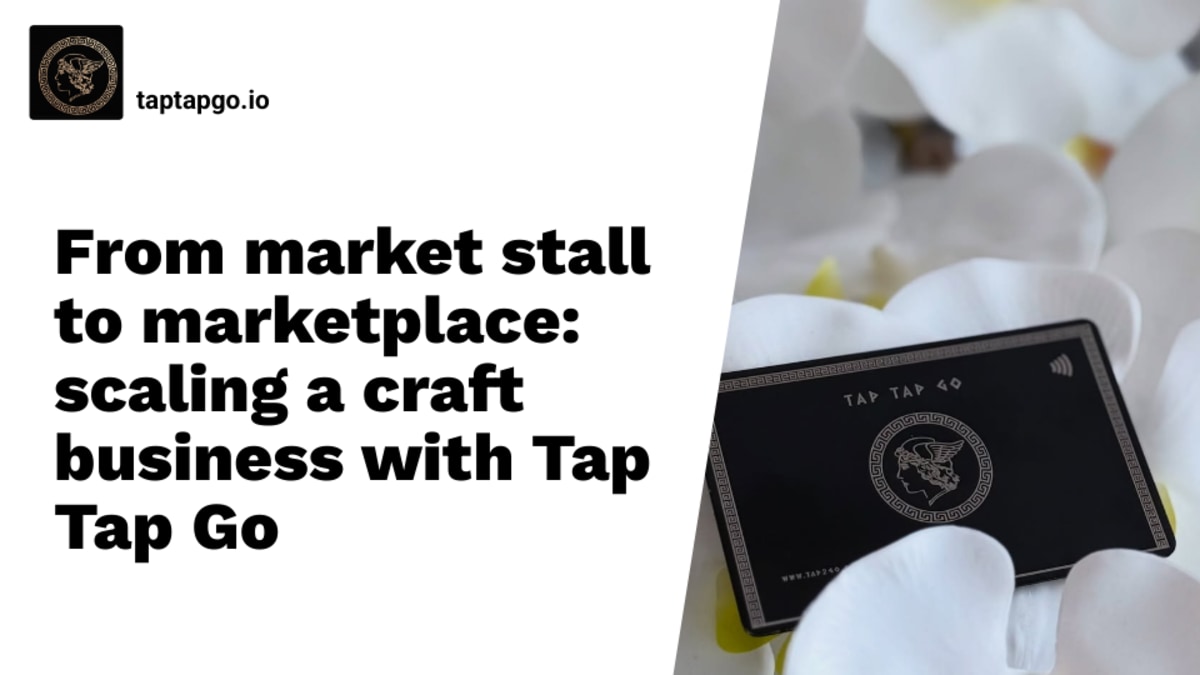
Tap Tap Go resolves the co-founder couple's branding paradox at the hardware level. Each partner receives their own NFC-enabled luxury card — chosen from the Gold 24K Carat Crest, Platinum Prestige, or Obsidian Opulence tier — each carrying a fully customisable digital profile. Name, role, social links, business credentials, and contact details are configured independently, so every profile reflects the individual behind the card, not a diluted composite.
Shared branding lives at the card level. Both profiles carry the same company logo, colour scheme, and tagline — reinforcing a unified front — while each partner's distinct role and area of expertise takes centre stage. The result is brand consistency without identity compromise: two cards, one company, zero confusion.
For the recipient, the experience is frictionless. No app download, no friction — a single tap delivers the relevant partner's complete profile instantly to any smartphone. First impressions land precisely as intended, every time.
Consider the difference this makes in practice. At a trade event, the husband taps his Obsidian card toward a potential investor — his profile leads with funding history, commercial traction, and strategic vision. Simultaneously, his wife taps hers with a press contact — her profile foregrounds creative direction, brand narrative, and media coverage. Neither interaction is generic. Both are deliberate.
Tap Tap Go's AI profile adaptation extends this precision globally. The platform's AI contextualises each partner's profile based on the recipient's region, language, and industry — so a shared brand communicates with local relevance whether the tap happens in a London boardroom, a Dubai expo hall, or a São Paulo startup summit. A unified brand that speaks every room's language is no longer a logistical challenge. It is a single tap away.
AI-Powered Networking That Works for Two
Most networking tools treat every user identically. Tap Tap Go's AI matchmaking doesn't — it surfaces high-value introductions tailored to each partner's specific domain. While one partner receives signals for business development leads or investor contacts, the other sees creative partnership opportunities or supplier connections. Same platform, two distinct pipelines.
At crowded conferences and events, voice-first networking removes the friction of manual contact capture entirely. Either partner can record a contact hands-free mid-conversation, and Tap Tap Go's AI automatically generates a meeting summary — key talking points, context, and follow-up prompts — attached directly to that new contact profile. Nothing falls through the cracks.
Smart re-engagement takes the mental load off both partners. The AI monitors activity signals across your network and identifies the optimal moment to reconnect with any given lead — so neither of you is left asking "when did we last speak to them?" or worse, double-contacting the same prospect from two different directions. The platform keeps each partner's relationship timeline precise and current.
Contact prioritisation and relationship scoring means each partner operates from their own ranked pipeline. Shared brand equity, independent relationship management — the kind of clarity that prevents the overlap and dropped threads that quietly cost co-founder couples real opportunities.
The practical action step here is intentional: before your next major event, define your networking remit explicitly. Who owns investor relationships? Who leads creative and press? Who handles operations and supplier contacts? Feed those lanes into how you each configure your Tap Tap Go profile, and let the AI reinforce those boundaries — maximising your collective coverage without duplicating effort or creating confusion in your shared contact ecosystem.
Go Cash, Shared Finances, and the Earn-Per-Tap Model
Go Cash is Tap Tap Go's USDT-pegged stablecoin — a digital currency anchored to the US dollar, engineered for zero-fee, gas-free cross-border transactions. Unlike traditional crypto, it carries none of the volatility. For co-founder couples operating across London, Dubai, or any international corridor, that means no conversion fees, no transfer delays, and no unpleasant surprises at settlement.
The platform's earn-per-tap model adds a layer of financial return that compounds across a partnership. Every NFC tap interaction generates $0.10. With two active partners networking across conferences, client meetings, and industry events, combined earning potential reaches $600+ per month — $7,200+ annually. Networking, quite literally, funds itself.
Business expense management tools within the platform give couples granular visibility into shared operational costs — subscriptions, vendor payments, event spend — while preserving individual transaction histories for each partner. There is no need to untangle joint expenses after the fact; the architecture handles the separation from the first tap.
This financial structure mirrors the brand architecture established by the dual NFC card setup. Each partner maintains a distinct earning profile and transaction record, yet both operate under the same business umbrella within the Tap Tap Go ecosystem. The result is a financial model as considered as the branding one — two professionals, two revenue streams, one unified operation. For husband-and-wife businesses serious about scaling globally, Go Cash does not just simplify transactions; it turns the act of showing up and connecting into a measurable financial asset.
Two Names. One Vision. Unlimited Potential.
The most powerful businesses are built on complementary strengths — and for co-founder couples, that dynamic is already embedded in the partnership. The challenge has never been the relationship. It has been finding a platform sophisticated enough to honour both identities while keeping the brand architecture unified.
Tap Tap Go resolves that tension elegantly. Separate NFC profiles carry distinct expertise and authority. AI matchmaking works for both partners simultaneously. Go Cash keeps shared revenue flowing without friction, and every tap — across both profiles — contributes to a combined earning potential of up to $7,200 a year.
This is what it means to transform your network into net worth: not as a tagline, but as a measurable, daily reality built by two people moving in the same direction.
If you and your partner are ready to build a brand that commands the room — together — explore the full ecosystem at taptapgo.io, or visit the blog at taptapgo.uk to keep building smarter.