How professors and lecturers can share syllabi, office hours, and resources through Tap Tap Go
Introduction
Academia produces some of the world's most sophisticated thinkers — yet the average professor's digital presence amounts to a static faculty page, a PDF that was outdated before it finished downloading, and office hours that students routinely miss because they were buried in an LMS sidebar. The professional networking revolution has reshaped how executives, founders, and creatives build influence and relationships. Somehow, higher education has largely been left behind.
This is not a minor inconvenience. When a professor's research, contact details, course materials, and professional identity are scattered across institutional portals, Google Scholar, and department noticeboards, the cost is real — disengaged students, missed collaboration opportunities, and expertise that never travels beyond the campus perimeter. Knowledge authority without professional infrastructure is influence that stalls at the lecture hall door.
Tap Tap Go changes that equation. Built for professionals who operate at the intersection of intellect and ambition, the platform gives academics a single, tap-activated presence that works as hard as they do — on campus, at conferences, and across borders.
The Problem with How Academics Share Information Today
The academic syllabus is outdated before the semester begins. Distributed as a static PDF on the first day of term — or uploaded to a learning management system that half the cohort rarely revisits — it offers no live updates, no version control, and no mechanism for students to know when something has changed. A revised reading list or rescheduled deadline becomes a logistical exercise in mass emails and hoping for the best.
Office hours suffer the same structural failure. A timeslot buried in a department portal or pinned to an LMS sidebar is easily ignored, forgotten, or simply never found. The result is chronically low attendance, missed mentorship moments, and students who disengage precisely when they need academic guidance most.
The fragmentation runs deeper than course administration. Most faculty maintain a research profile on one platform, a course page on another, and contact details scattered across an institutional directory, a personal website, and perhaps a Google Scholar page that was last updated in 2021. There is no single, living point of entry — for students, collaborators, or industry partners.
The cumulative cost is significant. Students disengage when information feels inaccessible. Faculty lose influence beyond their campus walls when their professional identity has no coherent, shareable form. And genuine collaboration opportunities — with researchers, institutions, and industry — dissolve before they can form, simply because the right profile was never in the right hands at the right moment.
One Tap, Every Resource: Using NFC Cards to Centralise Your Academic Profile
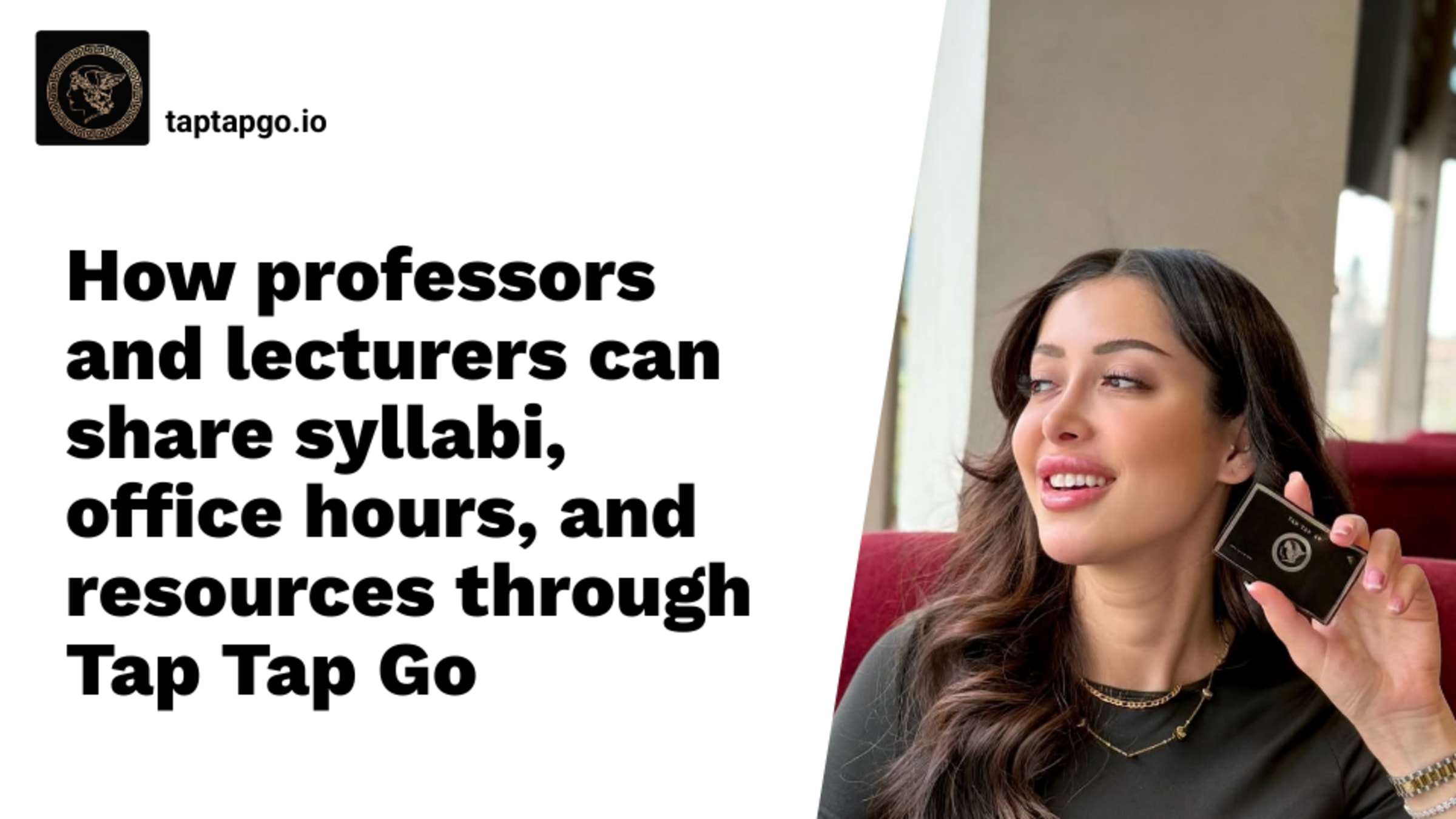
Tap Tap Go's NFC-enabled premium cards — including the mirror-finish Platinum Prestige and the striking Obsidian Opulence — solve the fragmentation problem in a single gesture. A professor holds their card to a student's smartphone, and the full digital profile transfers instantly. No app required on the recipient's end. No friction. No follow-up email saying "I'll send you the link later."
That profile is not static. From one centralised dashboard, professors embed live links to everything that matters: a current syllabus hosted on Google Docs or Notion, an office hours booking page via Calendly, a curated list of research publications, and direct department contact details. Update the syllabus on Monday morning — every student who has tapped the card already has access to the latest version.
Picture the first seminar of the autumn term. Rather than dictating a URL or waiting for an LMS upload to propagate, the professor taps their Tap Tap Go card against a student's phone. In under a second, that student has the full course profile, the week-one reading list, and a direct link to book their first advisory session. The entire administrative handshake of the first week — compressed into a single tap.
This is where NFC decisively outperforms QR codes. QR codes require a camera app, good lighting, and an unlocked screen. NFC is passive — it activates on contact, works through a locked screen, and registers in milliseconds. In a lecture hall of two hundred students, that difference in elegance is not trivial.
Beyond function, the card itself communicates something. Arriving at a faculty networking event or academic conference with a Tap Tap Go card signals professional seriousness before the conversation has even begun — a physical expression of a meticulously curated digital presence.
AI-Driven Engagement: Turning Student and Peer Connections into Ongoing Relationships
Most professors collect contacts the way academics collect citations — in abundance, with little system for activation. Tap Tap Go's AI contact management changes this entirely. Every tap interaction is logged, an AI-generated summary is attached to each contact profile, and the platform scores relationship strength over time — giving professors a living map of their professional and academic network.
The office hours scenario illustrates this precisely. After a one-to-one session with a postgraduate student, the AI auto-generates a summary of the topics discussed — dissertation trajectory, recommended sources, next steps — and attaches it directly to that student's profile. If that student goes quiet for three weeks, Tap Tap Go flags the lapse and prompts a re-engagement nudge at the optimal moment, before the relationship loses momentum entirely.
At academic conferences, the platform's AI matchmaking function becomes a strategic asset. Rather than navigating a crowded conference floor on instinct, professors receive curated introductions — researchers whose published work intersects with theirs, department heads exploring collaborative programmes, or industry partners seeking academic advisory input. The platform transforms ambient networking into precision relationship-building.
Voice-first networking removes the final friction point. Immediately after a seminar or a corridor exchange, professors can capture contact notes hands-free — no typing, no delay. The AI transcribes the note and attaches it to the correct contact profile automatically.
The actionable strategy here is deliberate and measurable: use the relationship scoring feature each semester to identify the top 20 students or collaborators worthy of proactive attention. Schedule touchpoints accordingly. What begins as transactional advising — answering questions, signing forms — compounds into genuine mentorship pipelines that extend well beyond graduation.
Building a Research and Professional Brand That Extends Beyond Campus
Groundbreaking research deserves a global audience — yet most academic work disappears behind institutional paywalls, department pages, and conference proceedings that few outside the academy ever find. Tap Tap Go's Media Hub changes that equation entirely, aggregating every professional channel — publications, lecture recordings, LinkedIn, X, ResearchGate — into a single, tap-activated profile that travels with you.
The platform's AI content generation tools do the heavy lifting of amplification. A professor can feed in a research abstract or lecture theme and watch the AI repurpose it into polished professional posts, distributed simultaneously across LinkedIn, X, and relevant academic networks. Research that once reached a seminar room of thirty now reaches a curated global audience with a single action.
Profile context adapts to the room. When a professor taps their Tap Tap Go card with an international delegate at a global summit — say, a policy summit in Geneva or a fintech conference in Dubai — the AI automatically surfaces the publications, research themes, and credentials most relevant to that delegate's region and industry. Every introduction becomes precisely calibrated, not accidental.
Go Cash removes the final barrier to global academic collaboration. Tap Tap Go's USDT-pegged stablecoin enables zero-fee, instant payments for international consulting engagements, speaking appearances, or co-authored project fees — eliminating the delays and cost of traditional wire transfers. A keynote in Singapore, a co-authored paper with a researcher in Berlin — the financial mechanics become invisible.
And the activity compounds. Every tap earns $0.10 through the platform's tap-to-earn model. Across a full semester of student interactions, office hours, and conference engagements, that accumulates into a meaningful income stream — making professional brand growth not just rewarding intellectually, but measurably so.
The Lecture Hall Is Just the Beginning
The most influential academics of the next decade will not be defined by the courses they teach — they will be defined by the networks they build, the research they amplify, and the relationships they sustain beyond the seminar room. Knowledge has always been the currency of academia. Now, the platform you carry determines how far that currency travels.
Tap Tap Go hands professors the infrastructure to operate as networked professionals — not just educators. A single tap connects a student to every resource they need, surfaces the right collaborator at the right conference, and earns real income with every interaction. The syllabus PDF was never built for this world. Tap Tap Go is.
If you are ready to transform your academic presence from static to living, from local to global, explore the full platform at taptapgo.io. Because in a world built on connections, a single tap holds the power to turn a classroom introduction into a career-defining relationship — and every network into net worth.