
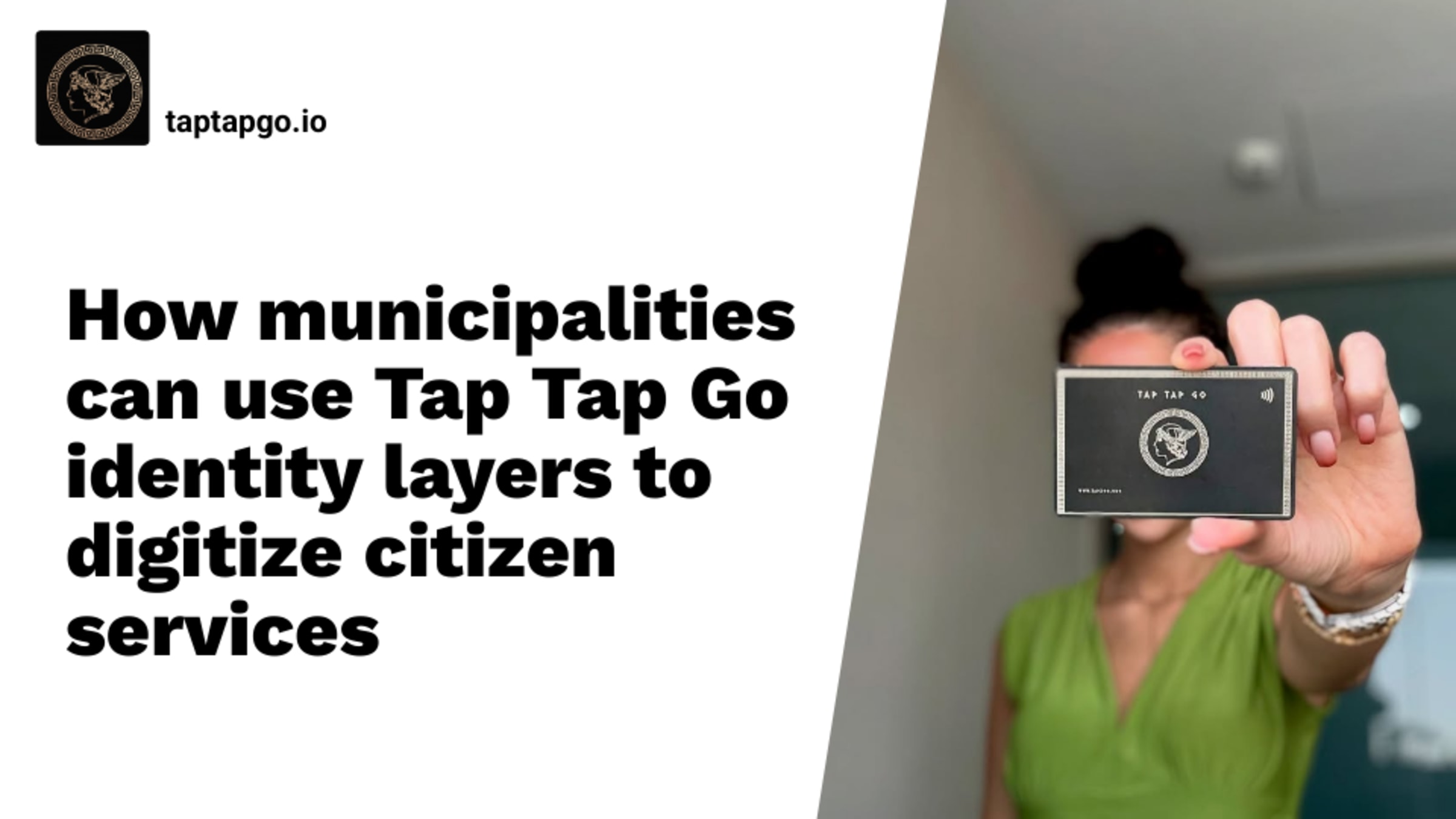
How municipalities can use Tap Tap Go identity layers to digitize citizen services
Most cities are not failing at smart city transformation because they lack the technology — they are failing because they cannot reliably verify who their residents are at the point of service. The backend infrastructure exists. The broadband is there. The cloud platforms are contracted. Yet millions of citizens still queue at council offices clutching paper documents, because no lightweight, portable identity layer connects them to the services waiting on the other side of the counter.
NFC technology has already solved this problem for the private sector. A single tap authenticates, communicates, and triggers action — no app required, no friction, no delay. Tap Tap Go's NFC identity architecture, built to serve high-performing professionals across global markets, carries a design logic that translates directly into civic infrastructure. Municipalities do not need to rebuild from scratch. They need a smarter onboarding layer — one that turns every resident interaction into a verified, data-rich, and potentially rewarding digital transaction.
The Identity Gap Holding Smart Cities Back
Billions flow into smart city infrastructure every year — sensor networks, data platforms, integrated transit systems — yet most initiatives stall before they reach the citizen. The failure point is rarely the backend technology. It is the onboarding layer: the moment a resident is asked to verify who they are, prove where they live, and access a digital service in a single, seamless interaction. That moment remains broken in most cities worldwide.
Traditional government identity systems were not built for this. They are siloed by department, anchored to paper documentation, and fundamentally incompatible with the speed and fluidity of modern digital service delivery. A resident seeking council housing support, healthcare access, and a parking permit may encounter three separate databases, three separate verification processes, and three separate queues — analogue friction in a world demanding digital flow.
NFC technology offers a structurally different approach. Near Field Communication enables a device or card to transmit encrypted identity and service data to a compatible reader in under a second — no app, no login, no form. A single tap authenticates the user and triggers the relevant service interaction. The technology already operates at billions of contactless payment terminals globally; the infrastructure exists, and the public behaviour is already conditioned.
Tap Tap Go's identity layer repurposes this architecture for civic use. Its NFC-enabled cards carry customisable, verifiable digital profiles — portable credentials that travel with the individual, not the institution. This is not a business card with a municipal logo. It is a tap-activated civic profile capable of authenticating identity across multiple service contexts.
Estonia proved the demand at national scale. Its digital identity programme, which handles healthcare records, tax filing, and voting through a single unified credential, demonstrates that lightweight ID infrastructure does not compromise security — it accelerates trust. The appetite exists. The architecture is ready.
From Business Card to Civic Credential: How Tap Tap Go's Identity Layer Works
Tap Tap Go's NFC cards are built around a simple architectural truth: a single tap can surface a fully customisable digital profile, verified instantly, without requiring the recipient to download anything. That same infrastructure — NFC chip, linked profile, contextual data layer — translates directly into a civic identity framework.
A municipality could issue NFC-enabled civic cards the way Tap Tap Go issues professional ones. Each card carries a resident's verifiable identity profile, linked to the specific services they are entitled to access — resident permits, healthcare registration, library borrowing rights, or social housing status. At the point of tap, the relevant credential is surfaced and authenticated. No queue. No paperwork. No manual lookup.
What makes this architecture genuinely intelligent is Tap Tap Go's AI profile adaptation feature. The same card doesn't present a static data dump — it reads context. Tap at a GP surgery, and the system surfaces healthcare credentials and appointment history. Tap at a transport kiosk, and it pulls transit entitlements. Tap at a council office, and it loads municipal admin records. The profile adapts to the service environment, reducing friction for both resident and service provider.
Go Cash, Tap Tap Go's USDT-pegged stablecoin, sits natively within this framework. Residents can settle civic fees, parking fines, or library charges at the point of tap — zero fees, instant settlement, with AI fraud detection running on every transaction. There is no separate payment terminal to navigate, no card machine delay.
Critically, no app is required on the recipient's side. A council kiosk, a GP reception terminal, or a library reader can process the tap interaction — making the system as accessible to a 70-year-old as it is to a digital native.
Practical Use Cases: What Digitized Civic Services Actually Look Like
Theory meets tarmac here. These four use cases illustrate exactly how the Tap Tap Go identity layer operates across core municipal touchpoints.
Resident Onboarding
A new resident arrives at a council kiosk, taps their NFC civic card, and instantly registers their address, receives bin collection schedules, and opts into local service alerts — no paper forms, no counter queues. What previously required multiple department visits collapses into a single 30-second interaction.
Healthcare Check-In
At a GP surgery or walk-in clinic, a tap replaces the clipboard. The patient's verified civic profile surfaces the relevant identity data — no duplication, no handwriting errors, no administrative backlog. Front-desk staff spend time on care, not data entry. For NHS trusts already under capacity pressure, this is measurable operational relief.
Parking and Transit Payments
Go Cash powers instant, zero-fee parking and transit payments at the point of tap. Every transaction is protected by AI-powered fraud detection that flags anomalies in real time — the same financial security infrastructure that governs Tap Tap Go's commercial ecosystem, now applied to public infrastructure payments.
Community and Civic Engagement
Residents tap to RSVP for town halls, log volunteering hours, and confirm participation in local elections. Each interaction triggers loyalty-style rewards, turning passive civic duty into an actively incentivised behaviour. Participation rates in digitally rewarded civic programmes — like those piloted in Singapore's Smart Nation initiative — consistently outperform traditional engagement models.
The Three-Phase Municipal Pilot Model
Any city authority can activate this framework in three sequential phases:
- Identity Issuance — Deploy NFC civic cards to residents, linked to verified digital profiles
- Service Integration — Connect card tap points to healthcare, transport, and council service systems
- Rewards Activation — Launch AI-driven loyalty campaigns that incentivise target behaviours from day one
Each phase is independently deployable, reducing implementation risk and allowing municipalities to scale at their own pace.
Why the Rewards Layer Is the Overlooked Engine of Civic Adoption
The most persistent obstacle in civic digitization is not infrastructure or budget — it is inertia. Residents default to analogue habits not because digital services are inferior, but because no one has given them a compelling reason to change. Technology alone has never solved a behaviour problem.
This is precisely where Tap Tap Go's tap-to-earn model reframes the equation. Every tap interaction generates $0.10 for the user — a mechanic designed for professional networking that translates directly into civic incentive architecture. A resident who taps to file a permit, check in at a clinic, or confirm recycling collection is not just completing a transaction; they are earning for choosing the digital path over the paper one.
The private sector has already proven this logic. ClassPass built consistent gym attendance through reward momentum. Deliveroo Plus converted occasional users into habitual ones through access-first loyalty. Municipalities can apply the same behavioural scaffolding — not to sell products, but to drive early tax filing, increase community meeting attendance, and reward recycling participation.
Tap Tap Go's AI-driven loyalty campaign tools let city planners design personalised reward journeys at scale — nudging specific resident cohorts toward specific target behaviours without blanket incentives that dilute impact.
The scaling effect compounds. As resident engagement deepens, the anonymised behavioural data available to city planners grows richer — revealing which services underperform, which demographics are underserved, and where friction still exists. Smarter engagement produces smarter cities. The rewards layer is not a feature; it is the adoption engine that makes every other layer viable.
The Municipality as a Network Node: Turning Civic Touchpoints Into Community Wealth
The most forward-thinking city leaders are no longer asking how to digitise paperwork. They are asking how to make every citizen interaction deliver measurable value — to the resident, to the community, and to the systems that serve them both.
Tap Tap Go's identity layer reframes the municipality not as a bureaucratic gatekeeper but as an active node in a living civic ecosystem. Every tap — at a council kiosk, a GP surgery, a transit terminal — becomes an opportunity to verify, reward, and deepen trust. The same philosophy that transforms professional networks into net worth applies here at city scale: turning civic touchpoints into community wealth.
This is not a distant blueprint. The infrastructure exists. The rewards mechanics are proven. The only variable is leadership willing to act.
If you are a public sector innovator, civic tech entrepreneur, or urban strategist ready to explore what this looks like in practice, visit taptapgo.io or discover deeper thinking on the future of connected communities at taptapgo.uk.