
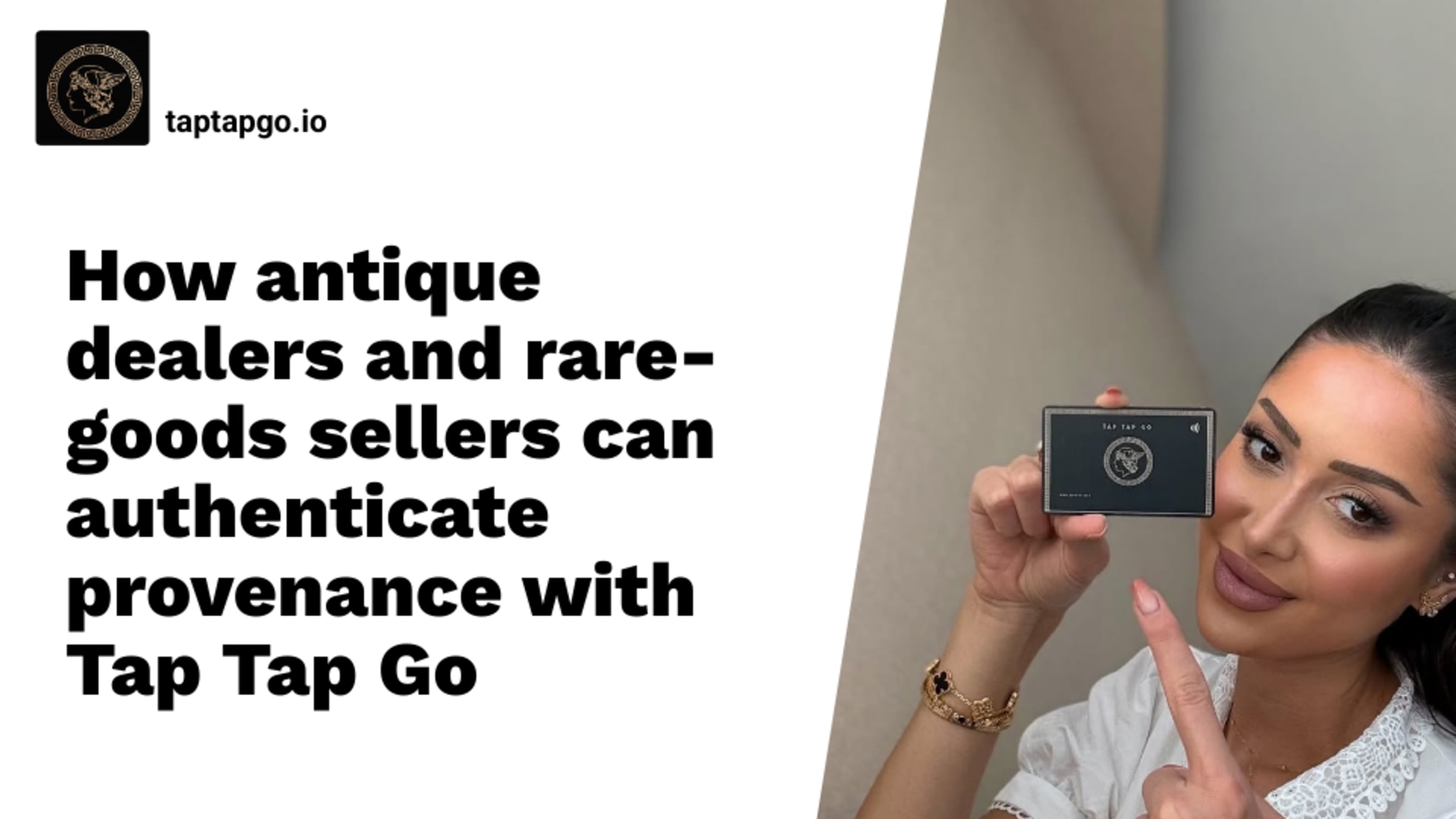
How antique dealers and rare-goods sellers can authenticate provenance with Tap Tap Go
The buyer stood in front of a verified 19th-century writing desk, asked one question about provenance, and walked out when the answer was a laminated sheet and a handshake. Not because the piece was fake. Because the proof felt like it could be.
Antique dealers and rare-goods sellers can authenticate provenance with a digital card tied directly to the object — carrying ownership history, appraisal data, condition records, and verified seller identity in one scannable, transferable record that travels with the piece across every future sale.
The industry has run on paper certificates and verbal reputation for decades, and most sellers still treat that as acceptable. It is not. Provenance chains break at resale because documentation does not transfer cleanly — and high-value buyers have started walking away from deals that paper cannot close.
Here is the honest admission: early digital tools for provenance were clunky, expensive, and built for institutions, not independent dealers. Most sellers tried one, got burned by the complexity, and went back to folders. That is not a reason to stay there.
Your provenance problem is not the object. It is the infrastructure behind it.
Why Provenance Documentation Fails at the Moment It Matters Most
A buyer is standing in front of a $40,000 piece. They ask for the provenance record. You hand them a laminated sheet with faded ink and a signature no one can verify. The deal dies there.
Paper certificates fail in exactly three ways: they degrade, they disappear between owners, and they are forged more often than the industry admits.
Provenance chains break at resale. Documentation rarely transfers cleanly — it stays with the seller, not the object.
The gap between what you claim and what you can prove is where brand equity evaporates. High-value buyers do not accept folders anymore. They expect verifiable digital records, and sellers who cannot produce them are competing on faith alone.
How Antique Dealers Can Authenticate Provenance with a Digital Card Tied to the Object
A digital card is not a replacement for a certificate. It is a living record — carrying ownership history, condition notes, appraisal data, and verified seller identity in one place that updates as the object moves.
Each time the piece changes hands, the card updates. The chain of custody travels with the object, not in a folder that gets left behind.
NFC or QR-enabled cards let buyers verify authenticity on the spot. No phone calls. No waiting on a third party to confirm what the seller already claims.
The forgery risk disappears because the record is tied to a verified digital identity — not a printout anyone can replicate in ten minutes.
How Tap Tap Go Turns Provenance Into a Brand Differentiator for Rare-Goods Sellers
Most sellers authenticate the object. They forget to authenticate themselves. TAPTAPGO's digital card infrastructure lets you attach your brand identity — name, credentials, contact, and dealer history — directly to the provenance record, not just the piece.
Every future transfer carries your card forward. The buyer who purchases that Georgian writing desk five years from now still sees your name first.
That is how you build secondary market equity without running a single additional ad.
For dealers running affiliate or membership programs, the card pulls double duty — provenance record and loyalty vehicle in one. TAPTAPGO is built specifically for this: custom card design, verified identity fields, and multi-function architecture that paper never could have supported.
The Business Case for Authenticated Provenance: What It Does to Conversion and Repeat Business
Trust is the last funnel conversion variable most rare-goods sellers ignore. Buyers who can verify provenance on the spot do not hesitate — they close. The ones who cannot verify it walk, or they negotiate the price down until the risk feels worth it.
Sellers without verifiable records compete on price alone. That is not a market position. That is a race to the bottom with no finish line.
Authenticated pieces command premiums because the documentation is the product. A verifiable digital record transforms a transaction into an experience — one buyers remember and refer. Repeat business and word-of-mouth referrals climb when the purchase process signals professionalism that paper never could.
Attribution modeling becomes possible when digital cards track movement through the secondary market. You see where buyers originated, how pieces transfer, and which seller touchpoints drove return purchases. That is data most antique dealers have never had access to — until now.
Provenance Is the Product. Start Treating It That Way.
The antique dealers who win the next decade are not the ones with the best inventory. They are the ones whose reputation travels with every piece they sell — long after the handshake, long after the invoice, long after the original buyer resells.
Paper certificates do not do that. A branded, verified digital card does.
Every deal you lose to a competitor with weaker inventory but stronger documentation is a signal. Buyers are not just buying the object — they are buying the certainty. Sellers who treat provenance as an afterthought are competing on price. Sellers who treat it as brand infrastructure are commanding premiums and generating referrals from buyers they met once.
Build your first provenance card on TAPTAPGO today. Your name, your credentials, and your reputation attach to the piece permanently — visible at every future transfer, every resale, every new owner who picks it up and wonders where it came from.
Your provenance is your brand. Make sure it survives the sale.