
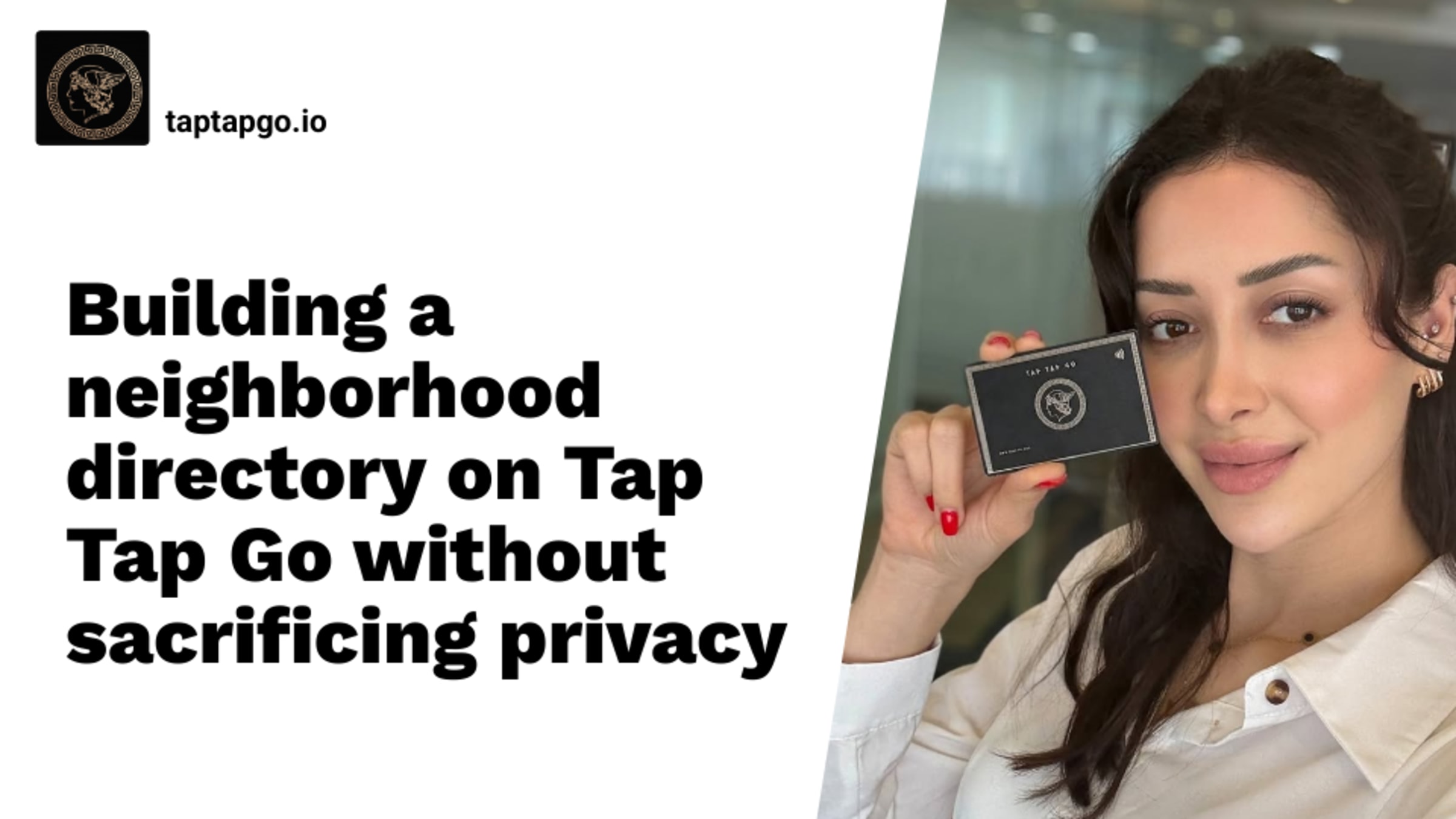
Building a neighborhood directory on Tap Tap Go without sacrificing privacy
Someone added 47 residents to a neighborhood WhatsApp group last spring, and by morning, three women had received unsolicited texts from a number no one recognized. The admin deleted the group. The directory died with it. This is not a horror story — it is the standard outcome when communities use convenience tools to solve infrastructure problems.
Tap Tap Go lets neighborhoods build fully functional member directories using branded digital cards, so residents share a card link instead of raw contact data — no exposed phone numbers, no shared spreadsheets, no admin holding a file they should never have owned.
Communities need connection. The tools most of them reach for — Google Sheets, Facebook groups, WhatsApp broadcasts — trade privacy for ease of setup, and residents feel it immediately. Participation drops. Data goes stale. The directory becomes a liability before it becomes an asset.
Here is the honest admission: the failure is never a marketing problem. It is always a trust problem disguised as a participation problem.
Your directory does not need more residents. It needs better infrastructure.
Why Most Neighborhood Directories Fail Before Anyone Even Uses Them
You launched the neighborhood directory in January. By March, eleven people had added their information. Everyone else either ignored the invite or gave a fake number.
The default tools are the problem. A shared Google Sheet exposes every resident's phone number, address, and email the moment someone opens the link. WhatsApp groups broadcast contact details to strangers automatically. Facebook pages hand your community's data to an advertising platform. There is no access control layer — which means there is no privacy.
Privacy violations in community directories are not edge cases. They are the standard outcome.
People do not opt out because they dislike community. They opt out because they distrust the infrastructure holding their personal data. The result is always the same: low participation, incomplete records, and a directory that becomes a ghost town within 60 days of launch.
The participation problem is not a marketing problem. It is a trust problem — and you cannot solve it by sending more reminder emails.
Building a Neighborhood Directory on Tap Tap Go: What Privacy-First Actually Looks Like
Every resident gets their own TAPTAPGO digital card. They decide what appears — a first name, a neighborhood role, a preferred contact method — and nothing else surfaces without their sign-off.
No shared spreadsheet. No exposed phone numbers. Residents share a card link, not their personal data.
Admins organize members by street, block, or committee role without ever holding raw contact information centrally. The infrastructure stays clean because the data never funnels into one vulnerable file.
The directory becomes a network of controlled, branded identities — not a database of data rows waiting to be leaked.
That is the difference between a community database and a community identity layer.
Control, Consent, and Brand Equity: The Three Things a Community Directory Must Protect
Most directories are built around admin convenience. Residents pay the price.
With Tap Tap Go, each member owns their card. They update it when they move, change roles, or add a home service listing — no ticket to the admin, no delay, no version mismatch in a central file. The directory stays accurate because the people with the most current information are the ones maintaining it.
Sharing a card is an active choice. That distinction matters more than most directory builders realize.
Passive enrollment — where joining a neighborhood group automatically exposes your contact details — is why people ghost directories after week two. When residents choose to share their card, that consent creates buy-in. Participation holds because ownership holds.
We underestimated how much residents care about who else can see their information. It is the first question, every time — not "how do I join," but "who sees what I put in."
Brand equity is the quiet multiplier here. An HOA running branded digital cards signals that the organization takes governance seriously. That perception translates directly into resident trust — and trust drives participation faster than any onboarding email sequence.
One card. WhatsApp share, QR scan at a block event, email introduction — same identity, every channel, zero inconsistency.
How to Launch Your Community Directory on Tap Tap Go in Under a Week
Start with structure, not cards. Map your streets, roles, and committees first — the architecture has to reflect how the community actually operates before a single card gets created.
Then build your branded template on TAPTAPGO. Every member card inherits consistent visual identity from day one.
Invite members to claim their own card. They choose what to show. You provide the infrastructure, not the data.
Distribute the directory as a curated collection of card links — never a data export. Privacy holds at every point of contact.
The directory you build this week is the brand infrastructure your neighborhood will trust for years.
Your Community Has One Shot at Getting This Right
Most neighborhoods do not lose trust dramatically. They lose it quietly — one exposed phone number, one shared spreadsheet that got forwarded to the wrong person, one resident who opted out and never came back. The infrastructure you choose today is not an admin decision. It is a community relationship decision.
Residents do not need more channels. They need one identity layer they can actually trust — something they control, something that represents them accurately, and something that does not expose them the moment they join.
That is what a Tap Tap Go community directory delivers.
Go to TAPTAPGO today, set up your branded community card template, and give every resident a digital identity they own — not a data row someone else manages.
The neighborhood that builds privacy-first infrastructure now will not be scrambling to rebuild trust after the breach that was always coming.