
Most professionals operate across multiple platforms. LinkedIn for networking. Instagram for visibility. PayPal for transactions. Calendly for scheduling. A website for credibility. A business card for introductions.
Each platform holds a fragment of identity. None of them connect.
Tap Tap Go, founded by entrepreneur Dhawal Laheri, is built to solve that problem. What appears to be a digital business card is actually something more foundational: a unified infrastructure layer that consolidates identity, interaction, and economic activity into a single, portable access point.
This isn't about replacing platforms. It's about creating the layer beneath them—one that allows individuals and businesses to move fluidly across digital and physical environments without losing continuity.
The Problem: Fragmentation at Scale
Digital presence has become mandatory across industries. But maintaining it requires managing dozens of disconnected tools.
A consultant might have:
-
A LinkedIn profile for professional credibility
-
A personal website for portfolio display
-
Calendly for booking meetings
-
Stripe or PayPal for invoicing
-
Google Reviews for social proof
-
WhatsApp and email for communication
-
Multiple social media profiles for visibility
Each platform operates independently. Updating contact information means editing profiles across all of them. Sharing credentials requires juggling links, apps, and formats. Transactions happen outside the context of connection.
The result is inefficiency, friction, and lost opportunities—especially in real-world interactions where speed and clarity matter.
Tap Tap Go addresses this by treating identity as infrastructure rather than content.
A Single Tap, A Complete Introduction
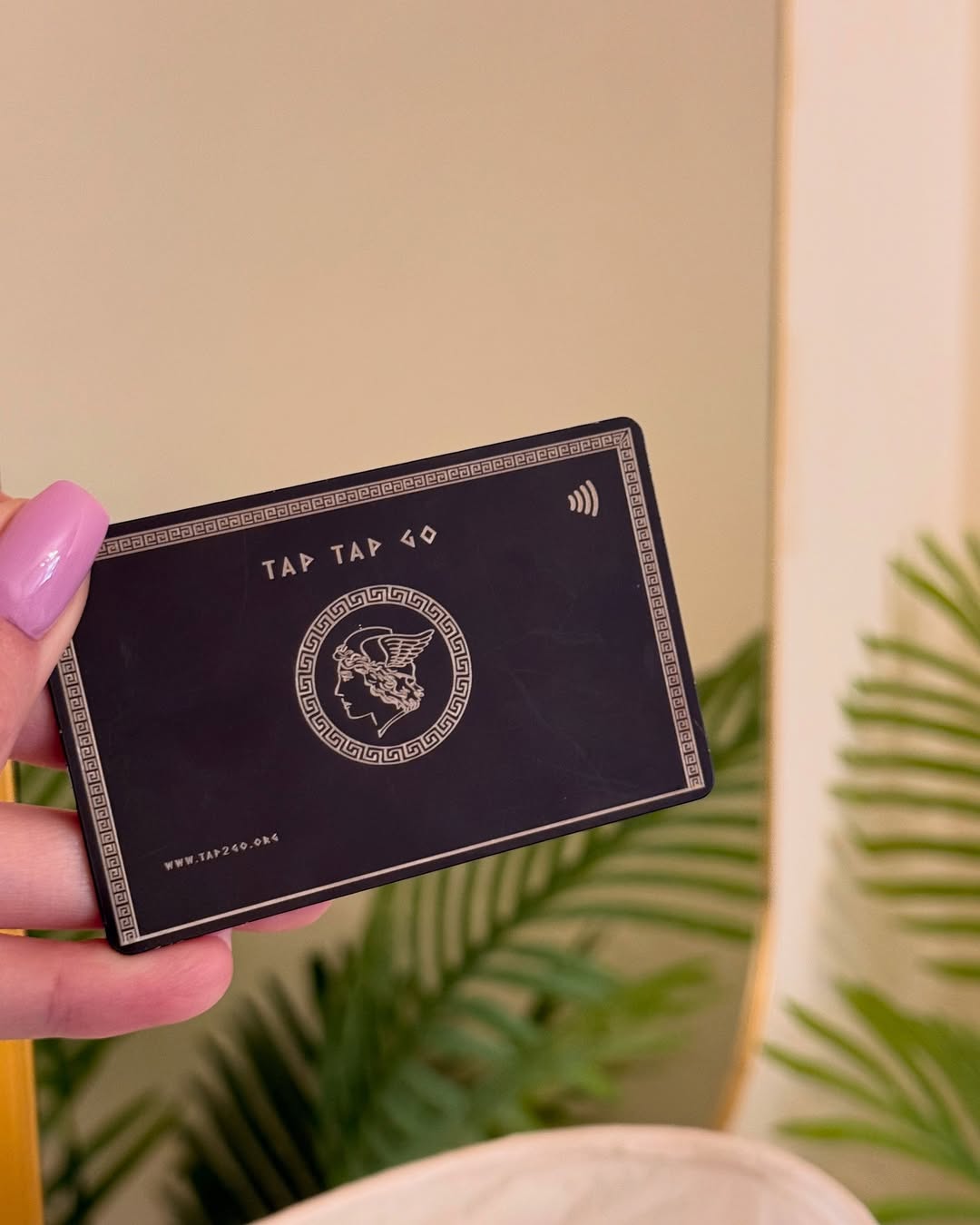
At its core, Tap Tap Go functions through Near Field Communication (NFC) technology embedded in a physical card. One tap against a smartphone instantly shares:
-
Full contact details
-
Professional portfolio and credentials
-
Social media links (up to 40 platforms)
-
Payment and transaction capabilities
-
Tasting notes, reviews, and testimonials
-
Video introductions and visual galleries
-
Document sharing (resumes, portfolios, reports)
Users control what gets shared in each context. A professional meeting might surface credentials and scheduling links. A casual introduction might emphasize social profiles and interests. A sales interaction can include payment rails and product catalogs.
The card becomes situational—adapting to the environment without requiring manual reconfiguration.
From Networking Tool to Economic Infrastructure
Where Tap Tap Go diverges from traditional digital business cards is in its integration of financial capability.
Through licensed global banking partnerships, the platform is embedding:
-
IBAN issuance
-
SWIFT and SEPA payment rails
-
Multi-currency exchange across 85+ currencies
-
Crypto-to-fiat and fiat-to-crypto conversion
-
Virtual debit cards
-
Cross-border remittance with near-zero fees
This means interaction and transaction are no longer separate actions. The same card that introduces you can also complete a sale, process a payment, or facilitate a cross-border transfer.
For freelancers, entrepreneurs, and businesses operating globally, this removes significant friction. A consultant can meet a potential client, share credentials, and invoice them—all through a single interaction.
Loyalty, Marketplace, and Events: The Ecosystem Expansion
Tap Tap Go is also building a closed-loop ecosystem designed to circulate value internally.
Loyalty Programs
Users earn rewards on card taps, profile views, referrals, marketplace activity, and event participation. Businesses can create custom loyalty campaigns with cashback, discounts, and exclusive perks. The system is designed to scale globally with enterprise-level controls.
Global Marketplace
The platform includes a built-in marketplace where users and businesses can list services, products, events, and digital offerings. Revenue comes from paid postings, featured placements, and subscription tiers for sellers. Every listing links directly to a Tap Tap Go profile, creating instant trust and credibility.
Events Engine
Tap Tap Go integrates a native events layer allowing users to discover local and global events, view verified organizers and attendees, and register or request access using their profile. Event organizers can create and manage events, control access (open, invite-only, paid, private), and issue digital entry passes. Events integrate with loyalty rewards and marketplace listings, turning the platform into a live access layer for real-world gatherings.
AI-Guided Onboarding and Networking
Recognizing that complex platforms often fail due to poor adoption, Tap Tap Go is integrating AI-powered assistance across two critical areas:
Onboarding Assistant
An AI companion walks new users through setup step-by-step, explains features in simple language, provides voice and audio guidance, and speaks the user's local language. This drastically reduces friction, support load, and drop-offs.
Networking and Utility Assistant
Once onboard, the AI suggests what to share, who to connect with, which events to attend, and when to follow up. It offers smart prompts for networking, business introductions, and profile optimization—converting passive profiles into active opportunity engines.
Non-Custodial Architecture: Users Own Their Identity
Unlike traditional platforms where user data is controlled by the company, Tap Tap Go operates on a non-custodial model.
Users retain full ownership of their digital identity and presence. They decide what gets shared, when, and with whom. This aligns with the broader movement toward decentralized identity systems—where individuals, not corporations, control access and visibility.
In practice, this means:
-
No platform lock-in
-
Portability across systems
-
Privacy by design
-
Compliance with emerging data sovereignty regulations
As digital identity becomes more critical to economic participation, ownership models will increasingly matter. Tap Tap Go positions itself on the side of user autonomy.
Global by Assumption, Not by Expansion
Most platforms launch locally and expand regionally over time. Tap Tap Go was built with global interoperability as a baseline assumption.
Localization, compliance readiness, multi-currency support, and cross-border functionality are embedded from the start. This allows the platform to operate across emerging and developed markets simultaneously rather than sequentially.
As digital participation detaches from geography, this structural decision becomes a competitive advantage. Businesses and individuals increasingly operate across jurisdictions. Infrastructure that assumes this reality outperforms infrastructure designed for single markets.
What Tap Tap Go Is Becoming
Tap Tap Go has not positioned itself aggressively in any single category. There have been no viral campaigns or disruptive announcements.
But the convergence of digital identity, global finance, AI-assisted interaction, loyalty systems, marketplace functionality, and event infrastructure suggests the platform is evolving into something more foundational than a product.
It increasingly resembles a connective layer—one that sits beneath applications rather than competing with them.
Historically, the most influential systems integrate quietly. They become dependencies before they become categories.
Founded by Dhawal Laheri, Tap Tap Go appears to be engineering exactly that kind of layer. One that doesn't fragment identity across platforms, but unifies it into a single, portable access point.
By the time the market gives it a name, the interaction may already be happening.
Frequently Asked Questions
Is Tap Tap Go just a digital business card?
While it functions as a digital business card, Tap Tap Go is built as infrastructure. It consolidates identity, interaction, and economic activity into a single access layer that works across digital and physical environments.
How does the financial integration work?
Through licensed global banking partnerships, Tap Tap Go integrates IBAN issuance, SWIFT/SEPA rails, multi-currency exchange, crypto-to-fiat conversion, and virtual debit cards—all tied to your identity layer.
Who owns my data on Tap Tap Go?
You do. Tap Tap Go operates on a non-custodial model, meaning users retain full ownership and control of their digital identity and presence.
Can I use Tap Tap Go for my business?
Yes. Businesses can create custom loyalty programs, list products and services in the marketplace, organize events, and leverage the platform's financial infrastructure for global transactions.
What makes Tap Tap Go different from other networking platforms?
Most platforms focus on a single function. Tap Tap Go treats interaction itself as infrastructure—combining identity, finance, networking, commerce, and events into one unified system.
A Single Card, A Unified Layer
Digital fragmentation is not just inconvenient—it's structurally inefficient.
Tap Tap Go is being built to address that inefficiency not by creating another platform, but by creating the layer that connects them all.
One card. One identity. One infrastructure.
Everything in motion.