
Why "Who You Are" Will Matter More Than "What Password You Remember" by 2030
By 2030, your identity — not your password — will unlock every professional door. Here's what that means for how you network, transact, and grow.*
The password is dying. Not metaphorically — structurally, technically, and commercially. By 2030, the question every platform, payment gateway, and professional network will ask is not what do you know? but who are you? The implications for ambitious professionals extend far beyond cybersecurity. They reach into how you build relationships, move money across borders, and establish trust in rooms — physical or digital — where reputation is currency.
This is not a story about biometrics replacing login screens. It is a story about identity becoming your most powerful professional asset.
The Password Was Always a Proxy for Trust
The reason passwords exist is simple: digital systems needed a way to verify that you are who you claim to be. The password was a crude but functional solution — a shared secret between you and a system. For decades, it worked.
What it never captured was the full texture of professional identity. Your network, your reputation, the quality of your introductions, the trust signals you carry from boardroom to boardroom — none of that is encoded in a string of characters. The password verified access. It never verified value.
By 2030, the infrastructure of trust is being rebuilt around richer identity signals: behavioural biometrics, verified credentials, AI-interpreted relationship graphs, and wallet-based identity that carries your professional history and financial trustworthiness without a single form field. The shift is already underway. Microsoft reported that over one trillion authentication events occur on its platforms monthly, and it has been aggressively phasing out passwords in favour of biometric and device-based verification since 2021. Apple's Passkeys framework, adopted across iOS and macOS, removes the password entirely. What replaces it is you — your device, your fingerprint, your face.
But for professionals, the deeper transformation is not in how you log in. It is in how you are known.
Identity as Infrastructure: The Professional Shift Nobody Is Talking About
Consider what a high-value introduction actually requires. It requires trust — that you are credible, that your intentions align, that the relationship is worth both parties' time. Historically, that trust was built through mutual contacts, reputation in specific circles, or the physical theatre of a premium business card exchanged at the right event.
The friction in that model is enormous. You meet 40 people at a conference. You collect 40 cards. Three weeks later, you remember perhaps eight of them with any clarity, and you have followed up meaningfully with two. The rest dissolve into a stack on your desk or an unread contact file.
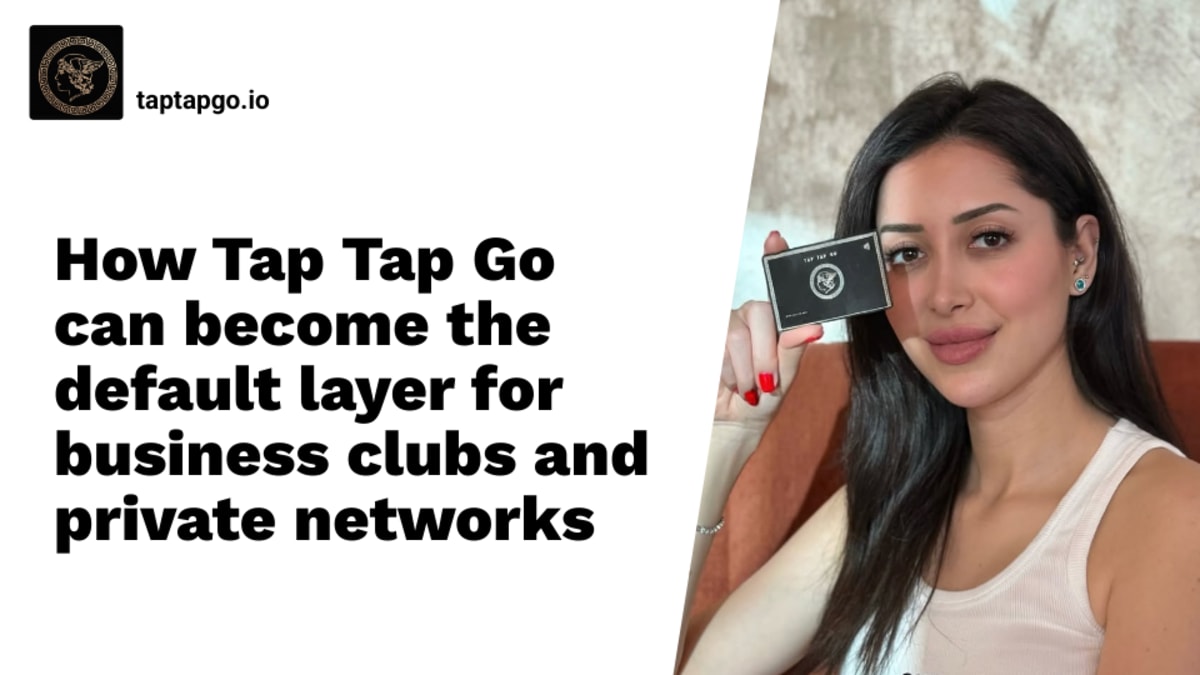
What emerges by 2030 is a system where your professional identity — your verified credentials, your relationship history, your transactional trustworthiness, your expertise signals — travels with you in real time. NFC-enabled technology, where a Near Field Communication chip embedded in a card or device transmits your full professional profile to another person's smartphone in a single physical tap, is already bridging this gap. No app required on the recipient's end. No form-filling. No forgetting.
The next layer is AI interpreting that identity dynamically. Imagine attending a summit in Dubai where an AI system cross-references your profile with the attendee list, identifies three investors whose portfolio thesis aligns precisely with your Series A raise, and surfaces those introductions before you have walked to the second panel. Your identity — your professional DNA — is doing work you cannot do manually at scale.
This is not speculative. It is the architecture that platforms building at the intersection of NFC hardware, AI relationship management, and digital finance are already deploying.
Your Wallet Is Becoming Your Résumé
There is a second identity shift occurring simultaneously in financial infrastructure, and it is equally profound. Stablecoins — digital currencies pegged to the value of a fiat currency like the US dollar, designed to eliminate the volatility associated with Bitcoin or Ethereum — are creating a new layer of financial identity. Your wallet address increasingly tells a story: where you transact, with whom, how frequently, and at what scale.
The implications for cross-border professionals are significant. Today, sending money from London to a business partner in Dubai involves correspondent banking fees, two to five business days, and conversion costs that erode value at every step. By 2030, that friction is largely eliminated. Stablecoin-based transfers with zero gas fees and instant settlement mean that your ability to transact globally is no longer limited by geography, banking relationships, or the operating hours of a clearing house.
More importantly, that transaction history becomes a form of verified professional identity. A freelance consultant who has transacted reliably with 30 global clients across 12 countries has a financial reputation that no CV can fully replicate. That reputation, embedded in a verified digital wallet, becomes a trust signal that opens doors — to clients, to investors, to premium platforms — far more efficiently than a password ever could.
Here is the actionable takeaway: If you are not building a verified, portable professional identity right now — through a curated digital profile, an NFC-enabled contact presence, and a structured record of your transactional and professional relationships — you are accruing a liability. The professionals who will command the most trust by 2030 are the ones building that identity deliberately today, not scrambling to reconstruct it when the infrastructure demands it.
The New Gatekeepers: AI, Reputation, and the Tap
The final piece of the identity shift is how AI is becoming the interpreter of professional trust. Traditionally, gatekeeping was human — a warm introduction from a mutual contact, a recommendation from someone in the right circle. That model is slow, unscalable, and often inadvertently exclusive.
AI-driven relationship scoring changes that calculus. Systems that analyse communication patterns, engagement signals, shared professional contexts, and follow-up behaviour can surface the optimal moment to re-engage a lead, identify which contacts in your network are most likely to facilitate a specific outcome, and even adapt how your professional profile is presented depending on whether you are meeting a venture capital partner in Singapore or a creative director in Milan.
The practical value of this is not just efficiency. It is precision. A mid-sized founder attending three conferences a year cannot manually track the relationship signals of 300 contacts. An AI that continuously scores and prioritises those relationships — and alerts you when a connection is warm — converts your existing network into active professional capital.
This is what it means to transform your network into net worth. Not by adding more contacts, but by extracting more value from the ones you already have, through intelligent, identity-anchored relationship management.
The professionals who understand this early will operate with a structural advantage. They will walk into rooms — physical and digital — where their identity precedes them, their trust signals are already verified, and the right introductions are already queued. The ones who rely on passwords and paper cards will spend the first ten minutes of every conversation doing what the infrastructure should have already done for them.
Conclusion: Build Your Identity Before 2030 Demands It
The shift from passwords to identity is not a distant forecast. It is already reshaping authentication, financial infrastructure, and professional networking simultaneously. The question is not whether your professional identity will become your primary trust signal — it will. The question is whether you are building that identity with the intentionality it deserves.
Start today. Audit your digital professional presence: is it consistent, credible, and portable? Does your networking approach capture every meaningful connection, or does it rely on memory and manual follow-up? Are your financial transactions building a trackable record of global credibility, or are they fragmented across platforms that tell no coherent story?
The tools to build this identity — NFC-enabled profiles, AI-powered relationship management, stablecoin-based financial ecosystems, and premium lifestyle positioning — exist now. The professionals who activate them early will not just be ahead of the curve. They will be the curve.
Single tap. Boundless connection. That is the architecture of professional identity in 2030 — and it starts the moment you decide that who you are should work harder than any password you have ever typed. Explore how Tap Tap Go is building this future at taptapgo.io, or visit the blog at taptapgo.uk to go deeper on the ideas shaping the next era of professional networking and digital finance.