
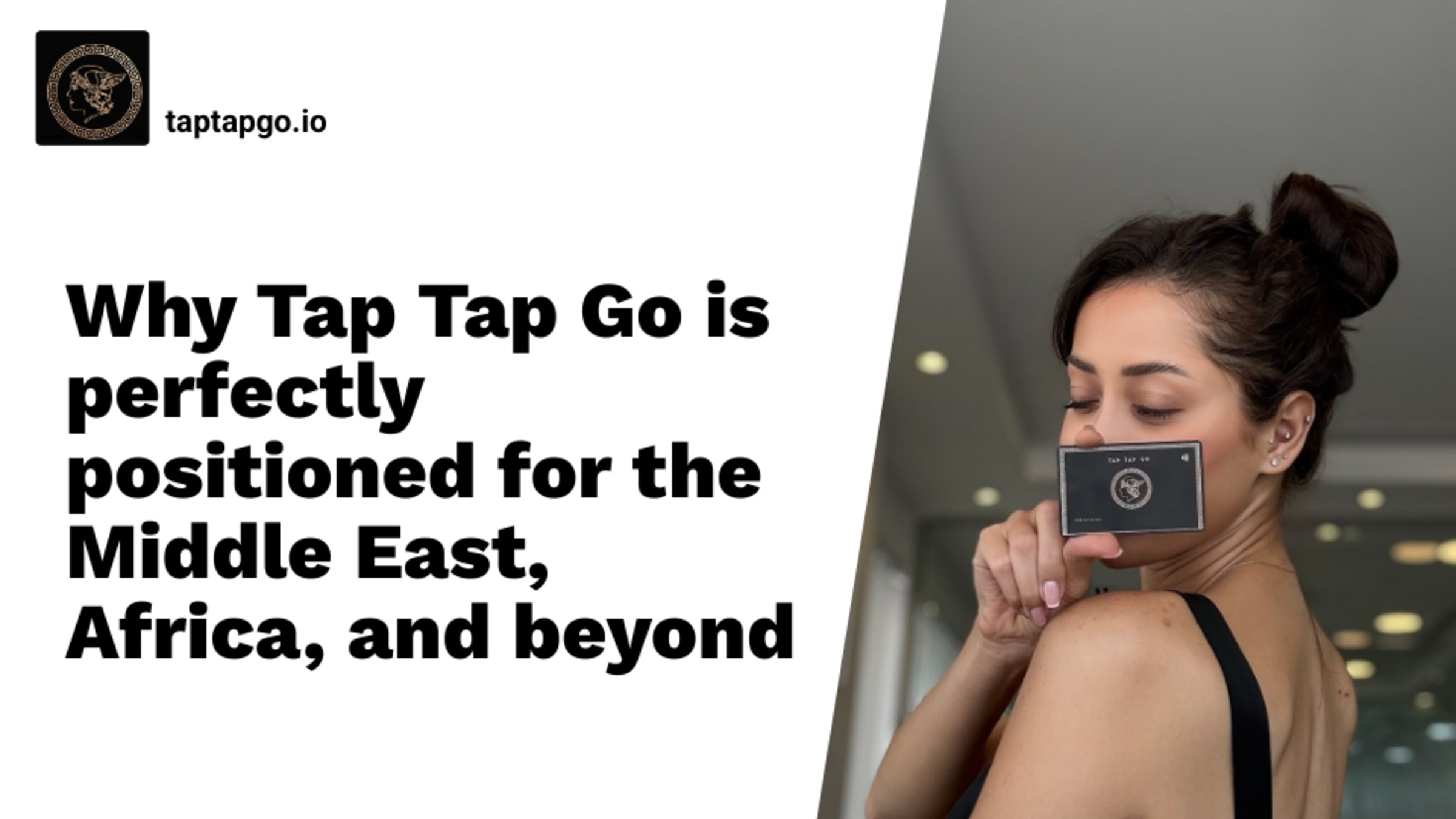
Why Tap Tap Go Is Perfectly Positioned for the Middle East, Africa, and Beyond
Why Tap Tap Go Is Perfectly Positioned for the Middle East, Africa, and Beyond
The most consequential professional opportunities of the next decade will not emerge from Silicon Valley or the City of London. They will be forged in the boardrooms of Dubai, the startup hubs of Lagos and Nairobi, and the venture corridors of Riyadh — markets where the appetite for premium, tech-forward solutions is growing faster than the infrastructure to support them. That gap is exactly where Tap Tap Go was built to operate.
Tap Tap Go is not simply a digital business card company. It is a full-stack professional ecosystem that fuses luxury NFC-enabled card technology, AI-driven contact management, a stablecoin-based financial layer called Go Cash, and a curated lifestyle rewards network into a single, tap-activated platform. Understanding why this combination is so well-suited to the Middle East and Africa requires looking past the surface-level "mobile-first" narrative and examining something more specific: what high-growth, high-mobility professionals in these regions actually need — and what legacy tools have consistently failed to deliver.
The Middle East Is Not an Emerging Market. It Is an Evolved One.
There is a persistent misconception that the Middle East and Africa are "emerging markets" in the sense of being underdeveloped or cautious. The reality is almost the opposite. The UAE, Saudi Arabia, and markets like Egypt and South Africa have demonstrated a consistent willingness to leapfrog legacy systems entirely — skipping the desktop computing era to go mobile, bypassing traditional banking to adopt digital payments, and embracing NFC and contactless technology years before European markets normalised it.
Dubai, in particular, operates as a global business crossroads. On any given week, a professional in the UAE might network with a fintech founder from Singapore, close a deal with an investor from London, and onboard a client from Nairobi — all while navigating the friction of different currencies, communication platforms, and professional identity formats. The existing toolkit — paper business cards, fragmented apps, expensive wire transfers — is not just inconvenient in this context. It is actively counterproductive.
This is precisely the environment Tap Tap Go was designed to serve. With operational roots in Dubai and a registered presence in London, the platform sits at the intersection of two of the world's most globally connected business ecosystems, with the architecture to scale across the corridors that connect them.
NFC as a Trust Signal, Not Just a Technology
Across the Gulf Cooperation Council (GCC) and parts of Africa, the exchange of a business card still carries cultural weight. It is a gesture of respect, a signal of seriousness. The challenge is that paper cards cannot carry context — they cannot tell you who this person knows, what they have built, or how best to engage with them after the event ends.
Tap Tap Go's NFC-enabled luxury cards — available in three tiers: Gold 24K Carat Crest, Platinum Prestige, and Obsidian Opulence — preserve that cultural ritual while transforming its utility. A single tap transfers not just contact details but a full digital profile: social links, professional biography, business credentials, and a direct channel for follow-up. The recipient requires no app. The interaction takes less than a second. And the card itself — precision-finished, weighted, distinctive — functions as a status signal in markets where material quality communicates intent.
This matters more than it sounds. In contexts where first impressions carry significant commercial weight, the card you hand over is part of your pitch. An Obsidian Opulence card tapped across a table at a GITEX networking evening or an Arab Health conference is not just a contact exchange. It is a positioning statement.
The Cross-Border Payment Problem — and Why Go Cash Solves It Differently
For anyone transacting across the Middle East and Africa, the cost of moving money is not a minor inconvenience. It is a structural tax on doing business. Traditional wire transfers between the UAE and Kenya, for example, can carry fees of 5–10% and settlement delays of two to five business days. For freelancers invoicing international clients, or founders distributing equity across borders, this friction compounds quickly.
Go Cash, Tap Tap Go's integrated stablecoin, is pegged to USDT — a US dollar-equivalent digital asset — and enables peer-to-peer and cross-border transactions with zero fees and no imposed limits. There is no waiting for correspondent banking networks to clear the transfer. There is no currency conversion uncertainty eating into the final amount. The transaction settles on-chain, secured by AI-powered fraud detection that operates in real time.
For a Dubai-based entrepreneur paying a development team across three countries, or a Nairobi-based consultant receiving retainers from European clients, this is not an incremental upgrade. It fundamentally changes the economics of operating internationally. And because Go Cash is integrated directly into the Tap Tap Go platform, it sits within the same ecosystem as your contact management, your digital identity, and your networking activity — not siloed in a separate fintech app.
One immediate strategy worth implementing: if you currently manage international client payments through traditional bank transfers, calculate your trailing twelve months of transfer fees and conversion losses. For most professionals transacting across more than two currencies, this figure exceeds what most premium platform subscriptions cost annually. The case for switching is financial, not philosophical.
AI Matchmaking in High-Stakes Environments
The GCC conference circuit is extraordinary in its density. Events like the World Government Summit, ADIPEC, and Cityscape Global draw thousands of decision-makers into the same venue over 48 to 72 hours. The conventional approach — working the room, collecting cards, hoping to follow up before the moment passes — is wildly inefficient for the calibre of people attending these events.
Tap Tap Go's AI matchmaking layer addresses this directly. At participating events, the platform analyses attendee profiles and surfaces high-value introduction opportunities based on industry alignment, investment appetite, and relationship gaps in your existing network. It does not simply suggest "people you might know." It identifies the connections most likely to advance a specific professional objective.
Beyond matchmaking, the AI generates meeting summaries attached directly to each contact profile — so that three days after a conference, you are not staring at a stack of unfamiliar names trying to reconstruct a conversation. The system also monitors activity signals to identify the optimal moment to re-engage a contact, sending smart prompts when a lead goes quiet or when a connection's professional activity suggests a relevant opportunity.
For executives managing relationships across multiple markets simultaneously, this is contact intelligence at a scale no human system can replicate. The AI adapts your profile presentation based on region, language, and industry context — meaning your profile as seen by a Saudi family office investor looks and reads differently from the version encountered by a Lagos-based tech founder, without you manually managing either.
The Loyalty Layer: Why Lifestyle Access Changes the Equation
Premium professionals in the Middle East and Africa are already well-served by status programmes tied to airlines, hotels, and credit cards. What has been consistently absent is a loyalty ecosystem tied to professional activity — rewards earned not by spending, but by networking, engaging, and growing.
Tap Tap Go integrates a curated lifestyle rewards network that includes partners such as WeWork, the Financial Times, ClassPass, Deliveroo Plus, MasterClass, and NordVPN, among others. These are not generic cashback offers. They are premium-tier services aligned to the daily operating needs of ambitious professionals: workspace access, premium information sources, personal development, and digital security.
The earn-per-tap model takes this further. Every NFC interaction generates $0.10 in Go Cash, with consistent engagement projecting to $300 per month — or $3,600 annually. In practice, this means that the platform pays you to network. The more actively you use it, the more your contact activity funds access to the rewards ecosystem around it. For entrepreneurs in markets where capital efficiency is paramount, this is a meaningfully different value proposition from any conventional networking tool.
A Platform Built for the Professional Who Operates Without Borders
What ultimately distinguishes Tap Tap Go's positioning in the Middle East, Africa, and the global corridors connecting them is not any single feature. It is the coherence of the ecosystem. The NFC card opens the door. The AI captures and contextualises what walks through it. Go Cash eliminates the friction of turning that relationship into a transaction. The lifestyle layer ensures the platform remains embedded in daily professional life, not reserved for occasional use.
For the professional who works across time zones, closes deals in multiple currencies, and builds relationships at the speed of ambition — this is not a tool. It is infrastructure.
The brand philosophy at the heart of Tap Tap Go — "Transform Your Network Into Net Worth" — is not abstract in regions where a single introduction at the right event can shift the trajectory of a company. It is the operating logic of every high-performing professional who understands that who you know, and how efficiently you convert those relationships into outcomes, is the real competitive advantage.
A single tap should be the beginning of something boundless. Explore the full platform at taptapgo.io, or visit taptapgo.uk for more insights on the future of professional networking and digital finance.