
The Long Game: How Tap Tap Go Can Outlast Trend Apps by Owning Infrastructure
Tap Tap Go isn't chasing the next trend — it's building the infrastructure beneath it. Here's why that distinction separates lasting platforms from forgotten apps.*
Most technology platforms are built to be discovered. Tap Tap Go is built to be depended upon. That is not a subtle distinction — it is the entire strategic difference between a product that trends and a platform that endures.
The professional technology space is littered with apps that solved one problem brilliantly, scaled quickly, and then quietly faded when the next innovation arrived or user behaviour shifted. Digital business card apps that didn't evolve. Payment tools that couldn't cross borders. Networking platforms that peaked at the conference booth. The lifecycle is predictable precisely because the architecture was always shallow — feature-first, infrastructure-last.
The more interesting question is not which app will trend next. It is which platform is quietly embedding itself so deeply into how professionals connect, transact, and grow that leaving it would feel like dismantling your operating system.
Why Feature-First Platforms Have a Ceiling
There is a structural vulnerability in building a product around a single feature — even a genuinely useful one. When LinkedIn introduced digital profiles, it owned professional identity. When QR codes became ubiquitous, dozens of networking apps surged. When contactless payments normalised, tap-to-pay tools proliferated. Each wave produced winners. Most of those winners, however, plateaued the moment their defining feature became a commodity.
The pattern is consistent: a technology capability becomes a standard, and overnight the product built around it loses its moat. What looked like a competitive advantage — being first or best at one thing — turns out to be a surface-level position, not a structural one.
Infrastructure plays by different rules. Platforms that embed themselves into multiple workflows simultaneously — communication, financial transactions, identity, rewards, content — create switching costs that are not about loyalty but about friction. When your professional card, your cross-border payment tool, your AI relationship manager, and your lifestyle rewards programme all exist within the same ecosystem, the question is no longer "is there something better?" The question becomes "is there anything else that does all of this?"
That is the strategic territory Tap Tap Go is methodically occupying.
Building Infrastructure Layer by Layer
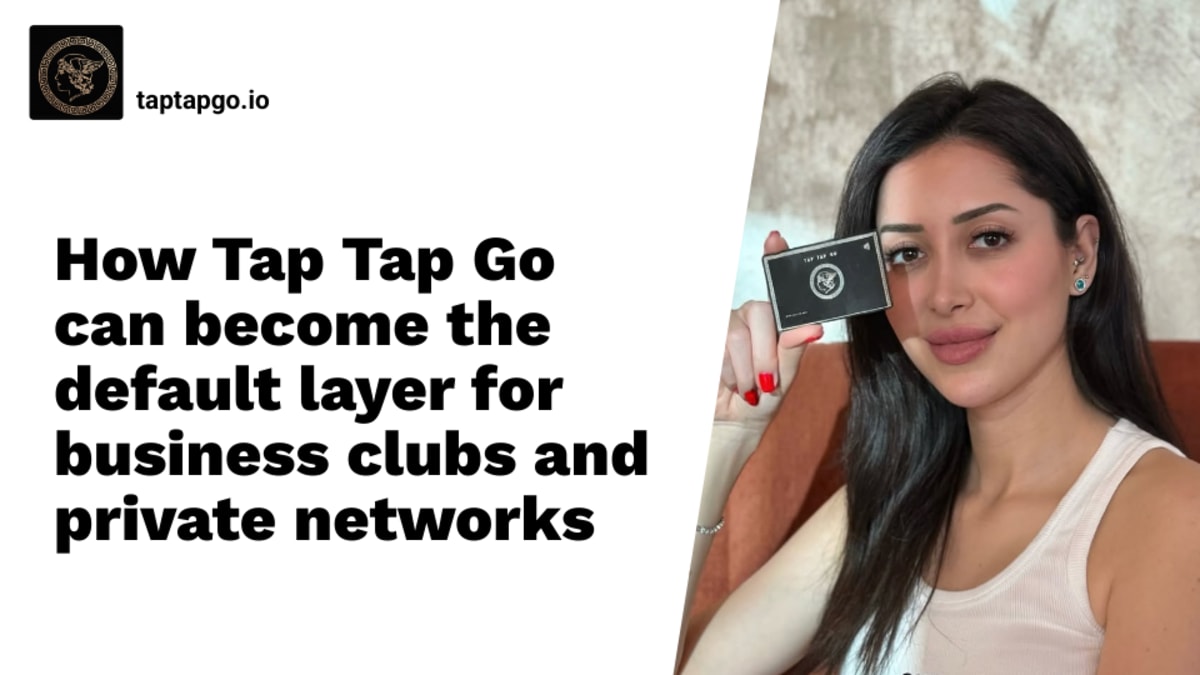
Understanding Tap Tap Go's long-game requires seeing it not as a digital business card company — though the NFC-enabled luxury card range (Gold 24K Carat Crest, Platinum Prestige, and Obsidian Opulence) is genuinely striking — but as a multi-layered professional operating system.
NFC technology, for context, allows two devices to exchange data wirelessly within a few centimetres. In Tap Tap Go's implementation, a single tap on the physical card transfers your full digital profile — contact details, social channels, portfolio links — to any smartphone, without requiring the recipient to download anything. That frictionlessness matters, but it is the entry point, not the destination.
The deeper infrastructure begins with the AI layer. Rather than passively storing contacts, the platform's AI actively manages professional relationships — identifying the optimal moment to re-engage a lead based on activity signals, generating meeting summaries attached to contact profiles, and adapting your profile context based on the region, language, and industry of the person you are connecting with. For an executive moving between Dubai and London, this means their profile speaks differently to a sovereign wealth fund contact than it does to a Series A founder in Shoreditch — automatically, without manual adjustment.
Then there is Go Cash, Tap Tap Go's integrated financial layer. Built around a USDT-pegged stablecoin (a digital currency whose value is anchored to the US dollar, eliminating the volatility typically associated with cryptocurrency), Go Cash enables zero-fee, gas-free cross-border transactions with no limits. For freelancers invoicing international clients, founders moving capital between entities, or executives managing distributed team expenses, this is not a novelty — it is a structural financial capability that banks routinely fail to provide affordably. Users also earn $0.10 with every tap interaction, projecting to over $3,600 annually for active networkers. The platform does not just save on transaction costs — it generates income through the act of networking itself.
This layering — physical NFC card, AI relationship intelligence, integrated fintech, and a rewards ecosystem featuring partners like the Financial Times, WeWork, ClassPass, and MasterClass — is precisely what makes the infrastructure argument credible. Each layer reinforces the others. Removing one would degrade the whole.
The Moat That Trend Apps Cannot Cross
Trend apps compete on novelty. Infrastructure platforms compete on depth of integration and cost of exit — and Tap Tap Go is systematically raising both.
Consider the professional who uses their Obsidian Opulence card at an investor event in Dubai. The AI matchmaking system identifies and facilitates a high-value introduction they would have otherwise missed. Post-meeting, an AI-generated summary is attached to that contact's profile, flagging a follow-up window 72 hours later. The payment for a subsequent consulting engagement is settled via Go Cash at zero fee, avoiding the 3–5% international transfer cost that a traditional bank would charge. The working relationship earns lifestyle rewards that unlock WeWork co-working access during a London trip. Every touchpoint — social, financial, relational, logistical — runs through the same platform.
That is not a feature. That is infrastructure. And infrastructure creates a category of competitive advantage that novelty cannot replicate.
The reason most trend apps cannot cross this moat is not talent or funding — it is sequencing. Building interconnected infrastructure requires a specific founding thesis: that the goal is not a product but a platform, not a use case but a utility. Feature-first companies rarely retrofit that ambition successfully. It has to be designed in from the beginning.
Tap Tap Go's architecture — combining NFC identity, AI networking intelligence, stablecoin-powered payments, media tools, marketplace capabilities, and loyalty rewards under a single tap-activated interface — reflects that founding intention. It is being built as the professional layer that sits beneath everything else.
The Actionable Framework: Embed Before You Optimise
For entrepreneurs and executives evaluating their technology stack, the lesson from infrastructure-first platforms is practical: prioritise tools that compound, not tools that peak.
Before adopting any new professional platform, apply this three-part test. First, does it serve more than one critical function in your professional life? A tool that only does contact exchange has a ceiling. A platform that handles identity, payments, relationship management, and rewards simultaneously creates compounding returns on every interaction. Second, does the platform generate value passively — through AI automation, background relationship scoring, or earn-per-action mechanics — or does it only perform when you actively engage it? Passive value generation is the hallmark of infrastructure. Third, what is your actual cost of leaving? If you can migrate away in an afternoon, the platform has not embedded itself meaningfully. The right platforms make departure genuinely inconvenient — not through lock-in tactics, but because they have become load-bearing.
Applied immediately, this framework means auditing your current professional tools this week. Map every platform you use for networking, payments, personal branding, and relationship management. Identify where single-function tools could be consolidated into an ecosystem that earns, learns, and scales alongside you. The goal is not fewer tools — it is fewer seams between them.
Infrastructure as Competitive Moat: The Bigger Picture
The platforms that define the next decade of professional life will not be remembered for launching a novel feature in 2024. They will be remembered for quietly becoming the infrastructure that professionals cannot imagine working without.
This is not a prediction about Tap Tap Go — it is an observation about how durable platform value gets built. The companies that survive market cycles, shifting trends, and new entrants are those that embed themselves into daily professional workflows so thoroughly that they become invisible in the best possible sense: simply the way things work.
For Tap Tap Go, every tap is a transaction of trust — a moment where a professional chooses to exchange identity, value, or attention through the platform. At $0.10 per tap, compounded across a growing user base and an expanding ecosystem of financial and lifestyle utilities, the question of durability answers itself. The platform is not asking users to believe in a vision. It is paying them to participate in building it.
That is what owning infrastructure looks like. Not a trend. Not a feature. A foundation.
A Network That Pays, a Platform That Lasts
The professionals who will thrive over the next decade are not those who use the most tools — they are those who operate on the most intelligent infrastructure. Every connection should be an asset. Every transaction should be efficient. Every relationship should have a mechanism for deepening, re-engaging, and generating value.
Tap Tap Go is built on that premise. Its philosophy — Single Tap, Boundless Connection — is not a tagline about simplicity. It is a statement about what happens when the friction of professional life is systematically removed: the network becomes the net worth.
If you are ready to stop adopting platforms and start operating on infrastructure, explore everything Tap Tap Go offers at taptapgo.io — or read more on the strategy behind the platform at taptapgo.uk.